Ireland
€
The shop is closed for this season 🔴, it is only possible to collect orders placed via the e-shop.
Ireland
€
The shop is closed for this season 🔴, it is only possible to collect orders placed via the e-shop.
Atlas fescue, Loukykvět

Festuca mairei

Atlas fescue

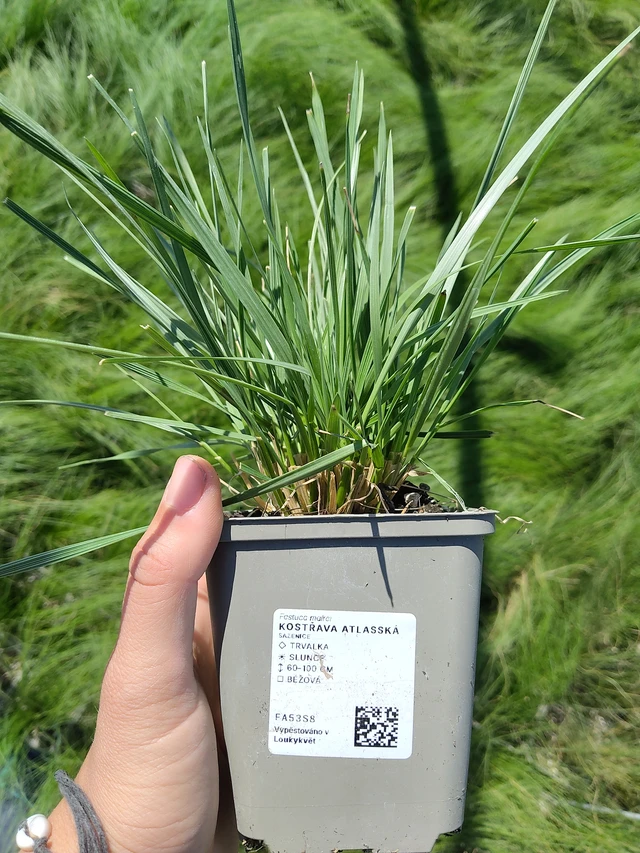
Festuca altissima is an impressive perennial grass that will bring calm and elegant texture to your garden. It naturally grows in the Atlas Mountains of North Africa, where it faces harsh mountain conditions. As a result, it is extremely durable, loves direct sun, and thrives best in poor, sandy, and well-drained soil. You will receive a mature seedling in a pot that just needs to be transplanted to your chosen spot in the bed, roughly 50 to 60 centimeters apart. It forms dense, hemispherical clumps of narrow, gray-green leaves that grow to a height of about 60 to 100 centimeters. During June and July, delicate beige inflorescences appear. It is a long-lived perennial that does not self-seed, survives frosts down to minus 28 degrees, and does not suffer from any diseases or pests. Beginners will easily master growing it. In the flower bed, it perfectly complements drought-tolerant perennials and softens the overall composition. You can use its inflorescences in summer bouquets or dry them for floral arrangements. If you leave them on the plant, they will provide a beautiful winter effect, especially when covered in morning frost. Show full description

Seedling

K9 pot (9×9×9.5 cm)
Seedling
Seedling
1-2 pieces
€3,79each
3-8 pieces
€3,39each
9-17 pieces
€3,09each
18+ pieces
€2,69each
Watch availability
0 pcs in stock

Difficulty

Beginner

Diseases

Disease-free 🙂

Flower color

Beige

Flower color: Shade

Beige

Foliage color

Grey-green

Fragrant (aromatic) 👃

No

Frost resistance

-28 °C
?
The temperature down to which the plant is frost hardy.

Hardiness zone

5a (-28.9 °C to -26.1 °C)

Height

60-100 cm

Moisture

💧

Pests

Pest-free 🙂

Position

Sun

Soil

Sandy, poor, well-drained

Spacing

50-60 cm
?
Recommended planting spacing.

Spacing: Plants per m²

3-5

Species

Perennial

Suitable for cutting

Yes

Suitable for drying

Yes
1
2
3
4
5
6
7
8
9
10
11
12
Flowering
June
July

Recommended products

Nigella Delft Blue, Loukykvět

Nigella papillosa

The Delft Blue variety is one of the most interesting Nigella cultivars. It brings the relaxed atmosphere of a country garden to your flower beds while requiring almost no care. It thrives in full sun or partial shade, preferring standard, well-draining soil. From spring through summer, blooms in soft tones of white, violet, and plum open above a canopy of fresh green leaves. Although they do not contain fragrant oils, they reliably attract bees and butterflies. Growing from seeds is fast and ideal even for absolute beginners. Nigella tolerates transplanting from pre-grown seedlings, but it also responds excellently to direct sowing right into the bed during the spring or late summer months. Throughout the summer, you can continuously cut the sturdy stems for fresh bouquets or leave them to fully mature. The resulting seed pods are perfect for drying and using in winter decorations.
€2,19
In Stock
Cornflower Tall Double Black Boy, Loukykvět

Centaurea cyanus

It is hard to imagine anything more rustic. The 'Tall Double Black Boy' variety is a much fuller-flowered Cornflower than the one we commonly see along roadsides and hedgerows. It is a truly extraordinary piece, with a color that transitions from dark burgundy and plum to almost black. It grows to a height of sixty to eighty centimeters, so it appreciates support in the flower bed to prevent its thin stems from breaking. Seeds from spring or autumn sowings germinate very readily within five to ten days. It is best to sow them directly in a sunny or semi-shaded location. The flowers appear in the summer months from June to August and become a huge attraction for bees, bumblebees, and butterflies. You will appreciate the Cornflower in naturalistic gardens alongside other annuals. It is absolutely great for cutting into vases, and its flowers also retain their shape and color when dried. If you like trying new things in the kitchen, you will be pleased to know that these dark flowers are edible and will beautifully brighten up summer salads or desserts.
€5,19
In Stock
Nigella Miss Jekyll Sky Blue, Loukykvět

Nigella damascena

Nigella 'Miss Jekyll Sky Blue' is an absolute classic among annuals and will bring enchanting shades of deep sky and royal blue to your garden. Originally from the Mediterranean, it immediately catches the eye with its delicate foliage, which creates a fluffy green cloud. From May to August, striking blue flowers peek out from it. It grows to a height of between fifty and one hundred centimeters, making it easy to create an eye-catching structure in the flower bed. The flowers act as a reliable attractant for bees and bumblebees. Nigella is a spring beauty, but its seed pods are also great for harvesting, meaning it will last in the garden well into summer. These original, inflated seed pods are a sought-after material for florists. Fresh flowering stems beautifully liven up summer bouquets in a vase, while the dried pods perfectly complement autumn decorations, as they retain their shape for a long time.
€2,09
In Stock
Nigella Midnight, Loukykvět

Nigella papillosa

Nigella damascena Midnight is an elegant annual that attracts attention with its unconventional flowers. Originally from the sunny regions of the Mediterranean and North Africa, it thrives best in sunny or semi-shaded locations. The Midnight cultivar stands out with its deep, dark purple to plum-toned flowers, which reach a size of about five centimeters. Together with its delicate green foliage, it creates a beautiful texture in the garden. The plant grows to a height of fifty to one hundred centimeters and has an airy appearance in the flowerbed, although it appreciates a little support for bushier clumps. You will love Nigella not only in the garden but also for creating bouquets. Its dark purple flowers look absolutely stunning in a vase and stay fresh for a long time. It is also valuable to florists after it has finished blooming, as it produces very decorative seed pods that are easy to dry and fit well into winter dried arrangements and wreaths. Whether you let it stand out next to light-colored annuals or incorporate it into wild, naturalistic plantings, it is guaranteed to liven up any corner.
€2,19
In Stock
Cornflower Classic Magic, Loukykvět

Centaurea cyanus

Classic Magic contains white flowers with a purple center, purple ones, and pieces transitioning to burgundy. A blackcurrant and cream combination. Cornflower is a garden classic, and Cornflowers of the Classic series are real troopers! Strong, straight stems ensure excellent cut flower quality.
€2,09
In Stock
Cornflower Tall Double Blue Boy, Loukykvět

Centaurea cyanus

The blue cornflower is an absolute classic of our fields and meadows, which probably needs no lengthy introduction. However, the 'Tall Double Blue Boy' variety brings something extra. Compared to its wild relatives that we see along roads, it boasts rich flowers in an unmistakable, deep blue shade, sometimes with a purple tone. You can hardly imagine anything more meadow-like. Thanks to its strong stems growing up to eighty centimeters tall, this annual is perfectly suited for cutting, adding true rustic charm to bouquets. But its use doesn't end in the vase. The flowers keep their fantastic color even after drying! At weddings, we loved using them in flower crowns and corsages, where they have excellent stamina! The petals are edible. They serve perfectly as an original garnish for summer salads, desserts, or festive cakes. Moreover, in the garden, it functions as a reliable magnet for bees and bumblebees, who simply go crazy for its nectar.
€5,19
In Stock
Didiscus Lacy Blue, Loukykvět

Didiscus caerulea

Didiscus has a strange name, but it is a great beauty similar to Ammi or ornamental carrot. The flowers are disc-shaped with tiny florets. Didiscus finishes blooming faster, similar to Ammi or ornamental carrot, so we recommend succession sowing. It likes warmth, so it can be sown even in summer.
€2,69
In Stock
Didiscus Lacy Pink, Loukykvět

Didiscus caerulea

Pale pink, delicate lace. Didiscus has a strange name, but it is a great beauty similar to Ammi or ornamental carrot. Flowers are disc-shaped with tiny florets. Didiscus finishes blooming faster, similar to Ammi or ornamental carrot, so we recommend multiple successional sowings. It likes warmth, so it can be sown even in summer.
€2,69
In Stock
Zinnia Queen Lime Orange, Loukykvět

Zinnia elegans

Warm orange and apricot. The Queen Lime series is our favorite Zinnia; it's love at first sight! The flowers are large, up to 10 cm, surrounded by many petals, giving a double-flowered appearance. Moving towards the center, the petals get smaller and end up unopened at the center, creating a frosted cupcake effect. No other Zinnia compares!
€8,99
In Stock
Zinnia Macarenia, Loukykvět

Zinnia elegans

Zinnias are a necessity for every garden, not just for cutting gardens. Unfortunately, florists have forgotten about them, which is a crying shame! Macarenia is a shade of high summer and fruit harvest. Striated orange with red centers.
€2,39
In Stock
Zinnia Queen Lime, Loukykvět

Zinnia elegans

€3,09
In Stock
Zinnia Oklahoma Salmon, Loukykvět

Zinnia elegans

A smaller zinnia is very practical! And the Oklahoma series has flowers 4-5 cm large and fits perfectly even into smaller floristry tasks such as wreaths. Shades of darker and lighter salmon. One plant produces at least 10 flowers.
€2,49
In Stock
Bells of Ireland Pixie Bells, Loukykvět
€2,49
In Stock
Cosmos Afternoon White, Loukykvět

Cosmos bipinnatus

Afternoon White is a snow-white piece, bred specifically for cutting. That is why we are newly adding it to our offer. Cosmos is among the most used items on our farm. In season, we cut hundreds of stems every day. Hats off to this one, it's a super cut flower!
€2,69
In Stock
Cosmos Rosetta, Loukykvět

Cosmos bipinnatus

Cosmos 'Rosetta' is one of our favorite annuals. Its shape resembles a large daisy, but its flowers shine in shades of dark and light pink that look like they were painted with delicate brushstrokes. It originates naturally from the sunny regions of America, and here, it thrives best in a bright location. As it is a low-maintenance plant, growing it from seeds is easy even for beginners. You can sow the seeds indoors on a windowsill starting in April, or directly into a spot in the flower bed from May to July. Germination takes only a few days. It grows to a height of about one meter, forms beautifully sturdy stems, and blooms from June until October, constantly attracting bees and butterflies. In the garden, it is an excellent addition to mixed borders. If you enjoy creating bouquets, 'Rosetta' will thrill you as a cut flower. From a single plant, you will gradually get at least twelve strong stems for the vase.
€2,39
In Stock
Cosmos Apricotta, Loukykvět

Cosmos bipinnatus

Cosmos are an absolute classic and a matter of the heart for us! In the past, we cut them by hundreds of stems on the farm and our customers, especially brides, literally loved them for their lightness and elegance. While common cosmos mainly offer a white and deep pink palette, 'Apricotta' brings a completely new and fresh color tone to the flowerbeds. It is a unique combination of light pink and the lightest salmon, which looks incredibly tender and original. The flowers have a silky appearance and gently sway in the wind, which adds pleasant dynamics to the garden.
€2,09
In Stock
Cosmos Cupcakes Blush, Loukykvět

Cosmos bipinnatus

Cosmos is one of the most used items on our farm. In season, we cut hundreds of stems every day. Hats off to it, it is a super cut flower! Cupcakes is a series of Cosmos where the flowers are shaped like cupcake wrappers. This creates a unique effect in both bouquets and flower beds. Cupcakes Blush comes in shades of soft pink.
€2,39
In Stock
Cosmos Double Click Cranberries, Loukykvět

Cosmos bipinnatus

Cosmos are among the most popular flowers on our farm. And now imagine that such a hit comes in a fully double-flowered version! 'Double Click Cranberries' is a dark pink in a magenta shade. A single plant will produce at least 12 stems.
€2,69
In Stock
Ornamental Carrot Dara, Loukykvět

Daucus carota

Pure splendor! Thin, sturdy stems with umbel inflorescences resembling dill at their ends. On each stem, there are thousands of tiny blooms creating the effect of a veil or lace. This is a mix of colors, where some flowers are pure white, while most are chocolate to burgundy with a touch of white, sometimes even pink.
€2,39
In Stock
Larkspur Fancy Smokey Eyes, Loukykvět

Delphinium consolida

€2,69
In Stock
Larkspur Fancy Belladonna, Loukykvět

Delphinium consolida

€2,69
In Stock
Larkspur Misty Lavender, Loukykvět

Delphinium consolida

€2,69
In Stock
Ammi Casablanca, Loukykvět

Ammi visnaga

Ammi likes low temperatures, so it is purely a spring and autumn beauty. It adds a fresh and airy effect to all bouquets, and the same applies to the flower bed. The flowers are composed of individual tiny florets resembling lace, which is why we use it instead of baby's breath. 'Casablanca' is a larger Ammi; the plants are taller and more robust, the stems stronger, and it doesn't fade as quickly. Still, we recommend sowing more than once.
€2,49
In Stock
Larkspur QIS Light Blue, Loukykvět

Delphinium consolida

Larkspurs are spring beauties that nothing compares to. However, if you want to harvest them for cut flowers, you must be vigilant and harvest quickly before all the buds open. They finish blooming quickly, especially during the warm springs of recent years, so we sow several batches 14 days apart just to keep up with the harvest. Larkspur QIS White is a soft white that fits beautifully into wedding floristry. You harvest one stronger stem and 4-5 smaller side stems from a single plant.
€13,59
In Stock
Rudbeckia Cherry Brandy, Loukykvět

Rudbeckia hirta

These beauties love heat, which is why we associate them mainly with late summer and early autumn. Scalding helps with vase life: dip freshly cut stems into 90°C water for 3 minutes and then immediately into cold water. One plant produces at least 5 stems. Cherry Brandy is a beautiful shade of dark wine.
€3,29
In Stock
Salvia White Swan, Loukykvět

Salvia horminum

€2,09
In Stock
Sunflower Autumn Beauty, Loukykvět

Helianthus annuus

Composition: Description: Sunflowers are ancient flowers and have belonged in Czech gardens since time immemorial. Bring summer into your vase!
€2,19
In Stock
Sunflower Soluna Gold, Loukykvět
New

Helianthus debilis

€2,39
In Stock
Sunflower ProCut Vanilla Maple Mix, Loukykvět
Mix barev

Helianthus annuus

✨ A color mix created at Loukykvět ✨ Finally, a sunflower color mix! A combination of vanilla, cinnamon, and maple syrup colors. A beautiful mix in autumn colors. Sunflowers of the PROCUT series are specially bred varieties suitable for cutting. These are single-stemmed reliable pieces. They do not produce pollen, which all florists will appreciate.
€7,59
In Stock
Zinnia Oklahoma White, Loukykvět

Zinnia elegans

Beautiful ashy white! The centers are ashy, greyish, and thanks to them, it is a flower that captures attention! A smaller zinnia is very practical! And the Oklahoma series has flowers 4-5 cm large and fits perfectly even into smaller floristry tasks such as wreaths. Shades of darker and lighter salmon. One plant produces at least 10 flowers.
€2,49
In Stock

Cultivation

The Atlas fescue seedling is a great choice for anyone looking for a reliable, long-lived perennial with absolutely minimal maintenance requirements. Once your seedling arrives, choose the sunniest spot possible in your garden. It is the abundance of direct sunlight that ensures the proper coloration of its characteristic gray-green leaves. This plant is an absolute specialist for dry habitats and thrives best in poor, sandy, and highly permeable soil. You don't have to worry about any complex soil improvement or adding compost. In overly nutritious soil, it tends to lose its natural hemispherical shape. If you have heavier or clay-like soil, create a raised bed or add a thick drainage layer to the planting hole.

To allow the seedlings to fully and healthily develop to their mature width, maintain a recommended spacing of 50 to 60 centimeters when planting. This generous spacing means you can safely place three to five plants per square meter. A larger distance between the tufts is extremely important for good air circulation, which helps keep the plant in perfect condition, although it is inherently completely resistant to any pests or diseases. Pay attention to watering only in the first few weeks after planting so that the root system can grow deep into the ground. Subsequently, the plant becomes independent and easily tolerates even prolonged summer droughts, making it an ideal element for gravel beds.

The peak of the season is undoubtedly the summer months, specifically June and July, when the gray-green tuft sends up long stems 60 to 100 centimeters high, bearing delicate beige flowers. These flowers are exceptionally suitable for cutting for summer vases or for drying for later decorative purposes. With the arrival of autumn and winter, the plant does not lose any of its magnificent beauty. Its leaves remain attractive throughout the winter and provide the garden with a prized winter effect, especially when wrapped in shimmering frost. Therefore, do not cut back the grass in the autumn under any circumstances. The remaining above-ground part reliably protects the heart of the plant from freezing, even though the grass is fully hardy down to -28 °C. In the spring, simply comb through the tuft thoroughly.

Fescue is also excellently suited for growing in designer containers and large flowerpots, where it can form a wonderful centerpiece for your balcony or terrace. In container cultivation, the biggest risk is waterlogging of the roots, so always carefully choose pots with a large drainage hole at the bottom. The substrate should be as airy as possible, ideally mixed with coarse sand or fine gravel in a ratio of two parts soil to one part sand. Place a sufficiently high drainage layer at the bottom of the container. Grass in a flowerpot cannot draw water from deeper layers of the ground, and therefore requires your occasional watering. During the winter, you can safely leave the container outside; the roots will handle the frost without any problems.

The information given is based on our experience, please use it as a guide only. Times may vary depending on the season, climate, location, sowing and transplanting dates and possibly also the conditions in the greenhouse/greenhouse. We always recommend testing how the plant performs in your conditions. Please do not take this as a guarantee.

Show all

Click to view the full growing instructions.

Frequently asked questions

Planting site

Basic information

Characteristics

Interesting facts

Troubleshooting

Propagation

Diseases & pests

Photos in time

See how the seedling looks over the course of a year.
Atlas fescue - 12. 8. 2026
12. 8. 2026
Atlas fescue - 16. 7. 2026
16. 7. 2026

More products in category Ornamental grasses

Autumn Moor Grass, Loukykvět

Sesleria autumnalis

Autumn moor grass is an exceptionally hardy ornamental grass that introduces fresh greenery to the garden right from early spring. Native to the rocky slopes of the Balkans, it is well-adapted to free-draining soils, making it an ideal choice for novice gardeners. It forms neat clumps growing thirty to fifty centimeters tall. Its greatest asset is its bright green foliage, which emerges early and remains in pristine condition in the borders well into winter. The plant is untouched by diseases or pests and handles severe frosts superbly. In August and September, delicate creamy-beige flowers appear above the foliage. These rather subtle spikelets give the plant an elegant, refined look. In the garden, it acts as a perfect filler perennial for sunny or partially shaded spots. It looks absolutely stunning paired with calamint, airy gaura, or flowering oregano. Its delicate flowers and leaves are easily used as foliage filler in fresh bouquets, or they can be dried for small-scale floristry projects.
€3,79
More from €2,69
Coming in 2027
Feather grass Pony Tails, Loukykvět

Stipa tenuissima

Feather grass flowers capture attention in beds and bouquets with their lightness and delicacy. All feather grasses love full sun and dry, stony, well-drained soil. To look most natural in beds, it is good to plant them in loose groups of several pieces together with other drought-loving perennials and bulbs. Only then do their stems and inflorescences, set in motion by the slightest breath of wind, truly stand out. Stipa 'Ponny Tails' is a species native to the steppes of Mexico, Texas, and Patagonia. Airy, dense clumps of hair-like delicate leaves resemble horsehair. The leaves are green, turning up to straw-colored towards the flowers. In a suitable location, it also self-seeds.
€3,79
More from €2,69
Coming in 2027
Feather Reed Grass Karl Förster, Loukykvět

Calamagrostis acutiflora

A tufted, upright growing grass. It sprouts very early. It is decorative due to its overall vertical habit and fine flower panicles, which bloom silvery-grey, turn yellow in summer, and transition to sandy beige. It decorates the garden until winter. You can plant it in mixed beds or use it as an element to rhythmically divide the space. Usable for bouquets and drying.
€4,29
More from €3,89
Coming in 2027
Fountain grass Hameln, Loukykvět

Pennisetum alopecuroides

Fountain grasses originate from East Asia, where they grow in meadows and light forests. They form hemispherical clumps of narrow leaves which, like the flowers, color up in the autumn. They are suitable for the vase and for drying. The 'Hameln' cultivar is one of the most reliable bloomers in cooler regions. The inflorescences initially have a soft pink tinge, then change color to yellow-brown or reddish-brown.
€4,29
More from €3,89
Coming in 2027
Dropseed, Loukykvět

Sporobolus heterolepis

Prairie dropseed originates from the vast North American prairies, where it forms a natural part of the wild and unbridled landscape. This ornamental grass grows in neat and very dense clumps of fresh green leaves, which turn bright yellow shades in autumn. During August and September, delicate clouds of pink and beige flowers hover above the clumps on sturdy stalks, reaching a height of up to seventy centimeters. The flowers also spread a very pleasant and unmistakable fragrance into their surroundings. In the garden, prairie dropseed stands out best when planted in a sunny spot in groups of multiple plants accompanied by other drought-tolerant perennials, with which it will create an impressive steppe scenery. The seedlings do not require any complicated care, they easily handle frosts down to minus twenty-eight degrees, and do not suffer from any diseases or pests. The airy and fragrant inflorescences are also perfectly suited for cutting into summer bouquets, to which they add unusual lightness and texture.
€4,29
More from €2,99
Coming in 2027
Tufted Hairgrass Goldschleier, Loukykvět

Deschampsia cespitosa

Tufted hairgrass is an undemanding native grass that remains green even in winter. In nature, it grows in meadows and forest clearings. It forms a compact tuft of leaves, from which grow fine, thin stems with transparent clouds of flowers. It adapts even to more difficult conditions, such as dry shade or compacted soil, and can handle waterlogging. Goldschleier has very tiny spikelets in light yellow panicles. The inflorescence forms a fluffy light yellow cloud above the tuft of leaves.
€3,79
More from €2,69
Coming in 2027
Tufted hairgrass Palava, Loukykvět

Deschampsia cespitosa

Tufted hairgrass is an undemanding native grass that remains green even in winter. In nature, it grows in meadows and forest clearings. It forms a neat clump of leaves, from which grow delicate thin stems with transparent clouds of flowers. It adapts even to more difficult conditions, such as dry shade or compacted soil, and can handle waterlogging too. The Czech cultivar 'Pálava' is valuable for its extra-long flowering time from July to October. Unlike other cultivars, its flowers are sterile and do not create any seedlings. It is stated that it resists drought best of all tufted hairgrasses.
€3,49
More from €2,39
Coming in 2027
Blue Moor Grass, Loukykvět

Sesleria caerulea

Blue moor grass is an elegant and undemanding native grass that livens up the spring garden at a time when other plants are just waking up. In the wild, it naturally grows in warmer areas on rocks and sunny slopes with well-drained soil. It forms dense, neat clumps growing to a height of about thirty centimeters. Its main advantage is its striking grayish-green and dark green leaves, which, with sufficient moisture, remain evergreen all year round. During April and May, the moor grass blooms with interesting brown spikelets. Over time, these flowers naturally fade into soft beige tones, and when dried, they are perfectly suited as a delicate addition to small dry arrangements. In flowerbeds, it represents an ideal companion for spring bulbs, with which it forms very harmonious compositions. Cultivation can easily be managed even by a beginner, as the plant does not suffer from any diseases or pests and can withstand frosts down to minus twenty-eight degrees without damage. Simply transplant the supplied mature seedling to a sunny or partially shaded location, ideally maintaining a planting distance of around forty centimeters.
€4,29
More from €2,99
Coming in 2027
Switchgrass Northwind, Loukykvět

Panicum virgatum

A perennial grass native to North American prairies. Switchgrass is very adaptable and long-lived. It adds clear structure to flower beds while also functioning as a softening element. This happens mainly after the veil-like flowers appear above the clumps of leaves. Northwind is a cultivar with an upright and slender growth habit. Its grey-blue-green leaves turn bright golden in the autumn.
€4,29
More from €2,99
Coming in 2027
Feather Reed Grass Overdam, Loukykvět

Calamagrostis acutiflora

A tufted, upright growing grass. It sprouts very early. Decorative with its overall vertical habit and fine panicles of flowers, which bloom silvery grey. Striking with its white variegated leaves. It adorns the garden until winter. You can plant it in mixed beds or use it as an element rhythmically dividing the space. Usable for bouquets and drying.
€4,29
More from €3,89
Coming in 2027
Fountain Grass Hameln Gold, Loukykvět

Pennisetum alopecuroides

Fountain grasses originate from East Asia, where they grow in meadows and light forests. They form semi-spherical clumps of narrow leaves which, like the flowers, color up in autumn. They are suitable for vases and for drying. The cultivar Hameln Gold turns golden yellow in autumn.
€4,29
More from €2,99
Coming in 2027
European feather grass, Loukykvět

Stipa pennata

The flowers of feather grasses catch the eye in beds and bouquets with their lightness and delicacy. All feather grasses love full sun and dry, stony, well-drained soil. To look most natural in flower beds, it is good to plant them in loose groups of a few pieces together with other drought-loving perennials and bulbs. Only then will their stems and inflorescences, set in motion by the slightest breeze, stand out. A grass naturally distributed in Europe, Central Asia, and North Africa. It forms sturdy grey-green clumps with upright stems. The flowers, in the form of silvery-white awns, resemble long hair.
€4,29
More from €3,19
Sold Out
Feather grass, Loukykvět

Stipa capillata

Feather grass flowers captivate in beds and bouquets with their lightness and delicacy. All Feather grasses love full sun and dry, stony, well-drained soil. To look most natural in beds, it is good to plant them in several pieces in loose groups together with other drought-loving perennials and bulbs. Only then will their stems and inflorescences, set in motion by the slightest breeze, stand out. *Stipa capillata* is a native steppe grass also widespread elsewhere in southern, central, and eastern Europe. It forms solid grey-green clumps with upright stems. The flowers, in the form of beige awns, stand almost horizontally away from the stem when ripening and twist interestingly.
€4,29
More from €2,99
Coming in 2027
Lovegrass, Loukykvět

Eragrostis spectabilis

Lovegrass originates from the sun-drenched plains of North America, where it naturally grows on dry and well-drained soils. This undemanding tufted grass is an ideal choice for beginner growers, as it does not suffer from any diseases or pests and easily handles frosts down to minus twenty-three degrees. During the season, its green leaves will catch your eye, gradually acquiring a warm orange to wine-red hue as autumn approaches. It stands out primarily in group plantings or in combination with drought-tolerant perennials, where it can beautifully soften and visually connect the entire composition. The real magic, however, lies in its blooming. During August and September, it creates literal clouds of tiny pink flower panicles above the leaf clumps, hovering at a height of around fifty centimeters. For its airiness and elegance, lovegrass is also exceptionally popular for cutting. Florists love to use it in summer and autumn bouquets, to which it adds lightness and volume. It is also perfect for drying, so you can preserve its charm for winter arrangements as well.
€3,79
More from €2,69
Coming in 2027
Muhly grass Ruby, Loukykvět

Muhlenbergia capillaris

A beautiful fine grass originating from the southern parts of North America. It has narrow gray-green leaves. The flowers bloom in fluffy clouds of deep pink color, creating the impression of a light haze over the flower bed. Beautiful for bouquets too.
€3,79
More from €2,69
Unavailable
Pro rok 2026 nedostupné
Melic grass Silky, Loukykvět

Melica ciliata

Melica ciliata grows wild on sunny and warm stony slopes. It blooms as early as May to June with creamy to silvery-white panicles; as they fade, they turn gray and thus harmonize with the gray-green leaves. Valuable for florists due to its early flowering and usability in both fresh and dried states.
€3,79
More from €2,69
Coming in 2027
Quaking grass Tinkerbell, Loukykvět

Briza media

Quaking grass 'Tinkerbell' is an undemanding native grass whose delicate appearance will enchant in any natural garden. It naturally grows in drier meadows across Europe, where it seeks poorer and well-drained soils. It easily handles less nutritious substrates, does not suffer from diseases, and effortlessly survives severe frosts. It forms dense green clumps from which thin stalks carrying unmistakable inflorescences sprout from May to July. The tiny spikelets in the shape of small plump hearts play with yellow and brown tones. They are famous for their trembling at the slightest breeze, which adds dynamics and lightness to flower beds. The compact 'Tinkerbell' variety grows to a height of fifty centimeters and behaves as a short-lived perennial. It perfectly complements drought-tolerant perennials in full sun. It remains very attractive until August, when it is good to trim it after blooming. For florists, it is an absolute treasure. The stalks are beautiful in fresh summer bouquets and are perfectly suited for drying, retaining their shape long-term in floristry arrangements.
€3,49
More from €2,39
Coming in 2027
Quaking grass Limouzi, Loukykvět

Briza media

Quaking grass 'Limouzi' is an undemanding and very charming native grass that naturally grows in sunny meadows and pastures with poorer and well-drained soil. From May onwards, long thin stalks sprout from its dense green clumps, carrying delicate spikelets in the shape of small hearts swaying on them. They are colored in inconspicuous green and brown tones. It is their constant movement and rustling at the slightest breeze that gives the flower beds extraordinary dynamics and lightness. This short-lived perennial, growing to a height of around half a meter, is perfectly suited to complement colorful steppe plantings, where it creates a soft filler between more prominently flowering species. It will also find its use among beginner growers, as it does not suffer from diseases or pests and handles strong frosts without problems. The airy inflorescences of quaking grass are perfect for cutting into summer bouquets and for drying for various floristry purposes. After blooming, roughly at the end of summer, it is good to trim the clumps, which will encourage their fresh appearance. The 'Limouzi' cultivar is characterized by its abundant flower set and slightly more compact growth, which maintains its shape even in more demanding conditions.
€3,49
More from €2,39
Coming in 2027
Tufted hairgrass Tardiflora, Loukykvět

Deschampsia cespitosa

Tufted hairgrass is an undemanding native grass that remains green even in winter. In nature, it grows in meadows and forest clearings. It forms a neat clump of leaves, from which grow delicate thin stems with transparent clouds of flowers. It adapts even to more difficult conditions, such as dry shade or compacted soil, and can handle waterlogging too. 'Tardiflora' is, after 'Pálava', one of the most richly flowering tufted hairgrasses. It blooms a bit later than the others.
€3,49
More from €2,39
Coming in 2027
Muhly grass Rosy, Loukykvět

Muhlenbergia reverchonii

A beautiful fine grass originating from Oklahoma and Texas. It has narrow gray-green leaves. The flowers bloom in fluffy clouds of pink color, creating the impression of a light haze over the flower bed. Beautiful for bouquets too.
€3,79
More from €2,69
Unavailable
Pro rok 2026 nedostupné