Ireland
🌸 Předprodej jiřin spustíme 3. února 2026 v 10.00. 🌸
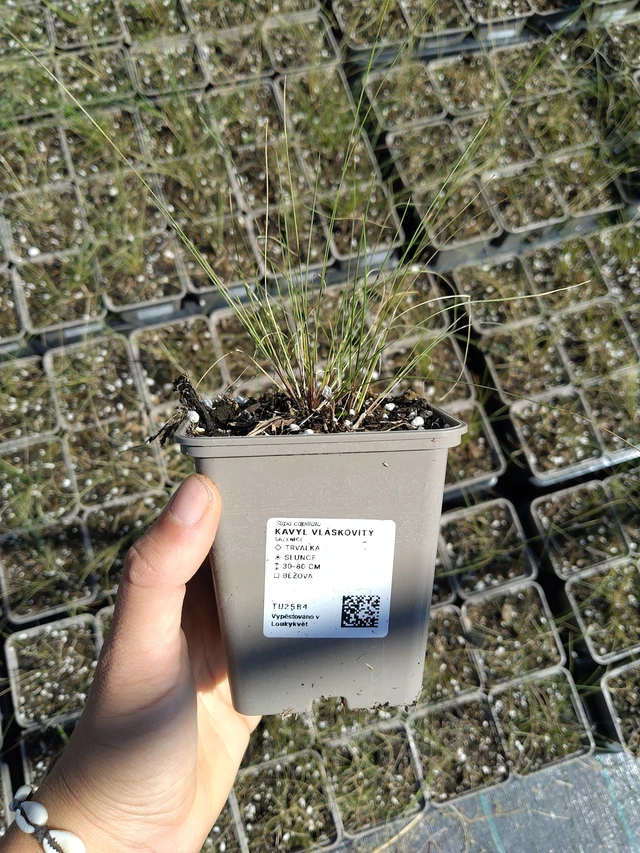
Feather grass vláskovitý, Loukykvět

Stipa capillata

Feather grass vláskovitý

Stipa flowers captivate in beds and bouquets with their lightness and delicacy. All stipas love full sun and dry, stony, well-drained soil. To make them look as natural as possible in beds, it's good to plant them in several pieces in loose groups along with other drought-tolerant perennials and bulbs. Only then will their stalks and inflorescences, moving with the slightest breath of wind, truly stand out. Stipa capillata is a native steppe grass also widespread elsewhere in Southern, Central, and Eastern Europe. It forms firm gray-green clumps with upright stalks. The beige awns, in the form of flowers, almost horizontally protrude from the stalk as they mature and twist interestingly. Show full description

Vyprodáno

Seedling

Vyprodáno
 za where

Barva květu

Béžová

Barva listu

Zelená

Druh

Trvalka

Mrazuvzdornost

-23
?
Do jaké teploty daná rostlina odolává mrazům.

Mrazuvzdornost (zóna)

6a (-23.3 °C až -20.6 °C)

Náročnost

Začátečník

Půda

Písčitá, propustná

Spon

30-30 cm
?
Doporučený spon pro pěstování.

Spon: Počet na m2

11

Stanoviště

Slunce

Vhodné k řezu

Ano

Vláha

Výška

30-80 cm
1
2
3
4
5
6
7
8
9
10
11
12
Kvetení
July
August

Recommended products

Gaura lindheimeri

Gaura is a clump-forming perennial native to Texas and Louisiana. In our climate, it behaves more like a short-lived perennial. It combines beautifully with grasses and adds lightness and airiness to flowerbeds. It is an excellent food source for insects. Tiny, butterfly-like flowers bloom tirelessly from June until the first frosts. For bouquets, we harvest as soon as the first two to three flowers open on the stem. Siskiyou Pink is a beautiful variety with rose-red flowers on slightly arched stems. Less hardy than white-flowering varieties. The red-spotted leaves are also interesting.
Sold Out
V prodeji opět na jaře 2026

Stipa tenuissima

Stipa flowers captivate in beds and bouquets with their lightness and delicacy. All stipas love full sun and dry, stony, well-drained soil. To make them look as natural as possible in beds, it is good to plant them in several pieces in loose groups along with other drought-tolerant perennials and bulbs. Only then will their stems and inflorescences come alive with the slightest breath of wind. 'Ponny Tails' is a species native to the steppes of Mexico, Texas, and Patagonia. Airy, dense tufts of hair-like, delicate leaves resemble horsehair. The leaves are green, turning straw-colored towards the flowers. It even self-seeds in a suitable location.
Sold Out
V prodeji opět na jaře 2026

Verbena bonariensis

This South American Verbena species is often grown as an annual here, but in mild winters, it can survive and self-seed. Its sturdy, airy stems beautifully soften perennial beds and add a special touch with their purple color. It perfectly complements steppe plantings with grasses and rose beds.
Sold Out
V prodeji opět na jaře 2026

Knautia macedonica

Chrastavec makedonský je bohatě a dlouze kvetoucí nenáročná trvalka. Jeho divoká forma pochází z Balkánu, kde roste na loukách a v křovinách. V záhonech okouzluje štíhlými vysokými stonky, které nesou pastelově vínové a růžové květy. Hodí se do přírodně pojatých slunných až polostinných záhonů a do lučních kytic. 
Sold Out
V prodeji opět na jaře 2026

Echinacea purpurea

A valuable garden and medicinal perennial, native to North America. The spiky flower cones are an irresistible magnet for butterflies. They last 7–10 days in a vase. After the petals are picked, the stems with the central cones can be dried or used in fresh bouquets as an interesting element. White Swan blooms with milky white flowers with brown-orange centers. The petals are not spread out completely horizontally; they bend slightly downwards.
Sold Out
V prodeji opět na jaře 2026

Perovskia atriplicifolia

Perovskia are sparsely branched subshrubs, native to regions from Afghanistan to Tibet. They grow in open, sunny, rocky, and stony habitats. Their white-felted shoots and grayish, aromatic leaves are striking. They are suitable for sunny flower beds with other drought-tolerant perennials, where they create interesting structures even in winter months.
Sold Out
V prodeji opět na jaře 2026

Gaura lindheimeri

Gaura is a clump-forming perennial native to Texas and Louisiana. Here, it tends to behave more like a short-lived perennial. It combines beautifully with grasses, adding lightness and airiness to flower beds. It's an excellent food source for insects. Tiny, butterfly-like flowers bloom tirelessly from June until the first frosts. For bouquets, harvest as soon as the first two or three flowers open on the stem. Summer Breeze has an abundant display of white and pink flowers. It is robust and resilient.
Sold Out
V prodeji opět na jaře 2026

Echinacea purpurea

A valuable garden and medicinal perennial, native to North America. It blooms in summer with dark purplish-pink flowers. The spiky flower heads are an irresistible magnet for butterflies. Lasts 7–10 days in a vase. After the petals are picked, the stems with the central heads can be dried or used in fresh bouquets as an interesting element. Rubinstern is very similar to the Magnus cultivar; the petals are darker and firmer. As they fade, they gradually lighten and bend downwards.
Sold Out
V prodeji opět na jaře 2026

Salvia nemorosa

This species of sage originally comes from the steppe regions of Central and Eastern Europe. It forms richly flowering small clumps with straight, upright stems. In flower beds, it looks best in groups. Traditionally, it is planted as an accompaniment to roses for its coincident flowering time. However, it will also look great in mixed xerophilous steppe plantings with grasses. It is an excellent food source for bees. It lasts 7 days in a vase. Amethyst is an elegant variety with long stems and an unusual pink flower color for sage.
Sold Out
V prodeji opět na jaře 2026

Alchemilla mollis

Lady's mantle naturally grows in mountain pastures and meadows, and in mixed forests. It is ornamental both in leaf and flower. The leaves have fine hairs, giving the plant a velvety character. It is a perennial sought after by ancient alchemists for the dew drops that appear in the leaf fans. Valuable for florists for its abundance of tiny greenish-yellow flowers. Important in beds for its ground-covering nature. It lasts 10 days in a vase.
Sold Out
V prodeji opět na jaře 2026

Stipa pennata

Stipa flowers captivate in beds and bouquets with their lightness and delicacy. All Stipas love full sun and dry, rocky, well-drained soil. To look as natural as possible in beds, it is good to plant them in groups of several plants in loose clusters together with other drought-tolerant perennials and bulbs. Only then will their stalks and inflorescences, moving with the slightest breath of wind, truly stand out. This grass is naturally widespread in Europe, Central Asia, and North Africa. It forms firm grey-green clumps with upright stalks. The flowers, in the form of silvery-white awns, resemble long hair.
Sold Out
V prodeji opět na jaře 2026

Calamagrostis acutiflora

A clumping, upright-growing grass. It sprouts very early. Decorative for its overall vertical habit and delicate flower panicles that bloom silvery-grey, turn yellow in summer, and transition to sandy beige. It adorns the garden until winter. You can plant it in mixed beds or use it as an element that rhythmically divides space. Useful for bouquets and drying.
Sold Out
V prodeji opět na jaře 2026

Echinacea purpurea

A valuable garden and medicinal perennial, native to North America. It blooms in summer with dark purplish-pink flowers. The spiky flower cones are an irresistible magnet for butterflies. They last 7–10 days in a vase. After the petals are picked, the stems with the central cones can be dried or used in fresh bouquets as an interesting element. Magnus has striking deep pink flowers with an orange-brown center.
Sold Out
V prodeji opět na jaře 2026

Knautia macedonica

Chrastavec makedonský je bohatě a dlouze kvetoucí nenáročná trvalka. Jeho divoká forma pochází z Balkánu, kde roste na loukách a v křovinách. Red Knight v záhonech okouzluje štíhlými vysokými stonky, které nesou tmavě vínové květy. Hodí se do přírodně pojatých slunných až polostinných záhonů a do lučních kytic. 
Sold Out
V prodeji opět na jaře 2026

Catananche caerulea

Catananche is a medium-tall, short-lived perennial. It originates from the Mediterranean and is therefore suitable for areas with milder winters. Attractive blue flowers that resemble chicory. The undeveloped flower buds are also beautiful, as are the silvery faded inflorescences. Also suitable for drying. Fresh, they last 7 days in a vase.
Sold Out
V prodeji opět na jaře 2026

Salvia nemorosa

This type of sage originally comes from the steppe regions of Central and Eastern Europe. It forms richly flowering small clumps with straight, upright stems. In beds, it looks best in groups. Traditionally, it is planted, for its coinciding blooming period, as an accompaniment to roses. However, it will look equally good in mixed drought-tolerant steppe plantings with grasses. It is an excellent food source for bees. It lasts 7 days in a vase. The cultivar Ostfriesland blooms in a strikingly dark violet-blue color.
Sold Out
V prodeji opět na jaře 2026
Lze sušit

Eryngium planum

A perennial that finds its use in naturalistic steppe and gravel beds. It attracts bees, bumblebees, and butterflies. It's floristically valuable for its flowers with striking bracts, which are also perfect for drying. The roots of some species were once candied as sweets in England and France and added to pastries and jellies. In herbal medicine, it was used, among other things, as an aphrodisiac, hence its folk name 'male fidelity'.
Sold Out
V prodeji opět na jaře 2026

Gaura lindheimeri

Gaura is a clump-forming perennial native to Texas and Louisiana. Here, it behaves more like a short-lived perennial. It combines beautifully with grasses, adding lightness and airiness to flowerbeds. It is an excellent food source for insects. Tiny flowers, resembling small butterflies, bloom tirelessly from June until the first frosts. For bouquets, harvest as soon as the first two to three flowers open on the stem. Whirling Butterflies blooms with pure white flowers that gradually acquire a pink tint. The buds also tend to be pinkish. It is characterized by compact growth and abundant flowering.
Sold Out
V prodeji opět na jaře 2026

Rudbeckia fulgida

Coneflowers (Rudbeckia) originate from North America and are robust and profusely flowering perennials of late summer and autumn. They are suitable for prairie plantings with tall grasses and for country gardens by cottages. The central cones, after the seeds ripen, look very effective and adorn perennial beds even through winter. For vases, harvest them as soon as they bloom. Vase life is 7 to 10 days. Dry central cones can also be used. Goldsturm is its most famous cultivar. It has bright golden-yellow flowers with dark centers.
Sold Out
V prodeji opět na jaře 2026

Pennisetum alopecuroides var. viridescens

Dochany pochází z východní Asie, kde rostou na loukách a ve světlých lesích. Tvoří polokulovité trsy úzkých listů, které se na podzim, stejně jako květy ještě vybarvují. Jsou vhodné do vázy i k usušení. Tento kultivar pěstujeme pro výrazně tmavé květy, které se ve velkém množství objevují zejména po teplých létech.
Sold Out
V prodeji opět na jaře 2026

Echinacea pallida

A valuable garden and medicinal perennial, native to North America. It blooms in late summer and captivates with long, hanging petals. Its spiky flower heads are an irresistible magnet for butterflies. Lasts 7–10 days in a vase. After the petals are picked, the stems with the central cones can be dried or used as an interesting element in fresh bouquets.
Sold Out
V prodeji opět na jaře 2026

Hyssopus officinalis

Hyssop, similar to lavender, is classified as a low woody subshrub. It can be used in similar types of plantings, with roses or in gravel beds of a steppe character. It also has culinary and medicinal uses. A great attraction for bees, bumblebees, and butterflies. Sweet pink flower color.
Sold Out
V prodeji opět na jaře 2026

Perovskia atriplicifolia

Perovskia are sparsely branched subshrubs, native to regions from Afghanistan to Tibet. They grow in open, sunny, rocky and stony habitats. Their striking features are their white felted shoots and greyish aromatic leaves. They are suitable for sunny beds with other drought-tolerant perennials, where they create interesting structures even in winter months. Little Spire is a smaller cultivar also suitable for pots with a soil volume of 7 liters or more.
Sold Out
V prodeji opět na jaře 2026

Sporobolus heterolepis

Grass native to North American prairie regions. It grows in dense clumps, with delicate, fragrant flower stalks notably rising above the foliage in summer. Best showcased when planted in groups with accompanying perennials.
Sold Out
V prodeji opět na jaře 2026

Coreopsis verticillata

A beautiful delicate perennial originating from North America. Striking, relatively large but delicate flowers harmonize beautifully with a rich fluffy cloud of tiny leaves. They form compact bushes and are ideal for the foreground of beds. Coreopsis are naturally short-lived perennials. Their lifespan can be partially influenced by choosing a suitable location and care throughout the season. The 'Moonbeam' cultivar blooms with a large number of light yellow flowers with darker centers. It lasts about a week in a vase.
Sold Out
V prodeji opět na jaře 2026

Pennisetum alopecuroides

Dochany pochází z východní Asie, kde rostou na loukách a ve světlých lesích. Tvoří polokulovité trsy úzkých listů, které se na podzim, stejně jako květy ještě vybarvují. Jsou vhodné do vázy i k usušení. Kultivar Hameln patří mezi nejspolehlivěji kvetoucí v chladnějších oblastech. Květenství mají zpočátku jemný růžový nádech, pak se přebarvují do žlutohnědé až červenohnědé.
Sold Out
V prodeji opět na jaře 2026

Leucanthemum vulgare

A classic perennial for early summer bouquets and cottage gardens. For bouquets, we harvest flowers with firm, smooth central discs. They will then last 7–10 days in a vase. 'Maikönigin' is an exceptionally free-flowering garden form.
Sold Out
V prodeji opět na jaře 2026

Nepeta faassenii

Catmints are ideal companions for roses, suitable for natural-style gardens and, the smaller varieties, for window boxes and pots. Some of them are an irresistible attraction for cats, due to the hallucinogen nepetalactone. This should be present in the highest degree in the species Nepeta cataria. Conversely, lemon-scented catmints reportedly do not attract cats. The botanical name Nepeta probably comes from the ancient Etruscan city of Nepet - Nepi in today's Italian province of Viterbo, where the plant was once cultivated. The faassenii group is characterized by vigorous upright growth, delicate foliage, and long stems suitable for cutting. 'Walker's Low' got its name from the Irish estate where it was bred in 1970. It has the most intense blue-purple flower coloration.
Sold Out
V prodeji opět na jaře 2026

Calamagrostis brachytricha

Hairy reed grass originates from East Asia. It is cultivated for its beautiful bushy panicles on sturdy upright stems. Drooping leaves emerge early in spring and turn bronze in autumn. It is striking on misty autumn mornings when dew drops catch in the panicles and then sparkle in the sun. Hence its name – diamond grass. Lasts up to 10 days in a vase.
Sold Out
V prodeji opět na jaře 2026

Cultivation

Vyžaduje slunné suché místo s propustnou, kamenitou nebo písčitou půdou, chudou na živiny. Dobře přezimuje, ale je citlivý na zimní přemokření.

The information given is based on our experience, please use it as a guide only. Times may vary depending on the season, climate, location, sowing and transplanting dates and possibly also the conditions in the greenhouse/greenhouse. We always recommend testing how the plant performs in your conditions. Please do not take this as a guarantee.

Show all

Click to view the full growing instructions.

Photos
in time

See how the seedling looks over the course of a year.
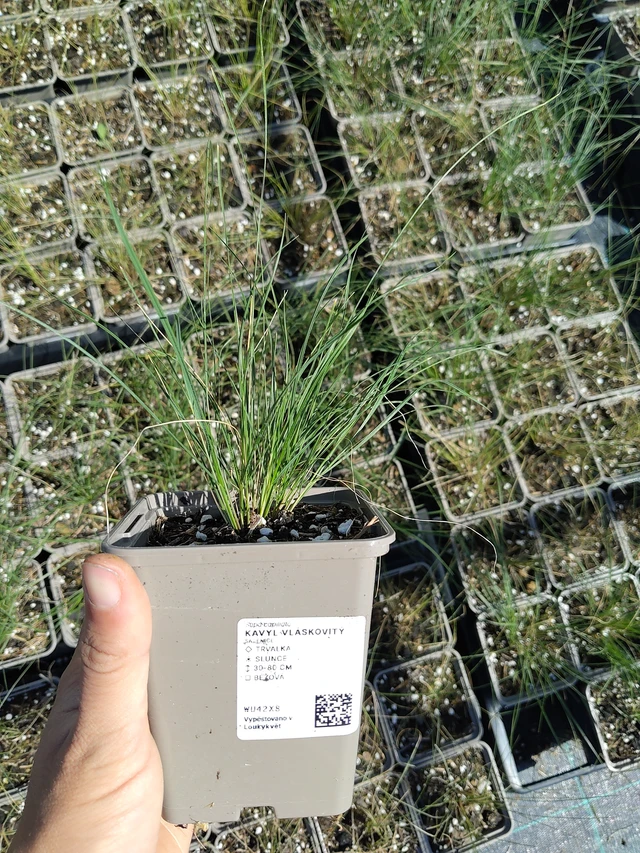
Feather grass vláskovitý - 10. 10. 2025
10. 10. 2025
Feather grass vláskovitý - 12. 9. 2025
12. 9. 2025
Feather grass vláskovitý - 10. 9. 2025
10. 9. 2025
Feather grass vláskovitý - 29. 7. 2025
29. 7. 2025
Feather grass vláskovitý - 10. 7. 2025
10. 7. 2025
Feather grass vláskovitý - 24. 6. 2025
24. 6. 2025
Feather grass vláskovitý - 9. 6. 2025
9. 6. 2025
Feather grass vláskovitý - 13. 5. 2025
13. 5. 2025
Feather grass vláskovitý - 2024
2024
Feather grass vláskovitý - 2024
2024

More products in category Kavyl

Stipa tenuissima

Stipa flowers captivate in beds and bouquets with their lightness and delicacy. All stipas love full sun and dry, stony, well-drained soil. To make them look as natural as possible in beds, it is good to plant them in several pieces in loose groups along with other drought-tolerant perennials and bulbs. Only then will their stems and inflorescences come alive with the slightest breath of wind. 'Ponny Tails' is a species native to the steppes of Mexico, Texas, and Patagonia. Airy, dense tufts of hair-like, delicate leaves resemble horsehair. The leaves are green, turning straw-colored towards the flowers. It even self-seeds in a suitable location.
Sold Out
V prodeji opět na jaře 2026

Stipa calamagrostis

Sold Out
V prodeji opět na jaře 2026

Achnatherum (Stipa) calamagrostis

An ornamental grass naturally growing on permeable, gravelly soils in Southern and Central Europe. It is one of the longest-flowering grasses and retains high decorative value until winter. Its feathery, silvery inflorescences are arranged in a graceful arch, bringing lightness and movement to perennial compositions. Excellent for cutting into fresh bouquets and for drying.
Sold Out
V prodeji opět na jaře 2026

Stipa pennata

Stipa flowers captivate in beds and bouquets with their lightness and delicacy. All Stipas love full sun and dry, rocky, well-drained soil. To look as natural as possible in beds, it is good to plant them in groups of several plants in loose clusters together with other drought-tolerant perennials and bulbs. Only then will their stalks and inflorescences, moving with the slightest breath of wind, truly stand out. This grass is naturally widespread in Europe, Central Asia, and North Africa. It forms firm grey-green clumps with upright stalks. The flowers, in the form of silvery-white awns, resemble long hair.
Sold Out
V prodeji opět na jaře 2026

Stipa tirsa

Stipa flowers captivate in beds and bouquets with their lightness and delicacy. All stipas love full sun and dry, stony, well-drained soil. To make them look as natural as possible in beds, it's good to plant them in several pieces in loose groups along with other drought-tolerant perennials and bulbs. Only then will their stalks and inflorescences, moving with the slightest breath of wind, truly stand out. Stipa tenuifolia is a thermophilic grass growing on sunny slopes. In the Czech Republic, especially in the České středohoří and South Moravia. Its caryopses are equipped with a long hairy awn. This species has the thinnest leaves of all native stipas.
Sold Out
V prodeji opět na jaře 2026

More products in category Okrasné trávy

Stipa tenuissima

Stipa flowers captivate in beds and bouquets with their lightness and delicacy. All stipas love full sun and dry, stony, well-drained soil. To make them look as natural as possible in beds, it is good to plant them in several pieces in loose groups along with other drought-tolerant perennials and bulbs. Only then will their stems and inflorescences come alive with the slightest breath of wind. 'Ponny Tails' is a species native to the steppes of Mexico, Texas, and Patagonia. Airy, dense tufts of hair-like, delicate leaves resemble horsehair. The leaves are green, turning straw-colored towards the flowers. It even self-seeds in a suitable location.
Sold Out
V prodeji opět na jaře 2026

Sesleria autumnalis

A beautiful lower grass, valued for its early sprouting and long-lasting foliage well into winter. The flowers are rather inconspicuous, beige, and appear in green clumps later in summer and autumn. The leaf color is bright green. A great combination with species such as savory, gaura, or oregano.
Sold Out
V prodeji opět na jaře 2026

Calamagrostis acutiflora

A clumping, upright-growing grass. It sprouts very early. Decorative for its overall vertical habit and delicate flower panicles that bloom silvery-grey, turn yellow in summer, and transition to sandy beige. It adorns the garden until winter. You can plant it in mixed beds or use it as an element that rhythmically divides space. Useful for bouquets and drying.
Sold Out
V prodeji opět na jaře 2026

Pennisetum alopecuroides

Dochany pochází z východní Asie, kde rostou na loukách a ve světlých lesích. Tvoří polokulovité trsy úzkých listů, které se na podzim, stejně jako květy ještě vybarvují. Jsou vhodné do vázy i k usušení. Kultivar Hameln patří mezi nejspolehlivěji kvetoucí v chladnějších oblastech. Květenství mají zpočátku jemný růžový nádech, pak se přebarvují do žlutohnědé až červenohnědé.
Sold Out
V prodeji opět na jaře 2026

Sporobolus heterolepis

Grass native to North American prairie regions. It grows in dense clumps, with delicate, fragrant flower stalks notably rising above the foliage in summer. Best showcased when planted in groups with accompanying perennials.
Sold Out
V prodeji opět na jaře 2026

Deschampsia cespitosa

Hair Grass is an undemanding native grass that remains green even in winter. In nature, it grows in meadows and forest clearings. It forms a compact clump of leaves from which delicate thin stems with transparent clouds of flowers emerge. It adapts to more difficult conditions such as dry shade or compacted soil and can even handle waterlogging. Goldschleier has very tiny spikelets in light yellow panicles. The inflorescence forms a fluffy, light yellow cloud above the clump of leaves.
Sold Out
V prodeji opět na jaře 2026

Deschampsia cespitosa

This undemanding native grass stays green even in winter. In nature, it grows in meadows and forest clearings. It forms a neat clump of leaves, from which delicate thin stems with transparent clouds of flowers emerge. It adapts to more difficult conditions, such as dry shade or compacted soil, and can even handle waterlogging. The Czech cultivar Pálava is valued for its extra-long flowering period from July to October. Compared to other cultivars, its flowers are sterile and do not form any seedlings. It is said to be the most drought-resistant of all Deschampsia.
Sold Out
V prodeji opět na jaře 2026

Sesleria caerulea

Pěchava (Sesleria) is our native grass, growing in warmer regions on rocks and sunny slopes. Its advantages are evergreen leaves when there's enough moisture, and early spring flowering. The leaves are grayish-blue. Its strikingly dark flowers gradually fade to beige. It combines well with spring bulbs.
Sold Out
V prodeji opět na jaře 2026

Pennisetum alopecuroides

Dochany (Pennisetum) originates from East Asia, where it grows in meadows and light forests. It forms hemispherical clumps of narrow leaves that, like the flowers, gain color in autumn. They are suitable for vases and for drying. The cultivar Hameln Gold turns golden-yellow in autumn.
Sold Out
V prodeji opět na jaře 2026

Briza media

An undemanding native grass that forms a dense green cover. In May, long stems emerge with delicate, heart-shaped spikelets resembling small hearts. Their movement with the slightest breeze is very striking. It remains beautiful until August or September. It's a good idea to trim it after flowering. It is perfectly suitable for drying.
Sold Out
V prodeji opět na jaře 2026

Deschampsia cespitosa

This undemanding native grass stays green even in winter. In nature, it grows in meadows and forest clearings. It forms a neat clump of leaves, from which delicate thin stems with transparent clouds of flowers emerge. It adapts to more difficult conditions, such as dry shade or compacted soil, and can even handle waterlogging. The flowers of the Schottland cultivar are brown at the beginning of flowering, later turning golden. Leaf clumps grow up to 60 centimeters, flower stalks up to 120.
Sold Out
V prodeji opět na jaře 2026

Calamagrostis acutiflora

A clump-forming, upright-growing grass. It sprouts very early. Decorative with its overall vertical habit and delicate silvery-grey flower panicles. Striking with its white variegated leaves. It adorns the garden until winter. You can plant it in mixed beds, or use it as an element to rhythmically divide space. Suitable for bouquets and drying.
Sold Out
V prodeji opět na jaře 2026

Briza media

An undemanding native grass that forms a dense green cover. In May, long stems emerge with delicate, heart-shaped spikelets resembling small hearts. Their movement with the slightest breeze is very striking. It remains beautiful until August or September. It's a good idea to trim it after flowering. It is perfectly suitable for drying.
Sold Out
V prodeji opět na jaře 2026

Deschampsia cespitosa

This undemanding native grass stays green even in winter. In nature, it grows in meadows and forest clearings. It forms a neat clump of leaves, from which delicate thin stems with transparent clouds of flowers emerge. It adapts to more difficult conditions, such as dry shade or compacted soil, and can even handle waterlogging. Tardiflora is, after Pálava, one of the most profusely flowering Deschampsia. It blooms a little later than others.
Sold Out
V prodeji opět na jaře 2026

Chasmanthium latifolium

Northern sea oats (Chasmanthium latifolium) originates from the eastern part of North America, where it grows in bright, moist forests. The flat spikelets hang from arching, pendulous stems and change colour from beige to pink, eventually taking on a warm copper tone. The leaves are fresh green and turn golden yellow in autumn. Besides being used fresh, it is also well-suited for drying.
Sold Out
V prodeji opět na jaře 2026

Luzula nivea

A beautiful, delicate woodland grass with evergreen, overwintering leaves and interesting white inflorescences. An intriguing element for spring beds. Flowers are suitable for fresh bouquets and for drying.
Sold Out
V prodeji opět na jaře 2026

Pennisetum alopecuroides

Pennisetums originate from East Asia, where they grow in meadows and light forests. They form hemispherical clumps of narrow leaves which, like the flowers, gain color in autumn. They are suitable for vases and for drying.
Sold Out
V prodeji opět na jaře 2026

Muhlenbergia reverchonii

A beautiful delicate grass native to Oklahoma and Texas. It has narrow, grey-green leaves. The flowers bloom in fluffy clouds of pink, creating the impression of a light mist over the flowerbed. Also beautiful in bouquets.
Sold Out
V prodeji opět na jaře 2026

Deschampsia cespitosa

This undemanding native grass stays green even in winter. In nature, it grows in meadows and forest clearings. It forms a neat clump of leaves, from which delicate thin stems with transparent clouds of flowers emerge. It adapts to more difficult conditions, such as dry shade or compacted soil, and can even handle waterlogging. Tauträger forms airy and upright clumps.
Sold Out
V prodeji opět na jaře 2026
Novinka

Pennisetum

A fast-growing ornamental grass with strikingly colored dark burgundy leaves. It blooms from July to October with pink to burgundy spikes that gradually fade to beige. Interesting not only for its flowers, but also for its overall habit and striking contrasting color.
Sold Out
V prodeji opět na jaře 2026