


Delphinium hybrida
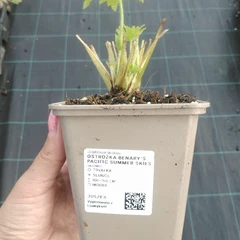
Larkspur Benary’s Pacific Summer Skies
Seedling


Attracts pollinators 🐝
Difficulty
Diseases
Edible
Flower color
Flower color: Shade
Foliage color
Fragrant (aromatic) 👃
Frost resistance
Hardiness zone
Height
Moisture
Pests
Position
Soil
Spacing
Spacing: Plants per m²
Species
Suitable for cutting
Suitable for drying
Recommended products

Delphinium hybrida
Larkspur Benary’s Pacific Galahad

Delphinium hybrida
Larkspur Benary’s Pacific Blue Bird

Delphinium hybrida
Larkspur Benary’s Pacific Black Knight

Delphinium hybrida
Larkspur Benary’s Pacific Astolat

Lavandula angustifolia
Lavender Rosea

Achillea millefolium
Yarrow Lilac Beauty

Delphinium elatum
Delphinium Magic Fountains Dark Blue (White Bee)

Gypsophila paniculata
Baby's Breath Snowflake

Achillea millefolium
Yarrow Terracotta

Limonium latifolium
Sea lavender

Anemone hybrida
Japanese anemone Lorelei

Alchemilla mollis
Lady's mantle Irish Silk

Phlox paniculata
Phlox Franz Schubert

Catananche caerulea
Shoofly plant Blue

Anemone hybrida
Japanese Anemone Whirlwind

Achillea millefolium
Yarrow Lachsschönheit

Achillea millefolium
Yarrow Cerise Queen

Leucanthemum vulgare
Daisy Maikönigin

Achillea millefolium
Yarrow Summer Pastels

Nepeta faassenii
Catmint Six Hills Giant

Knautia macedonica
Knautia Red Knight

Solidago canadensis
Goldenrod Romantic Glory

Helleborus orientalis
Hellebore Double Ellen White

Helleborus orientalis
Hellebore Double Ellen Picotee

Salvia nemorosa
Woodland Sage Ostfriesland

Anemone tomentosa
Anemone Robustissima

Rudbeckia fulgida
Rudbeckia Goldsturm

Aquilegia vulgaris
Columbine White Barlow

Salvia nemorosa
Salvia Mainacht

Anemone hybrida
Japanese Anemone Serenade
Cultivation
Larkspur Benary’s Pacific Mix seedlings are a true gem that will bring stunning height and elegance to your garden. For successful cultivation, choose a fully sunny and airy location. The soil must be loamy, humous, and truly rich in nutrients. Larkspur certainly does not belong among drought-loving plants, so it requires regular and thorough watering. When planting the seedlings, maintain a spacing of sixty centimeters, which corresponds to about two to three plants per square meter. This spacing is absolutely crucial so that the leaves can dry quickly after rain and morning dew. This will prevent the spread of powdery mildew, an unpleasant fungal disease that manifests as a white coating on the leaves.
Care during the season is based primarily on a few important steps:
• Fertilizing: Apply fertilizer right in March at the beginning of the growing season so that the stems can support the heavy flowers.
• Support: For tall stems growing up to one hundred and fifty centimeters, we recommend placing a support in time so that the summer wind does not break them.
• Pest protection: Especially in the spring, you must carefully monitor the newly emerging shoots against slugs and snails, for which they are a huge attraction.
• Pruning back: After the main flush of blooms in June, cut the plants back lightly just above the ground, water heavily, and fertilize again. Thanks to this, you will see another beautiful wave of flowers in August and September.
Although the larkspur is radiantly beautiful, remember that it is entirely poisonous, so handle it with care. However, you don't need to worry about the winter. The plant has tremendous frost resistance and can easily survive temperatures dropping to minus thirty-four degrees. Botanically speaking, it is a short-lived perennial, so when its vitality drops, we recommend simply digging up, dividing, and replanting older clumps in autumn or spring. If you are considering growing it in a container or a large planter box, choose a really large and heavy pot so that the tall plant doesn't tip over. In a container, it will also require much more frequent moisture checks and a more regular supply of nutrients than in open ground.
The information given is based on our experience, please use it as a guide only. Times may vary depending on the season, climate, location, sowing and transplanting dates and possibly also the conditions in the greenhouse/greenhouse. We always recommend testing how the plant performs in your conditions. Please do not take this as a guarantee.
How often should I water my Larkspur?
When and how should I fertilize the plant?
Do the tall stems need any support?
How can I encourage a second flush of blooms at the end of summer?
Frequently asked questions
Characteristics
Does Larkspur attract bees and butterflies to the garden?
Is this plant safe for children or pets?
How does Larkspur handle frost and the winter season?
Troubleshooting
Why are the tall flower stems breaking for no apparent reason?
What should I do if a white film appears on the leaves?
Diseases & pests
How can I protect young seedlings from pests?
Planting site
Can I grow Larkspur in a large pot on the terrace?
What is the best location for planting this seedling?
Harvest
Can the flowers of the Larkspur be used for drying?
Are sky-blue flowers suitable for cutting and placing in a vase?
Propagation
What does it mean that this is a short-lived perennial, and how can I keep it vital for longer?
Photos in time
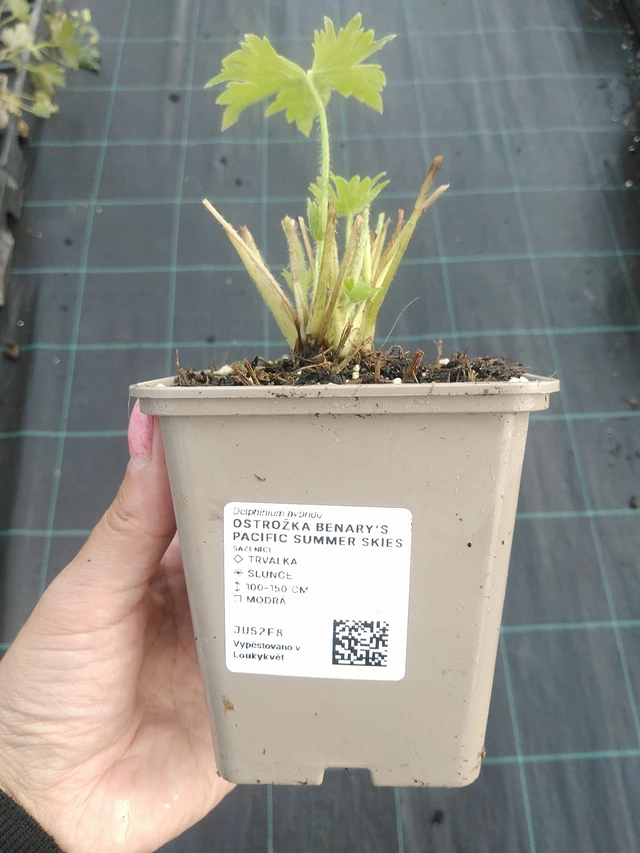
See how the seedling looks over the course of a year.


More products in category Larkspur
Delphinium hybrida
Larkspur Benary’s Pacific Galahad
Delphinium hybrida
Larkspur Benary’s Pacific Black Knight
Delphinium hybrida
Larkspur Benary’s Pacific Astolat
Delphinium hybrida
Larkspur Benary’s Pacific Blue Bird

Delphinium elatum
Delphinium Magic Fountains White (Dark Bee)

Delphinium hybrida
Larkspur Benary’s Pacific King Arthur

Delphinium elatum
Delphinium Magic Fountains Sky Blue (White Bee)
Delphinium elatum
Delphinium Magic Fountains Dark Blue (White Bee)

Delphinium elatum
Delphinium Magic Fountains Deep Rose (White Bee)

Delphinium elatum
Delphinium Magic Fountains Pure White

Delphinium elatum
Delphinium Highlander Cha Cha

Delphinium elatum
Delphinium Highlander Flamenco

Delphinium hybrida
Larkspur Benary’s Pacific Cameliard

Delphinium elatum
Delphinium Highlander Moonlight

Delphinium elatum
Delphinium Magic Fountains Dark Blue (Dark Bee)

Delphinium elatum
Delphinium Highlander Sweet Sensation

Delphinium elated
Delphinium Highlander Samba

Delphinium elated
Delphinium Highlander Bolero

Delphinium hybrida
Larkspur Benary’s Pacific Mix

Delphinium elatum
Delphinium Magic Fountains Mix
More products in category Perennials
Alchemilla mollis
Lady's mantle Irish Silk
Achillea millefolium
Yarrow Summer Pastels

Verbena bonariensis
Verbena

Salvia nemorosa
Woodland Sage Caradonna

Perovskia atriplicifolia
Russian Sage

Gaura lindheimeri
Gaura Siskiyou Pink

Echinacea purpurea
Coneflower Rubinstern

Echinacea pallida
Echinacea pallida
Salvia nemorosa
Woodland Sage Ostfriesland

Eryngium planum
Sea Holly

Echinacea purpurea
Coneflower Magnus

Calamintha nepeta
Calamint Blue Cloud
Rudbeckia fulgida
Rudbeckia Goldsturm

Calamintha nepeta ssp. nepeta
Calamint

Gaura lindheimeri
Gaura Summer Breeze

Salvia nemorosa
Woodland Sage Amethyst
Leucanthemum vulgare
Daisy Maikönigin
Achillea millefolium
Yarrow Terracotta

Perovskia atriplicifolia
Russian sage Little Spire

Salvia nemorosa


