
Calamintha nepeta ssp. nepeta
Calamint
Seedling


Attracts pollinators 🐝
Difficulty
Diseases
Edible
Flower color
Flower color: Shade
Foliage color
Fragrant (aromatic) 👃
Frost resistance
Hardiness zone
Height
Moisture
Pests
Position
Soil
Spacing
Spacing: Plants per m²
Species
Suitable for cutting
Suitable for drying
Recommended products

Pennisetum alopecuroides
Fountain grass Hameln

Alchemilla mollis
Lady's mantle Irish Silk

Leucanthemum vulgare
Daisy Maikönigin

Echinacea purpurea
Coneflower White Swan

Coreopsis verticillata
Coreopsis Moonbeam

Nepeta racemosa
Catmint Walker’s Low

Salvia nemorosa
Woodland Sage Schneehügel

Knautia macedonica
Knautia Red Knight

Sedum spectabile
Sedum Matrona

Achillea millefolium
Yarrow Summer Pastels

Gaura lindheimeri
Gaura

Nepeta faassenii
Catmint Six Hills Giant

Phlomis russeliana
Phlomis Russeliana

Perovskia
Russian Sage Blue Spire

Deschampsia cespitosa
Tufted hairgrass Palava

Sporobolus heterolepis
Dropseed

Achillea millefolium
Yarrow Terracotta

Rudbeckia fulgida
Rudbeckia Goldsturm

Anemone hybrida
Japanese Anemone Whirlwind

Deschampsia cespitosa
Tufted Hairgrass Goldschleier

Hyssopus officinalis
Hyssop Albus

Helleborus orientalis
Hellebore Double Ellen White

Sedum telephium
Sedum Star Dust

Anemone hybrida
Japanese anemone Lorelei

Sedum telephium
Sedum Herbstfreude

Achillea millefolium
Yarrow Lilac Beauty

Catananche caerulea
Shoofly plant Blue

Salvia nemorosa
Salvia Mainacht

Lavandula angustifolia
Lavender Rosea

Liatris spicata
Liatris Floristan White
Cultivation
Calamint is an absolutely ideal perennial for novice gardeners, as it is extremely modest and will forgive even potential growing mistakes. We recommend planting the supplied seedling in a hot and sunny location, which will provide it with the absolute best conditions for abundant and long flowering. It likes well-drained, dry, and not very nutrient-rich soil. Better avoid heavy and permanently wet soils. When planning the planting, count on a spacing of roughly 35 centimeters, which corresponds to eight to ten plants per square meter. This spacing will ensure problem-free air circulation. It sprouts rather later in the spring, so empty spots early in the spring are not a reason for concern.
During the season, this long-lived perennial will surprise you with its self-sufficiency. Once rooted, it is perfectly adapted to drought, so it requires watering only during extreme summer heatwaves. You can skip additional fertilizing entirely; poorer soil conditions suit it best of all. Calamint blooms with clouds of white and light purple flowers continuously from June to October. It is not necessary to remove the faded flowers, because they are sterile, do not form seeds, and constantly renew themselves. Moreover, the whole plant acts as a strong magnet for bees and butterflies and, thanks to its spicy fragrance, it can also be used as an edible herb in the kitchen.
With winter approaching, you do not have to worry about the calamint at all. It is fully frost-hardy down to a respectable -28 °C and will easily handle even very harsh winters in our conditions. The fundamental rule for successful overwintering is not to cut the plant in the fall. Perform the cleansing and deep cut only in early spring, before the first new shoots appear. Since it grows to a height of only 30 to 60 centimeters and maintains a compact shape, there is no need to install any support against lodging.
Are you considering growing calamint in a pot? It's a great idea! This species is absolutely perfect for planting in window boxes and ornamental containers and will brighten up any sunny terrace. It is important to choose a container with a drainage hole and pour coarse drainage of expanded clay or gravel at the bottom. As a substrate, mix common soil with sand, thereby mimicking its natural poor environment. The soil dries out faster in a pot, so regularly check the moisture and water only when the top layer of soil is dry to the touch. For winter, simply move the pot closer to the house wall, where it will be protected from excessive winter rains.
The information given is based on our experience, please use it as a guide only. Times may vary depending on the season, climate, location, sowing and transplanting dates and possibly also the conditions in the greenhouse/greenhouse. We always recommend testing how the plant performs in your conditions. Please do not take this as a guarantee.
How far apart should I plant the seedlings?
How should I care for Calamint in autumn and winter?
How often does Calamint need watering?
Is Calamint suitable for growing in containers?
Frequently asked questions
Characteristics
Is Calamint safe for children and pets?
How does this Calamint differ from other types?
Is Lesser Calamint frost-hardy?
When and for how long does Calamint bloom?
Does this plant attract bees and butterflies?
Planting site
Where is the best place to plant Calamint?
Propagation
Do I need to worry about Calamint self-seeding uncontrollably around the garden?
Harvest
Is this plant edible and how can I use it?
Diseases & pests
Does Calamint suffer from any pests or diseases?
Troubleshooting
Why isn't my Calamint coming up in the spring?
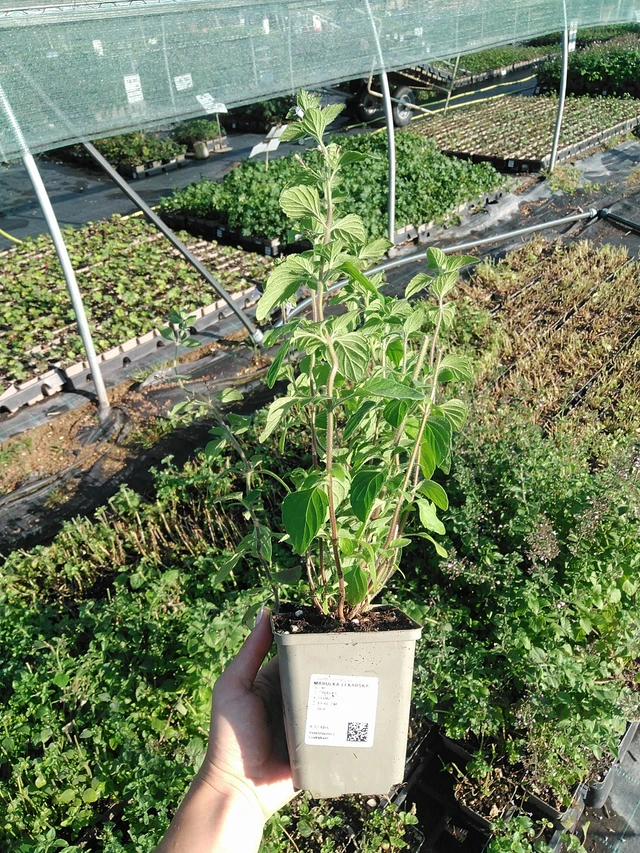
Photos in time
See how the seedling looks over the course of a year.


More products in category Calamint

Calamintha nepeta
Calamint Blue Cloud

Calamintha nepeta
Calamint White Cloud

Calamintha nepeta
Calamint Marvelette White

Calamintha sylvatica
Wood Calamint Menthe

Calamintha nepeta
Calamint Lila Riese

Calamintha nepeta
Calamint Marvelette Blue
More products in category Perennials
Alchemilla mollis
Lady's mantle Irish Silk
Achillea millefolium
Yarrow Summer Pastels

Verbena bonariensis
Verbena

Salvia nemorosa
Woodland Sage Caradonna

Perovskia atriplicifolia
Russian Sage

Gaura lindheimeri
Gaura Siskiyou Pink

Echinacea purpurea
Coneflower Rubinstern

Echinacea pallida
Echinacea pallida

Eryngium planum
Sea Holly

Echinacea purpurea
Coneflower Magnus

Salvia nemorosa
Woodland Sage Ostfriesland
Calamintha nepeta
Calamint Blue Cloud
Rudbeckia fulgida
Rudbeckia Goldsturm

Salvia nemorosa
Woodland Sage Amethyst

Gaura lindheimeri
Gaura Summer Breeze
Leucanthemum vulgare
Daisy Maikönigin
Achillea millefolium
Yarrow Terracotta

Perovskia atriplicifolia
Russian sage Little Spire
Salvia nemorosa
Woodland Sage Schneehügel

Lavandula angustifolia


