
Phlomis russeliana
Phlomis Russeliana
Seedling


Attracts pollinators 🐝
Difficulty
Diseases
Edible
Flower color
Flower color: Shade
Foliage color
Fragrant (aromatic) 👃
Frost resistance
Hardiness zone
Height
Moisture
Pests
Position
Soil
Spacing
Spacing: Plants per m²
Species
Suitable for cutting
Suitable for drying
Recommended products

Knautia macedonica
Knautia Red Knight

Alchemilla mollis
Lady's mantle Irish Silk

Calamintha nepeta ssp. nepeta
Calamint

Achillea millefolium
Yarrow Terracotta

Echinacea purpurea
Coneflower White Swan

Achillea filipendulina
Yarrow Parkers Varietät

Achillea millefolium
Yarrow Lilac Beauty

Sedum telephium
Sedum Star Dust

Rudbeckia fulgida
Rudbeckia Goldsturm

Catananche caerulea
Shoofly plant Blue

Gypsophila paniculata
Baby's Breath Snowflake

Cephalaria gigantea
Giant scabious

Echinops bannaticus
Globe thistle Blue Glow

Coreopsis verticillata
Coreopsis Moonbeam

Sanguisorba officinalis
Great Burnet

Deschampsia cespitosa
Tufted hairgrass Palava

Sedum spectabile
Sedum Matrona

Salvia nemorosa
Woodland Sage Schneehügel

Helleborus orientalis
Hellebore Double Ellen Yellow Spotted

Pennisetum alopecuroides
Fountain grass Hameln

Leucanthemum vulgare
Daisy Maikönigin

Rudbeckia subtomentosa
Rudbeckia Henry Eilers

Penstemon digitalis
Penstemon Husker Red

Deschampsia cespitosa
Tufted Hairgrass Goldschleier

Anemone hybrida
Japanese Anemone Whirlwind

Centaurea montana
Mountain Cornflower

Filipendula vulgaris
Meadowsweet

Nepeta racemosa
Catmint Walker’s Low

Aquilegia vulgaris
Columbine Kristall

Nepeta faassenii
Catmint Six Hills Giant
Cultivation
Successful growing of Phlomis begins with understanding its natural resilience and modesty. Since you will receive an already grown seedling, complicated pre-growing is eliminated, and you can place it straight into a permanent location. This plant will thrive in places where other perennials fail due to drought and poor soil. It seeks out sunny and warm locations, while also tolerating partial shade as long as the soil is not too damp. The soil should be rather poorer, well-drained, sandy to gravelly. If the soil is too nutritious and humous, the plant may become leggy and bloom less. When planting, make sure that the neck of the seedling is not submerged too deep underground, and after planting, water it so that it connects with the existing soil.
During the growing season, caring for Phlomis is very easy, which beginner gardeners will especially appreciate. Thanks to deep roots, the adult plant reaches for moisture itself and handles summer droughts excellently. It is not necessary to fertilize it; on the contrary, in poorer soils it is more compact and resilient. Its gray-green leaves create a dense ground cover that effectively suppresses weeds. If the plant starts to expand too much in width (it self-seeds and spreads by rhizomes), you can easily restrict it with a spade or by installing root barriers. The flowers are not only beautiful to look at, but they are also a magnet for bees and bumblebees, and if you cut them for a vase, they stay fresh for a long time. They are also perfect for drying into dry arrangements, where they retain their shape.
As for wintering, Phlomis is a fully frost-resistant perennial (zone 4a), which will survive the winter here without any problems. In autumn, avoid the urge to "tidy up" the garden and leave the dry stems in place. Not only will you support the garden's biodiversity by doing this, but you will also gain a gorgeous winter decoration right in the flowerbed. Spring maintenance then consists of removing these old stems and possibly damaged leaves so that the plant can sprout again. Because pests and diseases avoid Phlomis, you do not have to worry that leaving the old matter over the winter would cause health problems for the stand.
Growing in a planter or pot on a terrace is also an option for Phlomis, ideal for livening up sunny balconies. However, choose a container with drainage holes and use a substrate for herbs or succulents, or garden soil mixed in a 1:1 ratio with sand or perlite. In a container, there is limited space for the roots, so the plant will require occasional watering during hot days once the substrate dries out. For winter, it is advisable to insulate the container or move it closer to the wall of the house so that the root ball does not freeze as quickly as in the open ground, although the plant itself tolerates frost excellently.
The information given is based on our experience, please use it as a guide only. Times may vary depending on the season, climate, location, sowing and transplanting dates and possibly also the conditions in the greenhouse/greenhouse. We always recommend testing how the plant performs in your conditions. Please do not take this as a guarantee.
Does the [plant name] spread to the surrounding area?
How many seedlings should I plant per square meter?
Do I need to prune the [plant name] in the autumn?
How often do I need to water the [plant name]?
Does Phlomis need fertilizing?
Frequently asked questions
Planting site
Where is the best place to plant Phlomis russeliana?
Characteristics
When does this plant bloom and what color are the flowers?
Is Phlomis useful for bees and other insects?
Is the [plant name] frost-hardy, or do I need to cover it for the winter?
Is the [plant name] safe for children and pets? Is it poisonous?
What do the leaves of Phlomis look like and do they have a function?
Harvest
Can I use the flowers of this plant in bouquets?
Basic information
Is Phlomis difficult to grow? Can a beginner handle it?
Diseases & pests
Is this plant prone to any pests or diseases?
Troubleshooting
Why is my Phlomis not flowering in the first year after planting?
Photos in time
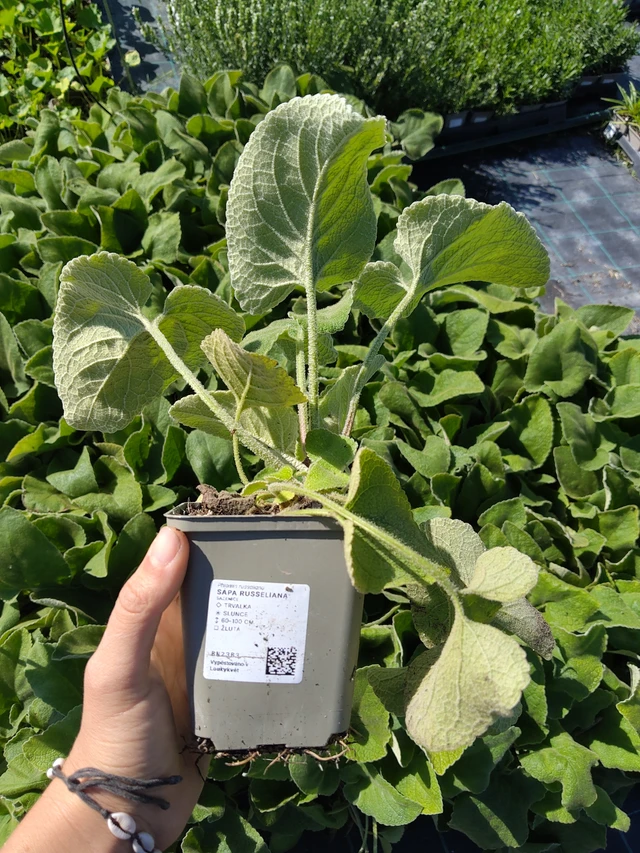
See how the seedling looks over the course of a year.


More products in category Jerusalem Sage

Phlomis tuberosa
Phlomis Tuberosa
More products in category Perennials
Alchemilla mollis
Lady's mantle Irish Silk

Achillea millefolium
Yarrow Summer Pastels

Verbena bonariensis
Verbena

Salvia nemorosa
Woodland Sage Caradonna

Perovskia atriplicifolia
Russian Sage

Gaura lindheimeri
Gaura Siskiyou Pink

Echinacea purpurea
Coneflower Rubinstern

Echinacea pallida
Echinacea pallida

Eryngium planum
Sea Holly

Echinacea purpurea
Coneflower Magnus

Salvia nemorosa
Woodland Sage Ostfriesland

Calamintha nepeta
Calamint Blue Cloud
Rudbeckia fulgida
Rudbeckia Goldsturm
Calamintha nepeta ssp. nepeta
Calamint

Salvia nemorosa
Woodland Sage Amethyst

Gaura lindheimeri
Gaura Summer Breeze
Leucanthemum vulgare
Daisy Maikönigin
Achillea millefolium
Yarrow Terracotta

Perovskia atriplicifolia
Russian sage Little Spire
Salvia nemorosa


