
Rudbeckia subtomentosa
Rudbeckia Henry Eilers
Seedling


Attracts pollinators 🐝
Difficulty
Diseases
Edible
Flower color
Flower color: Shade
Foliage color
Fragrant (aromatic) 👃
Frost resistance
Hardiness zone
Height
Moisture
Pests
Position
Soil
Spacing
Spacing: Plants per m²
Species
Suitable for cutting
Suitable for drying
Recommended products

Rudbeckia subtomentosa
Rudbeckia Little Henry

Achillea millefolium
Yarrow Terracotta

Rudbeckia fulgida
Rudbeckia Goldsturm

Coreopsis verticillata
Coreopsis Moonbeam

Helleborus orientalis
Hellebore Double Ellen Picotee

Achillea ptarmica
Yarrow The Pearl

Helianthus microcephalus
Sunflower Lemon Queen

Achillea millefolium
Yarrow Summer Pastels

Phlomis russeliana
Phlomis Russeliana

Helleborus orientalis
Hellebore Double Ellen Yellow Spotted

Cephalaria gigantea
Giant scabious

Achillea millefolium
Yarrow Cassis

Alchemilla mollis
Lady's mantle Irish Silk

Sedum spectabile
Sedum Matrona

Gypsophila paniculata
Baby's Breath Snowflake

Aster ericoides
Aster Lovely

Knautia macedonica
Knautia Red Knight

Achillea millefolium
Yarrow Lilac Beauty

Achillea filipendulina
Yarrow Parkers Varietät

Sanguisorba officinalis
Great Burnet

Verbascum chaixii
Mullein Sixteen Candles

Achillea millefolium
Yarrow Lachsschönheit

Salvia nemorosa
Woodland sage Schwellenburg

Boltonia decurrens
Boltonia decurrens

Solidago canadensis
Goldenrod Romantic Glory

Achillea millefolium
Yarrow Alabaster

Verbena hastata
Blue Vervain Pink Spires

Papaver orientale
Oriental Poppy Royal Wedding

Briza media
Quaking grass Tinkerbell

Echinops bannaticus
Globe thistle Blue Glow
Cultivation
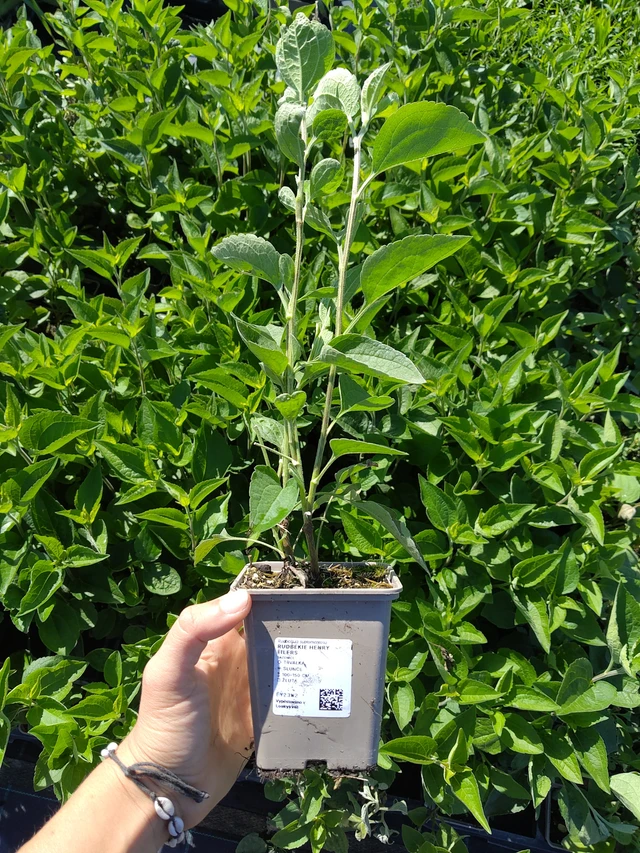
You will receive Rudbeckia 'Henry Eilers' as a high-quality, well-rooted seedling, which you can plant straight into the flower bed after unpacking. It will thrive best in an open location that offers plenty of direct sun. It needs a spot in full sun and well-drained loamy soil, but it can also handle heavier clay soil without any problems, provided it does not retain excess water. We recommend planting with a spacing of approximately 50 centimeters, which corresponds to three to five plants per square meter. This distance will ensure sufficient air circulation between the mature clumps. Although this is a species that is completely resistant to common diseases and pests, the airiness of the planting will support the overall vitality and firmness of the stems, which are over a meter tall, so they will not need any additional support.
Keep watering after planting regular until the seedling roots well. Later, this long-lived perennial is very low-maintenance. It can handle hot summers and, to some extent, drought, although occasional watering will benefit it during long periods without rain. Be rather careful with fertilizing. With an excess of nutrients, the clumps may not be stable and the stems could unnecessarily lodge. If you decide to grow the rudbeckia in a voluminous pot or a larger container on the terrace, provide it with a good drainage layer at the bottom and a more regular water supply. The substrate in containers dries out much faster than open soil in a flower bed. But the rule that moderate fertilizing brings more compact growth and richer flowering applies in containers too.
The plant blooms reliably from August to October, and bees and other pollinators will flock to it this whole time. Do not remove the faded dark centers from the plant in autumn. They create a beautiful winter effect, especially when covered by morning frost. For winter, it needs no cutting back or special frost protection. Its frost hardiness reaches down to minus twenty-eight degrees Celsius, so it will survive Central European winters completely without problems even without covering. Only in early spring, just before the new dark green leaves sprout, cut all the dry stems right above the ground. This will free up space for new growth and keep the plant in perfect condition for the next season.
The information given is based on our experience, please use it as a guide only. Times may vary depending on the season, climate, location, sowing and transplanting dates and possibly also the conditions in the greenhouse/greenhouse. We always recommend testing how the plant performs in your conditions. Please do not take this as a guarantee.
The plant grows up to 150 cm; do I need to stake it?
How often should I water the seedling after planting?
Do I need to protect or cover the plant specially for the winter?
At what spacing should I plant the seedlings?
Collections
The product can be found in the following collections.


Perennial Collection
Holiday Mood
A perennial collection full of airy forms and bright summer colors. These undemanding and adaptable species of perennials and…
Frequently asked questions
Basic information
In which months can I look forward to blooms?
Characteristics
Is this Rudbeckia dangerous for pets or children in any way?
How exactly does this cultivar differ from regular Rudbeckia?
Does the plant have any scent and is it attractive to beneficial insects?
Propagation
How can I propagate the plant for other beds if it doesn't self-seed?
Troubleshooting
My Rudbeckia is losing its stability and the large clumps are flopping over; what could be the reason?
Diseases & pests
Is this plant prone to any common diseases or pest infestations?
Planting site
Where is the best place to plant this Rudbeckia seedling?
Harvest
Are the flowers suitable for cutting and placing in a vase?
Can the cut flowers be used in other ways, for example, for drying in decorations?
Photos in time
See how the seedling looks over the course of a year.


More products in category Rudbeckia
Rudbeckia fulgida
Rudbeckia Goldsturm

Rudbeckia fulgida var. deamii
Rudbeckia Deamii

Rudbeckia occidentalis
Rudbeckia Green Wizard
Rudbeckia subtomentosa
Rudbeckia Little Henry

Rudbeckia fulgida
Rudbeckia Little Goldstar

Rudbeckia fulgida var. speciosa
Rudbeckia Speciosa

Rudbeckia missouriensis
Missouri Rudbeckia
More products in category Perennials
Alchemilla mollis
Lady's mantle Irish Silk
Achillea millefolium
Yarrow Summer Pastels

Verbena bonariensis
Verbena

Salvia nemorosa
Woodland Sage Caradonna

Perovskia atriplicifolia
Russian Sage

Gaura lindheimeri
Gaura Siskiyou Pink

Echinacea purpurea
Coneflower Rubinstern

Echinacea pallida
Echinacea pallida

Salvia nemorosa
Woodland Sage Ostfriesland

Eryngium planum
Sea Holly

Echinacea purpurea
Coneflower Magnus

Calamintha nepeta
Calamint Blue Cloud
Rudbeckia fulgida
Rudbeckia Goldsturm

Calamintha nepeta ssp. nepeta
Calamint

Gaura lindheimeri
Gaura Summer Breeze

Salvia nemorosa
Woodland Sage Amethyst

Leucanthemum vulgare
Daisy Maikönigin
Achillea millefolium
Yarrow Terracotta

Perovskia atriplicifolia
Russian sage Little Spire

Salvia nemorosa


