
Hyssopus officinalis
Hyssop Caeruleus
Seedling


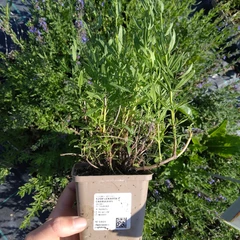
Attracts pollinators 🐝
Difficulty
Diseases
Edible
Flower color
Flower color: Shade
Foliage color
Fragrant (aromatic) 👃
Frost resistance
Hardiness zone
Height
Moisture
Pests
Position
Soil
Spacing
Spacing: Plants per m²
Species
Suitable for cutting
Suitable for drying
Recommended products

Alchemilla mollis
Lady's mantle Irish Silk

Hyssopus officinalis
Hyssop Albus

Salvia pratensis
Meadow Sage Rose Rhapsody

Achillea millefolium
Yarrow Summer Pastels

Achillea millefolium
Yarrow Lilac Beauty

Achillea ptarmica
Yarrow The Pearl

Leucanthemum
Daisy Christine Hagemann

Salvia nemorosa
Salvia Mainacht

Achillea millefolium
Yarrow Terracotta

Gypsophila paniculata
Baby's Breath Snowflake

Salvia nemorosa
Woodland Sage Schneehügel

Verbena bonariensis
Verbena

Nepeta faassenii
Catmint Six Hills Giant

Verbascum nigrum var. album
Black Mullein

Delphinium hybrida
Larkspur Benary’s Pacific Black Knight

Verbena hastata
Blue Vervain Pink Spires

Sedum spectabile
Sedum Matrona

Filipendula hybridum
Meadowsweet Kahome

Leucanthemum vulgare
Daisy Maikönigin

Lychnis coronaria
Campion Alba

Coreopsis verticillata
Coreopsis Zagreb

Nepeta racemosa
Catmint Walker’s Low

Catananche caerulea
Shoofly plant Blue

Delphinium hybrida
Larkspur Benary’s Pacific Galahad

Papaver orientale
Oriental Poppy Royal Wedding

Aster novi-belgii
Aster novi-belgii Fellowship

Anemone hybrida
Japanese Anemone Andrea Atkinson

Deschampsia cespitosa
Tufted Hairgrass Goldschleier

Calamintha nepeta ssp. nepeta
Calamint

Lychnis coronaria
Campion
Cultivation
For successful cultivation, choose a fully sunny location that best mimics its natural homeland in the southern Mediterranean. The soil should be above all well-drained, ideally light sandy or loamy. Definitely avoid heavy, clayey, and waterlogged soils, because hyssop absolutely cannot tolerate long-term waterlogging of the roots. When planting in a flowerbed, maintain a spacing of roughly 40 centimeters, which corresponds to six plants per square meter. This spacing will ensure sufficient air circulation around the compact shrub, which will grow to a height of 40 to 60 centimeters very soon after rooting.
Because it is a very undemanding plant that even complete gardening beginners can easily handle, you will not have to worry too much about maintenance. As soon as your new seedling roots well after planting, it copes wonderfully with drier periods and requires only minimal watering. Regular fertilizing is not necessary at all, as hyssop prefers soils poorer in nutrients. A huge advantage is the fact that this strongly aromatic plant does not suffer from any diseases and is avoided by all common pests. Moreover, throughout the summer, specifically from July to September, it will reward you with an amazing flood of blue-purple flowers. These flowers will safely attract bees, bumblebees, and butterflies from all around.
The key to maintaining a neat and dense shape of the subshrub is a proper and regular cut. With a strong cut, even almost to the ground, which you perform in early spring and immediately after the main blooming, you will keep the plant maximally compact. With this intervention, you will also often ensure very pleasant repeated blooming. In autumn, you do not have to fear even the first frosts at all, the plant is fully frost-hardy here down to -23 °C and will survive the winter without any special protection. Thanks to its evergreen leaves, it also serves as an interesting winter effect even under the snow. Moreover, hyssop reliably self-seeds in a suitable location, so you can soon look forward to new young plants in your flowerbed.
Customers often ask us if hyssop can also be successfully grown in a pot or on a balcony. The answer is definitely yes! For growing in containers, choose a sufficiently spacious and deep pot with the necessary drainage hole at the bottom. Use a light horticultural substrate mixed with coarse sand or fine gravel to ensure flawless drainage. Do not forget to place a thicker layer of expanded clay at the very bottom. In a container, the plant will naturally require slightly more frequent watering than in an open bed, but always honestly wait until the surface of the substrate dries out completely. Even when growing in a pot, you can regularly harvest excellent edible leaves and flowers for summer bouquets or directly into the kitchen.
The information given is based on our experience, please use it as a guide only. Times may vary depending on the season, climate, location, sowing and transplanting dates and possibly also the conditions in the greenhouse/greenhouse. We always recommend testing how the plant performs in your conditions. Please do not take this as a guarantee.
What is the correct procedure for planting a purchased seedling?
How often do I need to water hyssop after planting?
Do I need to prune or shape the hyssop in any way?
Does a hyssop shrub need any support so it doesn't tip over?
Collections
The product can be found in the following collections.


Perennial and Grass Collection with Bulbs and Seeds
Blue tones in the garden bed
Our perennial selection in blue. We have supplemented it with our favorite blue annual seeds and added blue-flowering spring …
Frequently asked questions
Planting site
What kind of location and soil are best for growing hyssop?
Can hyssop also be grown in a pot on a balcony or terrace?
Diseases & pests
What about pests and diseases for hyssop; do I need to spray it?
Basic information
Is hyssop frost-hardy, or do I need to cover it for the winter?
Harvest
Can I use hyssop leaves and flowers in the kitchen?
Characteristics
Which plants combine best with hyssop in a flower bed?
Is the plant poisonous or dangerous to pets and children?
When does hyssop bloom and what do the flowers look like?
Troubleshooting
Why is my hyssop wilting and its leaves turning yellow, even though it's in direct sunlight?
Propagation
Does hyssop spread on its own in the garden bed, or does it need help?
Photos in time
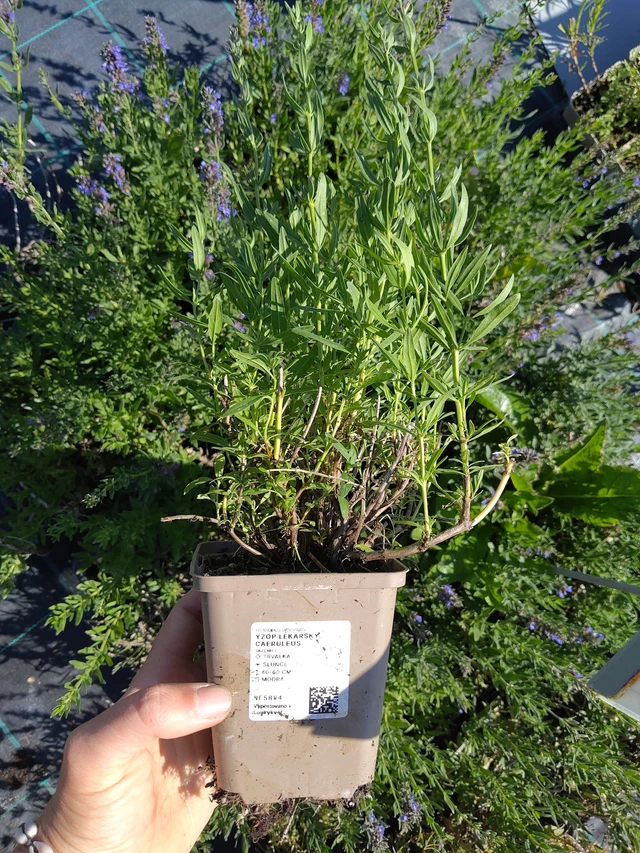
See how the seedling looks over the course of a year.


More products in category Hyssop

Hyssopus officinalis
Hyssop

Hyssopus officinalis
Hyssop Roseus
Hyssopus officinalis
Hyssop Albus
More products in category Perennials
Alchemilla mollis
Lady's mantle Irish Silk
Achillea millefolium
Yarrow Summer Pastels
Verbena bonariensis
Verbena

Salvia nemorosa
Woodland Sage Caradonna

Perovskia atriplicifolia
Russian Sage

Gaura lindheimeri
Gaura Siskiyou Pink

Echinacea purpurea
Coneflower Rubinstern

Echinacea pallida
Echinacea pallida

Salvia nemorosa
Woodland Sage Ostfriesland
Eryngium planum
Sea Holly

Echinacea purpurea
Coneflower Magnus

Calamintha nepeta
Calamint Blue Cloud

Rudbeckia fulgida
Rudbeckia Goldsturm
Calamintha nepeta ssp. nepeta
Calamint

Gaura lindheimeri
Gaura Summer Breeze

Salvia nemorosa
Woodland Sage Amethyst
Leucanthemum vulgare
Daisy Maikönigin
Achillea millefolium
Yarrow Terracotta

Perovskia atriplicifolia
Russian sage Little Spire
Salvia nemorosa


