Ireland
€
🪴 Is láithe deireanacha é an 6 Samhain le haghaidh seachadadh síológa an séasúr seo. Is féidir leat breathnú ar an tairiscint reatha anseo. 🪴
Ireland
€
🪴 Is láithe deireanacha é an 6 Samhain le haghaidh seachadadh síológa an séasúr seo. Is féidir leat breathnú ar an tairiscint reatha anseo. 🪴
Loosestrife Swirl, Loukykvět

Lythrum virgatum

Loosestrife Swirl

'Swirl' is a profusely flowering cultivar of wand loosestrife that will bring lightness and elegance to your garden. Compared to the common purple loosestrife, it has much airier inflorescences and a more slender habit, so it doesn't spread as much in flower beds. It grows to a height of about one meter and adorns the garden with its purplish-pink flowers all summer long. Although its natural home is in moister habitats, it is surprisingly tolerant to drier conditions compared to other species. This makes it a versatile plant that you can place both near water features and in mixed perennial plantings, where it beautifully complements grasses or other moisture-loving perennials. In addition to summer flowering, the loosestrife will delight you even at the end of the season. Its smooth and narrow leaves turn striking shades of red in the autumn, creating an interesting contrast to fading plants. It is an ideal choice for beginners because it requires no support, does not suffer from diseases, and is fully frost-resistant. If you like to create bouquets, don't hesitate to cut a few stems for a vase; they look very natural and wild in floral decorations. The plant is also a great attraction for bees and butterflies, providing them with plenty of nectar. Show full description

Seedling

K9 pot (9×9×9.5 cm)
Seedling
Seedling
Seedling
1-2 pieces
€4,29each
3-8 pieces
€3,89each
9-17 pieces
€3,39each
18+ pieces
€2,99each
Add to cart
81 pcs in stock

Attracts pollinators 🐝

Yes

Difficulty

Beginner

Diseases

Disease-free 🙂

Edible

Yes
?
Information on whether the plant is edible.

Flower color

Pink

Flower color: Shade

Magenta

Foliage color

Green, red

Fragrant (aromatic) 👃

No

Frost resistance

-34
?
The temperature down to which the plant is frost hardy.

Hardiness zone

4a (-34.4 °C to -31.7 °C)

Height

80-100 cm

Moisture

💧💧💧

Pests

Pest-free 🙂

Position

Sun, partial shade

Soil

Loamy, humus-rich, clay

Spacing

40-40 cm
?
Recommended planting spacing.

Spacing: Plants per m²

5-7

Species

Perennial

Suitable for cutting

Yes

Suitable for drying

No
1
2
3
4
5
6
7
8
9
10
11
12
Flowering
June
September

Recommended products

Loosestrife White Swirl, Loukykvět

Lythrum virgatum

The 'White Swirl' wand loosestrife gives a much more elegant and airy impression in the garden than its better-known relative, the purple loosestrife. It is characterized by a slimmer growth habit and smooth, narrow leaves that beautifully turn into dark red tones in the autumn, thereby extending the visual effect of the plant until the end of the season. The 'White Swirl' cultivar is prized for its delicate, pure white flower spikes, which tower up to a height of one meter and bring lightness and light to the plantings. Although loosestrifes generally love water and we find them in moist meadows in nature, this species surprisingly deals well with slightly less moisture. You can therefore plant it without worry not only along the edges of ponds but also in common perennial beds with loamy or clayey soil. From July to September, it becomes a magnet for bees and other pollinators. Furthermore, the sturdy stems are suitable for cutting into summer bouquets.
€4,29
More from €2,99
In StockIn stock – only 53 left
Daisy Maikönigin, Loukykvět

Leucanthemum vulgare

A classic perennial for early summer bouquets and cottage gardens. For bouquets, we harvest flowers with firm, smooth central disks. Then they last 7–10 days in a vase. Maikönigin is an exceptionally abundantly flowering garden form.
€2,79
More from €1,99
In Stock
Loosestrife Blush, Loukykvět

Lythrum salicaria

Originally a native wild perennial that can be found in moist meadows, in shallow waters, or marshy edges of water bodies. In autumn, the leaves turn orange-red. Blush is a lower cultivar among loosestrifes. The flowers are pure light pink and combine well with other perennials.
€4,29
More from €2,99
In StockIn stock – only 1 left
Meadow Sage Rose Rhapsody, Loukykvět

Salvia pratensis

Meadow sage occurs here primarily in warmer regions, especially in southern Moravia and northern and central Bohemia. It grows on sunny meadows and hillsides and along paths. Fragrant leaves form a basal rosette, from which several less leafy branched stems grow. The inflorescences are composed of striking bilabiate flowers, which are a great attraction for bees and bumblebees. Rose Rhapsody has light pink flowers.
€2,79
More from €1,99
In Stock
Loosestrife Robert, Loukykvět

Lythrum salicaria

Purple loosestrife is a native wild perennial that we commonly encounter in wet meadows, in shallow waters, or on the swampy edges of ponds. It is an absolutely undemanding plant that can handle even heavier clay soil and loves the sun. The cultivar Robert stands out with deep purple-pink spike-like inflorescences and, compared to the original species, grows more compactly, reaching a height of around 70 to 90 centimeters. Thanks to this, it fits even into smaller perennial beds, where it beautifully complements moisture-loving plantings. From July to September, it literally buzzes with life, as it is a huge attraction for bees, bumblebees, and butterflies. In autumn, its leaves then turn into striking orange-red tones, extending the effect in the garden until the first frosts. Furthermore, the flowers are suitable for cutting into summer bouquets.
€4,29
More from €2,99
In Stock
Loosestrife Pink Tails, Loukykvět

Lythrum salicaria

A native wild perennial that can be found in wet meadows, in shallow waters, or swampy edges of water bodies. In autumn, the leaves turn orange-red. Pink Tails has light old-pink flowers.
€4,29
More from €2,99
In StockIn stock – only 40 left
Calamint, Loukykvět

Calamintha nepeta ssp. nepeta

An undemanding and modest perennial that blooms with a large number of tiny flowers. It blooms for a record-breaking length of time throughout late summer and autumn. It forms smaller, compact, airy bushes that release a minty-spicy scent. The thyme-like flowers attract bees, bumblebees, and butterflies. It will look good among roses as well as in naturalistic steppe beds, perhaps with lower grasses. This calamint is generally more vigorous. It differs from other calamints with felted leaves by its record flowering length, stiff and shiny leaves, and also a larger number of flowers that do not form seeds and are therefore maximally durable. Sometimes sold under the cultivar name 'Triumphator'.
€2,79
More from €1,99
In stock with delivery from 19. 4. 2027
Fountain grass Hameln, Loukykvět

Pennisetum alopecuroides

Fountain grasses originate from East Asia, where they grow in meadows and light forests. They form hemispherical clumps of narrow leaves which, like the flowers, color up in the autumn. They are suitable for the vase and for drying. The 'Hameln' cultivar is one of the most reliable bloomers in cooler regions. The inflorescences initially have a soft pink tinge, then change color to yellow-brown or reddish-brown.
€4,29
More from €3,89
In Stock
Lady's mantle Irish Silk, Loukykvět

Alchemilla mollis

Alchemilla mollis, known as lady's mantle, is an indispensable perennial for anyone who wants to bring harmony and softness to the garden. Its home is the moister environments of mountain meadows and light forests, making it a very adaptable plant that will survive even severe frosts without problems in our climate. The 'Irish Silk' cultivar is prized for its vitality and abundant blooming, where clouds of tiny, yellow-green flowers float above clumps of gray-green leaves. It is precisely this neutral color that can work wonders in a flower bed – it softens overly sharp contrasts between other flowers and beautifully unifies the entire composition. Besides its ornamental function, lady's mantle also has practical uses. Thanks to its clumping growth and ability to quickly fill in, it is ideal for edging pathways or as an underplanting beneath taller shrubs and roses. Water droplets catch on its leaves, creating a magical spectacle in the garden. If you enjoy making bouquets, you will love lady's mantle as versatile filler greenery that matches almost anything. It will last beautiful for about ten days in a vase, and its inflorescences can also be easily dried without losing too much of their color or shape. Moreover, it is a magnet for pollinators, and its young leaves are even edible, so it also finds use in a natural kitchen.
€2,99
More from €2,09
In stock with delivery from 19. 4. 2027
Catmint Six Hills Giant, Loukykvět

Nepeta faassenii

Catmints are ideal companions for roses, suitable for naturalistic gardens, and lower species also for boxes and pots. Some of them are an irresistible attraction for cats, caused by the hallucinogen nepetalactone. This should be present in the highest amount in the species Nepeta cataria. Conversely, lemon-scented catmints reportedly do not attract cats. The botanical name Nepeta likely comes from the name of the ancient Etruscan city Nepet - Nepi in the territory of today's Italian province of Viterbo, where the plant was once cultivated. The faassenii group is characterized by vigorous upright growth, fine foliage, and long stems suitable for cutting. Six Hills Giant has a slightly lighter flower color than Walker's Low. It grows in airy clumps and blooms very profusely. Long stems suitable for cutting.
€2,99
More from €2,09
In Stock
Woodland Sage Schneehügel, Loukykvět

Salvia nemorosa

This species of sage originates from the steppe regions of Central and Eastern Europe. It forms abundantly flowering small clumps with straight upright stems. In beds, it looks best in groups. Traditionally, it is planted as a companion to roses due to the matching flowering time. However, it will look equally good in mixed drought-loving steppe plantings with grasses. It is an excellent food source for bees. It lasts 7 days in a vase. Schneehügel blooms white.
€2,99
More from €2,09
In StockIn stock – only 24 left
Yarrow Lilac Beauty, Loukykvět

Achillea millefolium

An original wild perennial with a large distribution area from Europe to Siberia. Suitable for natural and wild plantings. It grows in meadows and dry grassy places. A very adaptable and undemanding plant, it grows in clumps and spreads via runners. Cutting back after the first flowering encourages a new set of flowers. We harvest for bouquets when the florets are fully open. They last 10 days in a vase.
€3,49
More from €2,39
In Stock
Shoofly plant Blue, Loukykvět
Special offer

Catananche caerulea

Catananche caerulea, commonly known as Cupid's dart, is a charming plant that will win you over with its lightness and airiness. Its scientific name refers to ancient Greek legends, according to which it was used in love potions; today, however, you will appreciate it more for its undemanding nature and unique appearance. It is excellently suited for natural-style gardens, gravel beds, and drought-tolerant plantings, where it beautifully complements other perennials or ornamental grasses. It grows up to ninety centimeters tall and, despite its height, needs no support. The flowers have a lavender-blue color with a darker center and toothed petals at the ends. They bloom gradually from June to September. Cupid's dart loves drought and heat, but on the contrary, it cannot stand winter dampness, which harms it more than frost. If you provide it with a well-drained spot, it will survive temperatures down to -18 °C. It is a rewarding plant for beginner growers and experienced florists alike. Fresh flowers last a week in a vase, but they will bring you the most joy when dried. Harvest them fully open in dry weather and hang them upside down. They will keep their shape and remind you of summer all winter long.
€2,81
€2,59
More from €1,79
In Stock
Coneflower White Swan, Loukykvět

Echinacea purpurea

A valuable garden and medicinal perennial, native to North America. The spiky flower centers are an irresistible attraction for butterflies. They last 7–10 days in a vase. After removing the petals, the stems with the central disks can be dried or used in fresh bouquets as an interesting element. White Swan blooms with milky white flowers and brownish-orange centers. The petals are not spread entirely horizontally; they bend slightly downwards.
€3,79
More from €2,69
In StockIn stock – only 1 left
Yarrow The Pearl, Loukykvět

Achillea ptarmica

This Yarrow grows primarily in damp or wet habitats – wet meadows, springs, banks of watercourses and ponds. The flowers are semi-double with a gray-yellow center. They last 10 days in a vase.
€2,79
More from €1,99
In Stock
Russian Sage Blue Spire, Loukykvět

Perovskia

Russian sage will bring a touch of sunny steppes to the garden and places almost no demands on care. These sparsely branched subshrubs originally come from the harsh, rocky regions from Afghanistan to Tibet, where they grow on open plains bathed in sun. Due to its origin, it revels in full sun and in poor, well-drained sandy soil with minimal moisture. You will receive from us a well-rooted seedling in a pot, which you just need to transplant directly to the chosen spot in the flowerbed. It does not need support, common pests and diseases avoid it, and it will survive frosts down to minus twenty-eight degrees. It grows up to one hundred and twenty centimeters and forms conspicuous white-felted shoots with silvery-gray leaves. Blue Spire is an aromatic variety with airy, medium blue flowers that act as an attraction for bees and butterflies. Russian sage stands out next to drought-tolerant perennials. The flowers are suitable for both cutting and drying into winter arrangements. Moreover, the silvery stems will ensure a beautiful winter effect in the flowerbed.
€3,89
More from €2,89
In Stock
Salvia Mainacht, Loukykvět

Salvia nemorosa

Woodland sage 'Mainacht' is an aromatic perennial originating from the sunny steppes and dry meadows of Central and Eastern Europe. It is a very resilient and undemanding plant that thrives best here in full sun in well-drained and poorer soil. From the supplied grown seedling, a sturdy clump reaching a height of about half a meter will quickly grow. In flower beds, it stands out best when planted in larger groups, for example as a traditional companion to roses or in mixed drought-tolerant plantings with ornamental grasses. The 'Mainacht' cultivar is popular for its striking dark violet-blue flowers, which appear as early as May and June. If you cut it back after the first bloom, it will willingly bloom again at the end of August. During flowering, the sage is literally a magnet for bees and butterflies. It is an ideal choice for beginners, needs no support, and does not suffer from diseases. It is perfectly suited for cutting into fresh bouquets, where its stems stay fresh for approximately seven days. A surprising bonus is that the fragrant flowers are edible.
€2,99
More from €2,09
In StockIn stock – only 73 left
Yarrow Summer Pastels, Loukykvět

Achillea millefolium

An original wild perennial with a large distribution area from Europe to Siberia. Suitable for natural and wild plantings. It grows in meadows and dry grassy places. A very adaptable and undemanding plant, it grows in clumps and spreads by runners. By cutting back after the first flowering, we encourage a set of new flowers. For bouquets, we harvest when the florets are fully open. It lasts 10 days in a vase. Summer Pastels is characterized by a changeable and soft range of colors from white and vanilla to salmon, brick red, and bronze.
€3,09
More from €1,99
In Stock
Japanese Anemone Serenade, Loukykvět

Anemone hybrida

Anemones come from the same family as buttercups. With their elegant flowers on long slender stems, they can enliven and brighten up late summer and autumn flowerbeds. They stand out against the darker background of shrub groups and will also appreciate their partial shade. The Czech Perennial Association chose autumn anemones as the perennial of the season for 2022. They last 7 days in a vase. Serenade is a tender and vigorously growing cultivar. The flowers are semi-double, light pink with a center formed by distinct yellow stamens. The stems are firm and upright; it does not tend to lodge.
€4,79
More from €3,59
In Stock
Woodland sage Schwellenburg, Loukykvět

Salvia nemorosa

This species of sage originates from the steppe regions of Central and Eastern Europe. It forms profusely flowering small clumps with straight, upright stems. In flower beds, it looks best in groups. Traditionally, it is planted as a companion to roses due to the matching flowering time. However, it will look equally good in mixed drought-loving steppe plantings with grasses. It is excellent pasture for bees. It lasts 7 days in a vase. 'Schwellenburg' is a very special variety with a richly branched inflorescence. The little flowers have purple bracts and a wine-colored calyx.
€3,49
More from €2,39
In StockIn stock – only 65 left
Tufted hairgrass Palava, Loukykvět

Deschampsia cespitosa

Tufted hairgrass is an undemanding native grass that remains green even in winter. In nature, it grows in meadows and forest clearings. It forms a neat clump of leaves, from which grow delicate thin stems with transparent clouds of flowers. It adapts even to more difficult conditions, such as dry shade or compacted soil, and can handle waterlogging too. The Czech cultivar 'Pálava' is valuable for its extra-long flowering time from July to October. Unlike other cultivars, its flowers are sterile and do not create any seedlings. It is stated that it resists drought best of all tufted hairgrasses.
€3,49
More from €2,39
In Stock
Coreopsis Moonbeam, Loukykvět

Coreopsis verticillata

If you are looking for a delicate and long-blooming plant for full sun, whorled tickseed is a great choice. The basic species originates from North America, and here it thrives best in a sunny spot and well-drained, rather drier loamy soil. Although it is a short-lived perennial, with the right care and a well-chosen location, it can bring joy for several years. A distinctive feature of this species is its rich foliage of very tiny leaves, which form low, about forty-centimeter-tall bushes. After transplanting from the pot, the mature seedling is perfectly suited for the edges of flower beds or mixed drought-tolerant compositions, where it beautifully softens the overall look. In addition, the plant is fully frost-hardy, requires no special care, and is free from diseases. The 'Moonbeam' variety stands out with countless smaller, creamy-yellow flowers. These appear in mid-summer and continue to decorate the garden until early autumn, providing rich pasture for pollinators. You can easily cut the delicate stems with flowers to bring home. They will add an informal meadow touch to bouquets and will maintain their freshness in a vase for about seven days.
€2,99
More from €2,09
In stock with delivery from 19. 4. 2027
Tufted Hairgrass Goldschleier, Loukykvět

Deschampsia cespitosa

Tufted hairgrass is an undemanding native grass that remains green even in winter. In nature, it grows in meadows and forest clearings. It forms a compact tuft of leaves, from which grow fine, thin stems with transparent clouds of flowers. It adapts even to more difficult conditions, such as dry shade or compacted soil, and can handle waterlogging. Goldschleier has very tiny spikelets in light yellow panicles. The inflorescence forms a fluffy light yellow cloud above the tuft of leaves.
€3,79
More from €2,69
In Stock
Liatris Floristan White, Loukykvět

Liatris spicata

The pure white flowers of the 'Floristan White' variety bring elegant vertical lines and a completely novel look to summer beds. Blazing star is very popular among growers thanks to its peculiarity; it blooms exactly the opposite of most other plants, from the tip of the inflorescence downwards, which has earned it the fitting folk name "shorakvět" (top-flower) in our country. Its natural homeland is the North American prairies, where it grows in open sunny areas with nutritious and well-drained humous soil. Exactly such conditions will be ideal for it in your garden as well. We send customers grown seedlings directly in pots, which take root quickly after being transplanted into the ground and soon form vigorous clumps of narrow green leaves. Caring for this perennial is truly undemanding, and beginner gardeners can embark on it without worry. The plant grows to a height of sixty to ninety centimeters, has stable stems that do not require support, is avoided by diseases, and excels in reliable frost resistance, as it can withstand temperatures down to minus thirty-four degrees. The only unwanted visitor can be the field vole, which is sometimes attracted to its tubers. From mid-summer to early autumn, you can look forward to blooming, which makes the plant a living magnet for bees, bumblebees, and butterflies. In beds, it looks great in larger groups and gets along perfectly with ornamental grasses. The flowers apply excellently in floristry, because they stay fresh for a long time in a vase and liven up any bouquet. Furthermore, it pays off to leave the stems on the bed in autumn, as they provide a beautiful spectacle for winter interest.
€3,29
More from €2,29
In Stock
Japanese Anemone Whirlwind, Loukykvět

Anemone hybrida

Anemones come from the same family as buttercups. With their elegant flowers on long slender stems, they can liven up and brighten late summer and autumn beds. They stand out against the darker background of shrub groups and will also be grateful for their partial shade. The Czech Perennial Association chose autumn Anemones as the perennial of the season for 2022. They last 7 days in a vase. Whirlwind is a historical variety bred in 1887 in the USA. It has a semi-double pure white flower, often with inner twisted petals, and compact, strictly upright growth. The flowers are very durable.
€3,49
More from €3,59
In Stock
Coneflower Mellow Yellows, Loukykvět

Echinacea purpurea

A valuable garden and medicinal perennial, native to North America. The spiky central discs are an irresistible attraction for butterflies. They last 7–10 days in a vase. After removing the petals, the stems with the central discs can be dried or used in fresh bouquets as an interesting feature. Flowers in shades of yellow.
€2,99
More from €2,09
In StockIn stock – only 21 left
Mountain Cornflower, Loukykvět

Centaurea montana

Mountain cornflower brings to our gardens the charm of wild meadows and bright clearings of central and southern Europe, where it has its natural home. Thanks to its mountain origin, it is an exceptionally resilient and undemanding plant that can easily handle harsher conditions and severe frosts. Its unmistakable blue-purple flowers appear from May to July and reliably attract bees and other pollinators, for whom they are a valuable food source. In the garden, it is best utilized in natural plantings or rural submontane gardens, where it looks great in the company of other robust species. If you like to decorate your home with fresh flowers, you will be pleased to know that it is suitable for cutting and lasts about a week in a vase. It is a rewarding plant that easily self-seeds in a suitable location, creating natural, wild-looking nooks.
€3,09
More from €2,19
In StockIn stock – only 8 left
Cranesbill Cambridge, Loukykvět

Geranium cantabrigiense

Cantabrigiense cranesbill Cambridge is an invaluable perennial that will reliably conjure up a dense and fragrant green carpet in the garden. It naturally originates from the crossing of mountain species coming from the Balkans and Southern Europe. Because of this, it is exceptionally tough and adaptable. It thrives best in full sun or partial shade, where it is perfectly happy with standard well-draining loamy soil. It is a low-maintenance plant that handles summer droughts and severe frosts wonderfully. From the received potted seedling, a compact cushion growing to a height of thirty centimeters will soon grow after transplanting. It will serve as a versatile groundcover perennial. From May to July, striking purple-pink flowers on upright stems emerge from the aromatic foliage. The garden will come alive thanks to them, as they reliably attract bees and butterflies. The flowers are also great for cutting into summer bouquets, where they beautifully complement other species. The Cambridge variety will also delight you with a beautiful autumn transformation. With the arrival of cold days, the green leaves change to impressive red tones. It does not suffer from pests or diseases, and caring for it is a joy even for beginners.
€3,29
More from €2,29
In Stock
Knautia Red Knight, Loukykvět

Knautia macedonica

Macedonian scabious is an abundantly and long-blooming, undemanding perennial that will bring the untamed charm of summer meadows to the garden. Its wild form originates from the sun-drenched Balkans, where it naturally grows on sunny hillsides and in warm thickets. You will receive from us a mature seedling in a pot, which just needs to be transplanted into well-drained loamy or sandy soil in the sun or partial shade. Here it will quickly take root and form a vigorous clump. The Red Knight cultivar enchants with slender stems up to ninety centimeters tall, which all summer from June to September carry a flood of dark burgundy to deep wine-red flowers. These edible flowers act as a huge attraction for bees, bumblebees, and other insects. The plant is an ideal choice for beginners because it reliably resists frosts down to minus twenty-eight degrees and does not suffer from any pests or diseases. Although it belongs to short-lived perennials, in a suitable place it gladly self-seeds. It will fit perfectly into naturalistically designed plantings with ornamental grasses and is popularly used in sweeping meadow bouquets. We recommend cutting the flowers fully open; they will then stay beautifully fresh in a vase for several days.
€2,79
More from €1,99
In Stock
Yarrow Terracotta, Loukykvět

Achillea millefolium

A native wild perennial with a large distribution range from Europe to Siberia. Suitable for natural and wild plantings. It grows in meadows and dry grassy places. A very adaptable and undemanding plant, it grows in clumps and spreads via runners. Cutting back after the first bloom encourages a new set of flowers. Harvest for bouquets when the tiny flowers are fully open. It lasts 10 days in a vase. Terracotta features ochre, shades of orange and yellow, and gray-green foliage.
€2,99
More from €2,89
In Stock

Cultivation

When looking for the ideal spot for Loosestrife 'Swirl', focus on locations with plenty of sun, which supports rich flowering and intense coloration of the flowers and autumn foliage. The plant can also tolerate partial shade, but in full sun it will be more compact and healthier. The soil should be nutritious and able to retain water. Don't be afraid to plant it in heavier clay soils or near water features where the ground is permanently waterlogged. Plant the seedlings at a spacing of 40 cm; if you are planting a group, expect the plant to spread out over time and form a rich clump. Immediately after planting, water the plant thoroughly so that it bonds with the existing soil.
Since this is a plant native to wetland habitats, watering is crucial, especially in the first year after planting and during periods of summer drought. If you are growing Loosestrife in a regular perennial bed that is not naturally damp, a mulch of bark or wood chips will help you retain moisture in the soil longer. Fertilizing is not strictly necessary if the soil is naturally humous, but a spring dose of organic fertilizer or compost will give the plant energy to start the new season. Due to the fact that this cultivar is sterile or minimally fertile, you do not have to worry about the invasive spread by seeds, which is typical for the wild purple loosestrife.
Maintenance of Loosestrife is very easy and suitable even for complete beginners. The plant maintains its elegant, upright habit and does not require staking. The inflorescences are airy and delicate, so they do not break in the rain. If you like to create bouquets, do not hesitate to cut the flowering stems for a vase – it won't hurt the plant and they will stay fresh in water for a long time. The gratifying news is that Loosestrife is essentially free of diseases and pests, not even tasting good to slugs, so your care will be limited to just admiring the flowers and watching the butterflies that the plant attracts.
Overwintering is trouble-free, the plant is long-lived and highly frost-hardy. Do not remove the drying stems in autumn; their reddening color and structure decorate the garden even on dreary days. Cut the dry matter back only in spring in March, just before the new leaves emerge. You often ask about the possibility of growing it in pots on the terrace – yes, Loosestrife 'Swirl' will grow in a container, but it is more demanding regarding watering. Choose a large container with high-quality potting mix and ensure that the plant does not suffer from a lack of moisture even on hot summer days. For winter, it is better to sink the pot of container plants into the ground or wrap it with insulation, although the plant itself is frost-hardy, the root ball in a container freezes much faster than in the ground.

The information given is based on our experience, please use it as a guide only. Times may vary depending on the season, climate, location, sowing and transplanting dates and possibly also the conditions in the greenhouse/greenhouse. We always recommend testing how the plant performs in your conditions. Please do not take this as a guarantee.

Show all

Click to view the full growing instructions.

Frequently asked questions

Basic information

Characteristics

Planting site

Harvest

Diseases & pests

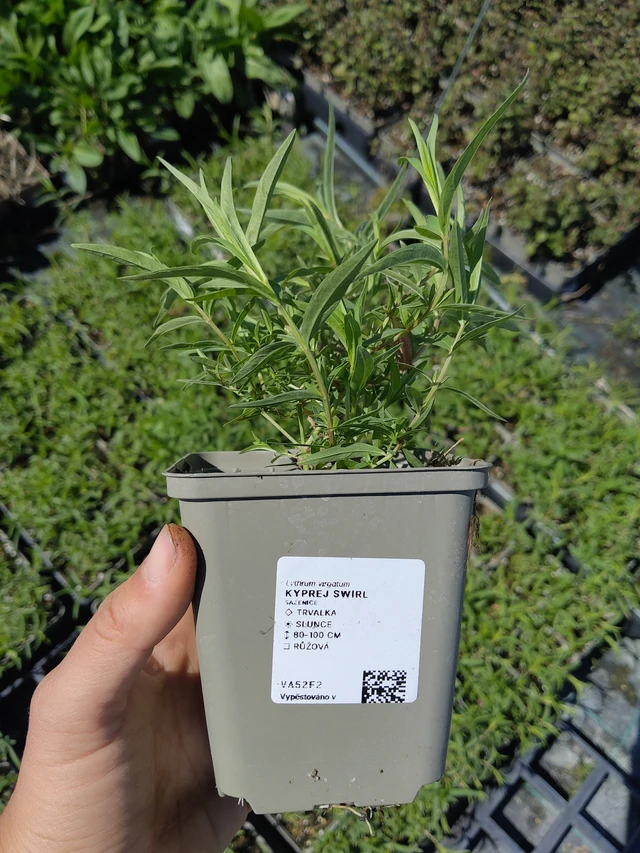
Photos in time

See how the seedling looks over the course of a year.
Loosestrife Swirl - 12. 8. 2026
12. 8. 2026
Loosestrife Swirl - 10. 10. 2025
10. 10. 2025
Loosestrife Swirl - 10. 9. 2025
10. 9. 2025
Loosestrife Swirl - 19. 8. 2025
19. 8. 2025
Loosestrife Swirl - 29. 7. 2025
29. 7. 2025
Loosestrife Swirl - 11. 7. 2025
11. 7. 2025
Loosestrife Swirl - 24. 6. 2025
24. 6. 2025
Loosestrife Swirl - 9. 6. 2025
9. 6. 2025
Loosestrife Swirl - 13. 5. 2025
13. 5. 2025
Loosestrife Swirl - 2024
2024
Loosestrife Swirl - 2024
2024
Loosestrife Swirl - 2024
2024

More products in category Loosestrife

Loosestrife Rose Queen, Loukykvět

Lythrum virgatum

Wand loosestrife is more elegant and slender than the better-known purple loosestrife. It also features much airier inflorescences. The leaves are smooth and narrower, turning dark red in autumn. Rose Queen is a very pretty variety, short for a loosestrife, with fine flower spikes. It handles slightly lower moisture levels well and can be planted in standard beds as well as at pond edges.
€4,29
More from €2,99
Unavailable
Pro rok 2026 nedostupné
Loosestrife Pink Tails, Loukykvět

Lythrum salicaria

A native wild perennial that can be found in wet meadows, in shallow waters, or swampy edges of water bodies. In autumn, the leaves turn orange-red. Pink Tails has light old-pink flowers.
€4,29
More from €2,99
In StockIn stock – only 40 left
Loosestrife White Swirl, Loukykvět

Lythrum virgatum

The 'White Swirl' wand loosestrife gives a much more elegant and airy impression in the garden than its better-known relative, the purple loosestrife. It is characterized by a slimmer growth habit and smooth, narrow leaves that beautifully turn into dark red tones in the autumn, thereby extending the visual effect of the plant until the end of the season. The 'White Swirl' cultivar is prized for its delicate, pure white flower spikes, which tower up to a height of one meter and bring lightness and light to the plantings. Although loosestrifes generally love water and we find them in moist meadows in nature, this species surprisingly deals well with slightly less moisture. You can therefore plant it without worry not only along the edges of ponds but also in common perennial beds with loamy or clayey soil. From July to September, it becomes a magnet for bees and other pollinators. Furthermore, the sturdy stems are suitable for cutting into summer bouquets.
€4,29
More from €2,99
In StockIn stock – only 53 left
Loosestrife Blush, Loukykvět

Lythrum salicaria

Originally a native wild perennial that can be found in moist meadows, in shallow waters, or marshy edges of water bodies. In autumn, the leaves turn orange-red. Blush is a lower cultivar among loosestrifes. The flowers are pure light pink and combine well with other perennials.
€4,29
More from €2,99
In StockIn stock – only 1 left
Loosestrife Lady Sackville, Loukykvět

Lythrum salicaria

Originally a native wild perennial that can be found in wet meadows, shallow waters, or swampy edges of water bodies. In autumn, the leaves turn orange-red. Lady Sackville blooms deep pink to light purple.
€4,29
More from €2,99
Unavailable
Pro rok 2026 nedostupné
Loosestrife Robert, Loukykvět

Lythrum salicaria

Purple loosestrife is a native wild perennial that we commonly encounter in wet meadows, in shallow waters, or on the swampy edges of ponds. It is an absolutely undemanding plant that can handle even heavier clay soil and loves the sun. The cultivar Robert stands out with deep purple-pink spike-like inflorescences and, compared to the original species, grows more compactly, reaching a height of around 70 to 90 centimeters. Thanks to this, it fits even into smaller perennial beds, where it beautifully complements moisture-loving plantings. From July to September, it literally buzzes with life, as it is a huge attraction for bees, bumblebees, and butterflies. In autumn, its leaves then turn into striking orange-red tones, extending the effect in the garden until the first frosts. Furthermore, the flowers are suitable for cutting into summer bouquets.
€4,29
More from €2,99
In Stock
Loosestrife Dropmore Purple, Loukykvět

Lythrum virgatum

Lythrum virgatum is more elegant and slender than the better-known purple loosestrife (Lythrum salicaria). It also has much airier inflorescences. The leaves are smooth and narrower, turning up to a dark red in autumn. Dropmore Purple blooms with purple to reddish-violet flowers arranged in slender spikes.
€4,29
More from €2,99
Unavailable
Pro rok 2026 nedostupné
Loosestrife Robin, Loukykvět

Lythrum salicaria

Robin purple loosestrife is, in its original form, a native wild perennial that you will commonly encounter in nature in wet meadows, shallow waters, or on the swampy edges of ponds. It is a plant that literally loves water and sun, so if you have a wetter corner or a pond in your garden, it will be absolutely happy there. Thanks to its origin, it is extremely resilient and fully frost-resistant, which makes it an ideal choice even for beginner gardeners. In summer, it becomes a magnet for bees, bumblebees, and butterflies looking for nectar on its purple flowers. The main difference of the cultivar Robin compared to the very similar Robert variety is its narrow, unbranched inflorescences with stems densely covered with flowers and leaves at the same time. In autumn, it will also please you when its leaves turn into beautiful shades of orange and red. The sturdy stems are also suitable for cutting into a vase, where they stay fresh for a long time, but this perennial is not suitable for drying.
€4,29
More from €2,99
Unavailable
Pro rok 2026 nedostupné
Loosestrife Pink Blush, Loukykvět

Lythrum salicaria

A native wild perennial that can be found in wet meadows, in shallow waters, or swampy edges of water bodies. In autumn, the leaves turn orange-red. Pink Blush has pink florets and creates a slightly fuller impression than other loosestrifes.
€4,29
More from €2,99
Unavailable
Pro rok 2026 nedostupné

More products in category Perennials

Lady's mantle Irish Silk, Loukykvět

Alchemilla mollis

Alchemilla mollis, known as lady's mantle, is an indispensable perennial for anyone who wants to bring harmony and softness to the garden. Its home is the moister environments of mountain meadows and light forests, making it a very adaptable plant that will survive even severe frosts without problems in our climate. The 'Irish Silk' cultivar is prized for its vitality and abundant blooming, where clouds of tiny, yellow-green flowers float above clumps of gray-green leaves. It is precisely this neutral color that can work wonders in a flower bed – it softens overly sharp contrasts between other flowers and beautifully unifies the entire composition. Besides its ornamental function, lady's mantle also has practical uses. Thanks to its clumping growth and ability to quickly fill in, it is ideal for edging pathways or as an underplanting beneath taller shrubs and roses. Water droplets catch on its leaves, creating a magical spectacle in the garden. If you enjoy making bouquets, you will love lady's mantle as versatile filler greenery that matches almost anything. It will last beautiful for about ten days in a vase, and its inflorescences can also be easily dried without losing too much of their color or shape. Moreover, it is a magnet for pollinators, and its young leaves are even edible, so it also finds use in a natural kitchen.
€2,99
More from €2,09
In stock with delivery from 19. 4. 2027
Yarrow Summer Pastels, Loukykvět

Achillea millefolium

An original wild perennial with a large distribution area from Europe to Siberia. Suitable for natural and wild plantings. It grows in meadows and dry grassy places. A very adaptable and undemanding plant, it grows in clumps and spreads by runners. By cutting back after the first flowering, we encourage a set of new flowers. For bouquets, we harvest when the florets are fully open. It lasts 10 days in a vase. Summer Pastels is characterized by a changeable and soft range of colors from white and vanilla to salmon, brick red, and bronze.
€3,09
More from €1,99
In Stock
Verbena, Loukykvět
Special offer

Verbena bonariensis

A verbena species originally from South America. In our country, it is often used as an annual, but in mild winters it can overwinter and reproduce by self-seeding. The firm, airy stems beautifully soften perennial beds and make them special with their purple color. It beautifully complements steppe plantings with grasses and rose beds.
€3,03
€2,59
More from €1,79
Coming in 2027
Woodland Sage Caradonna, Loukykvět

Salvia nemorosa

This species of sage originally comes from the steppe regions of Central and Eastern Europe. It forms profusely flowering small clumps with straight upright stems. In flower beds, it looks best in groups. Traditionally, due to the identical flowering time, it is planted as a companion to roses. However, it will look just as good in mixed drought-loving steppe plantings with grasses. It lasts 7 days in a vase. The cultivar Caradonna stands out with a long flowering period and dark, almost black-purple stems with tiny purple flowers and dark purple bracts. If we cut it back after flowering, it will bloom again in late August and September.
€2,99
More from €2,09
Unavailable
Pro rok 2026 nedostupné
Russian Sage, Loukykvět

Perovskia atriplicifolia

Russian sage reliably brings a touch of sunny steppes into the garden and places almost no demands on care. These sparsely branched subshrubs originally come from harsh, rocky areas from Afghanistan to Tibet, where they grow on open sun-drenched plains. Thanks to its origin, it delights in full sun and poor, well-drained sandy soil with minimal moisture. You will receive from us a well-rooted seedling in a pot, which just needs to be transplanted straight to the chosen spot in the flower bed. It does not need support, is avoided by common pests and diseases, and will survive frosts down to minus twenty-eight degrees. It grows up to one hundred and twenty centimeters and forms striking white felted shoots with silvery grey aromatic leaves. From July to October, it blooms with tiny blue-purple flowers that act as a lure for bees and butterflies and are even edible. Russian sage stands out next to drought-tolerant perennials. The flowers are suitable for cutting and drying for winter arrangements. Moreover, the silvery stems will ensure a beautiful winter effect in the flower bed.
€2,99
More from €2,09
Sold Out
Gaura Siskiyou Pink, Loukykvět
Special offer

Gaura lindheimeri

Gaura Siskiyou Pink is a charming perennial that brings lightness and airiness to the garden. Its original native area is in the warm regions of Texas and Louisiana, which is why it thrives in full sun and well-drained sandy soil. It grows in clumps and from June until the autumn frosts produces tiny raspberry-pink flowers that resemble fluttering butterflies. An interesting detail of this variety is the green leaves with a bronze tint and red spots. It is an absolutely undemanding plant, does not suffer from diseases or pests, and even beginners can handle its care. You will receive a grown seedling in a pot from us, which you simply need to transplant directly into the flowerbed. Here it complements ornamental grasses perfectly and acts as an attraction for bees and bumblebees. Although it grows more as a short-lived perennial in our climate, in a suitable place it reliably self-seeds. Occasional pinching will encourage richer branching. Gaura is excellent for summer bouquets. We cut the stems for a vase as soon as the first two to three little flowers open.
€3,03
€2,59
More from €1,79
Unavailable
Pro rok 2026 nedostupné
Coneflower Rubinstern, Loukykvět

Echinacea purpurea

A valuable garden and medicinal perennial, originally from North America. It blooms in summer with dark purple-pink flowers. The spiky flower discs are an irresistible lure for butterflies. Lasts 7–10 days in a vase. After plucking the petals, the stems with the central discs can be dried or used in fresh bouquets as an interesting element. Rubinstern is very similar to the Magnus cultivar; the petals are darker and firmer. As they fade, they gradually pale and droop downwards.
€2,99
More from €2,09
Unavailable
Pro rok 2026 nedostupné
Echinacea pallida, Loukykvět

Echinacea pallida

The pale coneflower is one of the exceptionally interesting prairie perennials of the North American continent. In its natural environment, it grows on open, sunny plains, which is why it thrives best in our gardens in full sun in drier, well-drained soil. You just need to transplant this grown seedling straight into the flower bed, where it will reliably take root. It does not need support, easily withstands severe frosts, and is avoided by common diseases and pests, making it ideal for beginner growers. During June and July, it will reward you with aromatic flowers with unusually narrow and drooping petals in light purple and pink tones. The prominent prickly centers are literally a magnet for bees and bumblebees, and the flowers themselves are surprisingly edible. The plant stands out especially in rustic plantings together with ornamental grasses. Gardeners and florists love it for its versatility. The fresh stems bring joy in a vase for about a week. Moreover, the distinctive central cones hold their shape perfectly, can be perfectly dried for winter decorations, or left in the flower bed, where they will create an eye-catching winter structure under a layer of snow.
€2,99
More from €2,09
Coming in 2027
Sea Holly, Loukykvět
For drying

Eryngium planum

Sea holly is an indispensable perennial for all lovers of naturally styled gardens. It earned its folk name - male fidelity - in times when it was used in herbal medicine as an aphrodisiac, and its roots were even candied as sweets in France and England. Today, however, you will appreciate it mainly for its low maintenance and unique appearance. Its home is on sunny hillsides and dry meadows, so even in our gardens, it will welcome well-drained, even poorer sandy soil and full sun. It produces upright, sturdy stems topped with blue-purple flowers with prickly bracts, which bring interesting structure and a silvery touch to the flowerbeds. It is literally a magnetic plant for bees, bumblebees, and butterflies, who find a rich food source on it. Floristically, it is extremely valuable, because its flowers are perfectly suited for cutting as well as drying for winter decorations. If you decide not to harvest it, feel free to leave it in the flowerbed all winter. Its silhouette covered in hoarfrost creates a wonderful winter effect. Although it is a short-lived perennial, in a suitable location it reliably self-seeds, so you will enjoy its beauty for many years.
€2,79
More from €1,99
Unavailable
Pro rok 2026 nedostupné
Coneflower Magnus, Loukykvět

Echinacea purpurea

A valuable garden and medicinal perennial, native to North America. It blooms in summer with dark purple-pink flowers. The spiky flower centers are an irresistible attraction for butterflies. They last 7–10 days in a vase. After removing the petals, the stems with the central disks can be dried or used in fresh bouquets as an interesting element. Magnus features distinctive deep pink flowers with an orange-brown center.
€2,99
More from €2,09
Coming in 2027
Woodland Sage Ostfriesland, Loukykvět

Salvia nemorosa

This species of sage originates from the steppe regions of Central and Eastern Europe. It forms abundantly flowering small clumps with straight upright stems. In beds, it looks best in groups. Traditionally, it is planted as a companion to roses due to the matching flowering time. However, it will look equally good in mixed drought-loving steppe plantings with grasses. It is an excellent food source for bees. It lasts 7 days in a vase. The cultivar Ostfriesland blooms with a strikingly dark violet-blue color.
€2,99
More from €2,09
Unavailable
Pro rok 2026 nedostupné
Calamint Blue Cloud, Loukykvět

Calamintha nepeta

Lesser calamint Blue Cloud is an undemanding and modest perennial that reliably perfumes any sunny garden. Its original homeland is the sunny and dry slopes of Southern Europe, which is why it thrives best here in direct sun in well-drained, sandy, or poorer loamy soil. It handles winter without problems, tolerating frosts down to minus twenty-three degrees. You will receive a grown seedling in a pot from us, which you just need to transplant straight into the flowerbed, where it will very soon form a compact, airy small shrub reaching a height of up to forty centimeters. It does not suffer from any diseases or pests, so even complete beginners can easily handle caring for it. Throughout late summer and into autumn, it blooms with a record number of tiny blue flowers that are so typical of the Blue Cloud variety. The whole plant emits a pleasant minty-spicy scent, and its flowers, which resemble thyme, act as a literal magnet for bees, bumblebees, and butterflies. It will look great among roses or in naturally designed steppe flowerbeds, where it naturally complements lower ornamental grasses. Additionally, both the blue flowers and green leaves are edible, so you can use them to garnish summer dishes. Lesser calamint is also excellently suited for cutting into smaller fresh bouquets, adding a fine structure to them in a vase.
€2,79
More from €1,99
Sold Out
Rudbeckia Goldsturm, Loukykvět

Rudbeckia fulgida

Rudbeckia Goldsturm is a reliable and long-lived perennial that will bring the warm tones of late summer and autumn into your garden. It originally comes from the open plains and prairies of North America, so it delights most in sunny locations with common garden soil, whether it is loamy, humus-rich, or clayey. You will receive from us an already grown seedling in a pot, which you just need to transplant to the chosen spot in the flower bed. It is a completely undemanding plant, does not suffer from diseases or pests, and easily survives severe frosts. The Goldsturm cultivar grows to a height of about seventy centimeters and does not need support. From August to October, it produces a flood of golden-yellow flowers with distinctly dark centers. These edible flowers attract pollinators and fit perfectly into both prairie and rustic plantings. Rudbeckia is also great for cutting, lasting around ten days in a vase. In addition, the distinctive dark centers can be easily dried. If you leave them in the flower bed over the winter, they will provide a wonderful spectacle.
€2,79
More from €1,99
In stock with delivery from 19. 4. 2027
Calamint, Loukykvět

Calamintha nepeta ssp. nepeta

An undemanding and modest perennial that blooms with a large number of tiny flowers. It blooms for a record-breaking length of time throughout late summer and autumn. It forms smaller, compact, airy bushes that release a minty-spicy scent. The thyme-like flowers attract bees, bumblebees, and butterflies. It will look good among roses as well as in naturalistic steppe beds, perhaps with lower grasses. This calamint is generally more vigorous. It differs from other calamints with felted leaves by its record flowering length, stiff and shiny leaves, and also a larger number of flowers that do not form seeds and are therefore maximally durable. Sometimes sold under the cultivar name 'Triumphator'.
€2,79
More from €1,99
In stock with delivery from 19. 4. 2027
Woodland Sage Amethyst, Loukykvět

Salvia nemorosa

This species of sage originates from the steppe regions of Central and Eastern Europe. It forms profusely flowering small clumps with straight, upright stems. In flower beds, it looks best in groups. It is traditionally planted as a companion to roses due to the matching flowering time. However, it looks equally good in mixed drought-tolerant steppe plantings with grasses. It is an excellent food source for bees. Lasts 7 days in a vase. Amethyst is an elegant variety with long stems and a pink flower color that is unusual for sages.
€2,99
More from €2,09
Unavailable
Pro rok 2026 nedostupné
Gaura Summer Breeze, Loukykvět

Gaura lindheimeri

The charming gaura comes from the sun-drenched plains of Texas and Louisiana and represents exactly the plant that can liven up any drought-tolerant planting. It is a naturally profusely blooming perennial that delights in full sun and well-drained, sandy, and nutrient-poor soil. You will receive from us an already grown seedling in a pot, which will quickly form a vigorous clump after being transplanted into the garden. From early summer until late autumn, it will delight you with a flood of tiny flowers in pure white and delicate pink tones. The flowers gently sway in the breeze and with their appearance resemble a flock of tiny butterflies, which also really like to land on the plant, as do bees and bumblebees. Although gaura is known as a short-lived perennial, thanks to its willing self-seeding, it will last for many years in your garden. Caring for it is completely undemanding, it is avoided by most diseases and pests, and it can handle frosts down to eighteen degrees below zero without any problems. It is often used in mixed borders, where it beautifully softens the overall impression, and perfectly matches various types of ornamental grasses. The Summer Breeze variety is popular for its strong and healthy growth as well as its exceptionally generous set of flowers, which grow to about one meter. If you like to create your own bouquets, do not hesitate to cut gaura for a vase. Harvesting is best done the moment the first small flowers on the stem begin to open. These delicate flowers are not suitable for drying into dried arrangements, but they will beautifully lighten up fresh bouquets.
€2,99
More from €2,09
Unavailable
Pro rok 2026 nedostupné
Daisy Maikönigin, Loukykvět

Leucanthemum vulgare

A classic perennial for early summer bouquets and cottage gardens. For bouquets, we harvest flowers with firm, smooth central disks. Then they last 7–10 days in a vase. Maikönigin is an exceptionally abundantly flowering garden form.
€2,79
More from €1,99
In Stock
Yarrow Terracotta, Loukykvět

Achillea millefolium

A native wild perennial with a large distribution range from Europe to Siberia. Suitable for natural and wild plantings. It grows in meadows and dry grassy places. A very adaptable and undemanding plant, it grows in clumps and spreads via runners. Cutting back after the first bloom encourages a new set of flowers. Harvest for bouquets when the tiny flowers are fully open. It lasts 10 days in a vase. Terracotta features ochre, shades of orange and yellow, and gray-green foliage.
€2,99
More from €2,89
In Stock
Russian sage Little Spire, Loukykvět

Perovskia atriplicifolia

Perovskia are sparsely branched subshrubs, originating from areas ranging from Afghanistan to Tibet. They grow in open, sunny, rocky, and stony habitats. Their white-felted shoots and grayish aromatic leaves are striking. They fit well in sunny flower beds with other drought-loving perennials, where they create interesting structures even in the winter months. Little Spire is a smaller cultivar suitable even for pots with a soil volume of 7 liters or more.
€3,49
More from €3,59
Unavailable
Pro rok 2026 nedostupné
Woodland Sage Schneehügel, Loukykvět

Salvia nemorosa

This species of sage originates from the steppe regions of Central and Eastern Europe. It forms abundantly flowering small clumps with straight upright stems. In beds, it looks best in groups. Traditionally, it is planted as a companion to roses due to the matching flowering time. However, it will look equally good in mixed drought-loving steppe plantings with grasses. It is an excellent food source for bees. It lasts 7 days in a vase. Schneehügel blooms white.
€2,99
More from €2,09
In StockIn stock – only 24 left