


Lythrum salicaria
Loosestrife Robert
Seedling


Attracts pollinators 🐝
Difficulty
Diseases
Edible
Flower color
Flower color: Shade
Foliage color
Fragrant (aromatic) 👃
Frost resistance
Hardiness zone
Height
Moisture
Pests
Position
Soil
Spacing
Spacing: Plants per m²
Species
Suitable for cutting
Suitable for drying
Recommended products

Lythrum salicaria
Loosestrife Blush

Lythrum virgatum
Loosestrife Swirl

Achillea millefolium
Yarrow Summer Pastels

Calamintha nepeta ssp. nepeta
Calamint

Physostegia virginiana
Obedient plant Bouquet Rose

Achillea millefolium
Yarrow Lilac Beauty

Knautia macedonica
Knautia Red Knight

Alchemilla mollis
Lady's mantle Irish Silk

Filipendula hybridum
Meadowsweet Kahome

Achillea millefolium
Yarrow Cassis

Leucanthemum vulgare
Daisy Maikönigin

Echinacea purpurea
Coneflower White Swan

Catananche caerulea
Shoofly plant Blue

Salvia nemorosa
Woodland sage Schwellenburg

Verbena hastata
Blue Vervain Pink Spires

Sidalcea
Checkerbloom Brilliant

Sedum spectabile
Sedum Matrona

Sanguisorba officinalis
Great Burnet

Phlomis russeliana
Phlomis Russeliana

Achillea millefolium
Yarrow Cerise Queen

Leucanthemum
Daisy Polaris

Dicentra spectabilis
Bleeding Heart

Nepeta faassenii
Catmint Six Hills Giant

Nepeta racemosa
Catmint Walker’s Low

Perovskia
Russian Sage Blue Spire

Liatris spicata
Liatris Floristan White

Achillea ptarmica
Yarrow The Pearl

Physostegia virginiana
Obedient Plant Rosea

Salvia nemorosa
Woodland Sage Schneehügel

Succisa pratensis
Devil's-bit scabious
Cultivation
Choosing the right location is absolutely crucial for this moisture-loving perennial, because the demands of subsequent care depend on it. Since you will receive an already grown seedling, you can plant it practically anytime during the growing season. Loosestrife 'Robert' literally loves water and sun. Ideal locations are therefore the banks of garden ponds, wetlands, or places with a high groundwater level. If you want to place it in a regular perennial bed, choose the wettest spots, or those where the soil is heavier and clayey. Clay retains water brilliantly, which suits this plant more than quickly drying sandy subsoil. When planting, keep a spacing of approximately 50 cm (4 to 6 plants per m2) so that the clump has enough room for its compact growth and at the same time air circulation is ensured.
Watering is decisive for growing loosestrife, especially in the first weeks after planting and during hot summer days. If you do not grow the plant directly in the marginal zone of a pond, you must ensure that the soil never dries out completely. The plant is indeed vigorous and resilient, but drought does not agree with it. Regarding nutrition, in humous soils rich in nutrients, over-fertilizing is not necessary. It is enough to add a little mature compost to the plant in the spring. A great advantage of the 'Robert' cultivar is its excellent health – the plant does not suffer from common diseases or pests, so you can do without protective sprays.
Care during the year is minimal and can be handled even by a complete beginner. Loosestrife is a long-lived perennial that will last for many years in one place. After flowering, you can cut the stems back, preventing it from seeding into the surroundings – loosestrife is very willing to self-seed. However, if you want to support biodiversity or like the winter silhouette of the garden, feel free to leave the dry inflorescences on the plant until spring. In addition, in autumn the leaves turn beautifully red and decorate the garden until the frosts. Perform a complete cutback only in early spring just above the ground to make room for new shoots. Frost resistance is extreme; the plant easily handles temperatures down to -40 °C, so it does not need any winter cover.
Growing in containers is possible but requires a specific approach. Due to its high moisture requirements, loosestrife is not a typical balcony plant for forgetful growers. If you want to have it in a pot, choose a sufficiently large container and ideally a self-watering planter. The substrate should be heavier, mixed with loam or clay, to hold moisture. Water can easily stand permanently in the saucer, which would lead to root rot in other plants, but loosestrife will welcome it. Remember that the substrate in a container freezes faster than in the ground; although the plant is frost-resistant, it is better to wrap the container in jute or polystyrene for the winter to protect the root ball from extreme temperature fluctuations.
The information given is based on our experience, please use it as a guide only. Times may vary depending on the season, climate, location, sowing and transplanting dates and possibly also the conditions in the greenhouse/greenhouse. We always recommend testing how the plant performs in your conditions. Please do not take this as a guarantee.
Can I grow loosestrife in a pot on the patio?
When and how should I prune this plant?
How often do I need to water loosestrife?
Does loosestrife need fertilizing?
Frequently asked questions
Characteristics
Is the plant toxic to children or pets?
How big does this variety grow and how much space does it need?
Is loosestrife hardy, or does it need winter protection?
Is loosestrife good for bees and butterflies?
What does loosestrife look like in the autumn?
Planting site
What is the best location for loosestrife 'Robert'?
What kind of soil should I prepare before planting the seedling?
Diseases & pests
Is this plant prone to any diseases or pests?
Propagation
Does loosestrife spread around the garden on its own?
Basic information
How is the 'Robert' cultivar better than wild purple loosestrife?
Harvest
Are purple loosestrife flowers suitable for cutting for a vase?
Photos in time
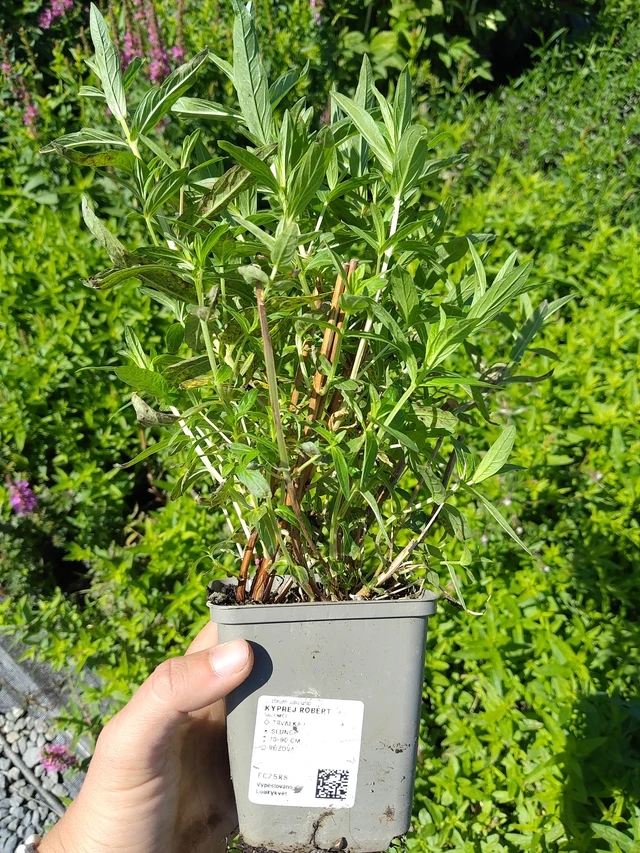
See how the seedling looks over the course of a year.


More products in category Loosestrife

Lythrum virgatum
Loosestrife Rose Queen

Lythrum salicaria
Loosestrife Pink Tails
Lythrum virgatum
Loosestrife Swirl

Lythrum virgatum
Loosestrife White Swirl
Lythrum salicaria
Loosestrife Blush

Lythrum salicaria
Loosestrife Lady Sackville

Lythrum virgatum
Loosestrife Dropmore Purple

Lythrum salicaria
Loosestrife Robin

Lythrum salicaria
Loosestrife Pink Blush
More products in category Perennials
Alchemilla mollis
Lady's mantle Irish Silk
Achillea millefolium
Yarrow Summer Pastels

Verbena bonariensis
Verbena

Salvia nemorosa
Woodland Sage Caradonna

Perovskia atriplicifolia
Russian Sage

Gaura lindheimeri
Gaura Siskiyou Pink

Echinacea purpurea
Coneflower Rubinstern

Echinacea pallida
Echinacea pallida

Eryngium planum
Sea Holly

Echinacea purpurea
Coneflower Magnus

Salvia nemorosa
Woodland Sage Ostfriesland

Calamintha nepeta
Calamint Blue Cloud

Rudbeckia fulgida
Rudbeckia Goldsturm
Calamintha nepeta ssp. nepeta
Calamint

Salvia nemorosa
Woodland Sage Amethyst

Gaura lindheimeri
Gaura Summer Breeze
Leucanthemum vulgare
Daisy Maikönigin

Achillea millefolium
Yarrow Terracotta

Perovskia atriplicifolia
Russian sage Little Spire
Salvia nemorosa


