Ireland
🟢 The e-shop for seedlings is open again. 🌱 I also have dahlia seedlings and eucalyptus. 🟢
Ireland
🟢 The e-shop for seedlings is open again. 🌱 I also have dahlia seedlings and eucalyptus. 🟢
Fountain grass Moudry, Loukykvět

Pennisetum alopecuroides

Fountain grass Moudry

Fountain grasses originate from East Asia, where they grow in meadows and light forests. They form hemispherical clumps of narrow leaves that, like the flowers, change color in autumn. They are suitable for vases and for drying. Moudry is a compact, lower-growing cultivar. The flowers are dark purple to almost black. The leaves are deep green. Show full description

Seedling

Květináč K9 (9×9×9,5 cm)
Seedling
Seedling
1-2 kusy
4,29/ks
3-8 kusů
3,89/ks
9-17 kusů
3,39/ks
18+ kusů
2,99/ks
Watch availability
Skladem 0 ks
Připravujeme 162 ks

Difficulty

Beginner

Diseases

Disease-free 🙂

Flower color

Brown

Flower color: Shade

Magenta

Foliage color

Yellow, green

Frost resistance

-28
?
The temperature down to which the plant is frost hardy.

Hardiness zone

5a (-28.9 °C to -26.1 °C)

Height

60-80 cm

Moisture

💧💧

Pests

Pest-free 🙂

Position

Sun, partial shade

Soil

Loamy, humus-rich, well-drained

Spacing

80-80 cm
?
Recommended planting spacing.

Spacing: Plants per m²

1

Species

Perennial

Suitable for cutting

Ano

Suitable for drying

Ano
1
2
3
4
5
6
7
8
9
10
11
12
Flowering
August
September

Recommended products

Feather grass Pony Tails, Loukykvět

Stipa tenuissima

Feather grass flowers capture attention in beds and bouquets with their lightness and delicacy. All feather grasses love full sun and dry, stony, well-drained soil. To look most natural in beds, it is good to plant them in loose groups of several pieces together with other drought-loving perennials and bulbs. Only then do their stems and inflorescences, set in motion by the slightest breath of wind, truly stand out. Stipa 'Ponny Tails' is a species native to the steppes of Mexico, Texas, and Patagonia. Airy, dense clumps of hair-like delicate leaves resemble horsehair. The leaves are green, turning up to straw-colored towards the flowers. In a suitable location, it also self-seeds.
3,79
More from 2,69
In Stock
Fountain grass viridescens, Loukykvět

Pennisetum alopecuroides var. viridescens

Fountain grasses originate from East Asia, where they grow in meadows and light forests. They form hemispherical clumps of narrow leaves which, like the flowers, color up in the autumn. They are suitable for the vase and for drying. We grow this cultivar for its distinctively dark flowers, which appear in large numbers especially after warm summers.
4,29
More from 2,99
In Stock
Fountain Grass Hameln Gold, Loukykvět

Pennisetum alopecuroides

Fountain grasses originate from East Asia, where they grow in meadows and light forests. They form semi-spherical clumps of narrow leaves which, like the flowers, color up in autumn. They are suitable for vases and for drying. The cultivar Hameln Gold turns golden yellow in autumn.
4,29
More from 2,99
In Stock
Russian Sage, Loukykvět

Perovskia atriplicifolia

Russian sage reliably brings a touch of sunny steppes into the garden and places almost no demands on care. These sparsely branched subshrubs originally come from harsh, rocky areas from Afghanistan to Tibet, where they grow on open sun-drenched plains. Thanks to its origin, it delights in full sun and poor, well-drained sandy soil with minimal moisture. You will receive from us a well-rooted seedling in a pot, which just needs to be transplanted straight to the chosen spot in the flower bed. It does not need support, is avoided by common pests and diseases, and will survive frosts down to minus twenty-eight degrees. It grows up to one hundred and twenty centimeters and forms striking white felted shoots with silvery grey aromatic leaves. From July to October, it blooms with tiny blue-purple flowers that act as a lure for bees and butterflies and are even edible. Russian sage stands out next to drought-tolerant perennials. The flowers are suitable for cutting and drying for winter arrangements. Moreover, the silvery stems will ensure a beautiful winter effect in the flower bed.
2,99
More from 2,09
In Stock
Gaura Siskiyou Pink, Loukykvět

Gaura lindheimeri

Gaura Siskiyou Pink is a charming perennial that brings lightness and airiness to the garden. Its original native area is in the warm regions of Texas and Louisiana, which is why it thrives in full sun and well-drained sandy soil. It grows in clumps and from June until the autumn frosts produces tiny raspberry-pink flowers that resemble fluttering butterflies. An interesting detail of this variety is the green leaves with a bronze tint and red spots. It is an absolutely undemanding plant, does not suffer from diseases or pests, and even beginners can handle its care. You will receive a grown seedling in a pot from us, which you simply need to transplant directly into the flowerbed. Here it complements ornamental grasses perfectly and acts as an attraction for bees and bumblebees. Although it grows more as a short-lived perennial in our climate, in a suitable place it reliably self-seeds. Occasional pinching will encourage richer branching. Gaura is excellent for summer bouquets. We cut the stems for a vase as soon as the first two to three little flowers open.
2,99
More from 2,09
In Stock
Coneflower Rubinstern, Loukykvět

Echinacea purpurea

A valuable garden and medicinal perennial, originally from North America. It blooms in summer with dark purple-pink flowers. The spiky flower discs are an irresistible lure for butterflies. Lasts 7–10 days in a vase. After plucking the petals, the stems with the central discs can be dried or used in fresh bouquets as an interesting element. Rubinstern is very similar to the Magnus cultivar; the petals are darker and firmer. As they fade, they gradually pale and droop downwards.
2,99
More from 2,09
In Stock
Fountain grass Cassian, Loukykvět

Pennisetum alopecuroides

Fountain grasses originate from East Asia, where they grow in meadows and light forests. They form hemispherical clumps of narrow leaves which, like the flowers, color up in autumn. They are suitable for vases and for drying. Cassian is a variety valued for early and exceptionally abundant flowering; early in autumn, it reliably turns golden-orange with a red tinge.
4,29
More from 4,29
Coming Soon
Autumn Moor Grass, Loukykvět

Sesleria autumnalis

Autumn moor grass is an exceptionally hardy ornamental grass that introduces fresh greenery to the garden right from early spring. Native to the rocky slopes of the Balkans, it is well-adapted to free-draining soils, making it an ideal choice for novice gardeners. It forms neat clumps growing thirty to fifty centimeters tall. Its greatest asset is its bright green foliage, which emerges early and remains in pristine condition in the borders well into winter. The plant is untouched by diseases or pests and handles severe frosts superbly. In August and September, delicate creamy-beige flowers appear above the foliage. These rather subtle spikelets give the plant an elegant, refined look. In the garden, it acts as a perfect filler perennial for sunny or partially shaded spots. It looks absolutely stunning paired with calamint, airy gaura, or flowering oregano. Its delicate flowers and leaves are easily used as foliage filler in fresh bouquets, or they can be dried for small-scale floristry projects.
3,79
More from 2,69
In Stock s doručením od 10. 8. 2026
Coneflower White Swan, Loukykvět

Echinacea purpurea

A valuable garden and medicinal perennial, native to North America. The spiky flower centers are an irresistible attraction for butterflies. They last 7–10 days in a vase. After removing the petals, the stems with the central disks can be dried or used in fresh bouquets as an interesting element. White Swan blooms with milky white flowers and brownish-orange centers. The petals are not spread entirely horizontally; they bend slightly downwards.
3,79
More from 3,89
In Stock s doručením od 10. 8. 2026
Woodland Sage Amethyst, Loukykvět

Salvia nemorosa

This species of sage originates from the steppe regions of Central and Eastern Europe. It forms profusely flowering small clumps with straight, upright stems. In flower beds, it looks best in groups. It is traditionally planted as a companion to roses due to the matching flowering time. However, it looks equally good in mixed drought-tolerant steppe plantings with grasses. It is an excellent food source for bees. Lasts 7 days in a vase. Amethyst is an elegant variety with long stems and a pink flower color that is unusual for sages.
2,99
More from 2,09
In Stock s doručením od 3. 8. 2026
Lady's mantle Irish Silk, Loukykvět

Alchemilla mollis

Alchemilla mollis, known as lady's mantle, is an indispensable perennial for anyone who wants to bring harmony and softness to the garden. Its home is the moister environments of mountain meadows and light forests, making it a very adaptable plant that will survive even severe frosts without problems in our climate. The 'Irish Silk' cultivar is prized for its vitality and abundant blooming, where clouds of tiny, yellow-green flowers float above clumps of gray-green leaves. It is precisely this neutral color that can work wonders in a flower bed – it softens overly sharp contrasts between other flowers and beautifully unifies the entire composition. Besides its ornamental function, lady's mantle also has practical uses. Thanks to its clumping growth and ability to quickly fill in, it is ideal for edging pathways or as an underplanting beneath taller shrubs and roses. Water droplets catch on its leaves, creating a magical spectacle in the garden. If you enjoy making bouquets, you will love lady's mantle as versatile filler greenery that matches almost anything. It will last beautiful for about ten days in a vase, and its inflorescences can also be easily dried without losing too much of their color or shape. Moreover, it is a magnet for pollinators, and its young leaves are even edible, so it also finds use in a natural kitchen.
2,99
More from 2,09
Coming Soon
Fountain grass Rubens, Loukykvět
New

Pennisetum

A fast-growing ornamental grass with strikingly colored dark burgundy foliage. It blooms from July to October with pink to burgundy spikes that gradually fade to beige. It is interesting not only for its flowers but also for its overall habit and striking color contrast.
4,29
More from 3,89
Unavailable
Pro rok 2026 nedostupné
Columbine Kristall, Loukykvět

Aquilegia vulgaris

The common columbine is a versatile perennial that will reliably inhabit both rural and modern flowerbeds. In the wild, it grows on the edges of forests and in light groves across all of Europe, which is why it thrives best in the garden in full sun to partial shade and ordinary loamy soil rich in humus. Its main charm lies in its unusually shaped flowers, but it is also valuable for its very early sprouting green leaves, which awaken the garden after winter. You will receive a beautifully grown seedling in a pot from us, which you just need to transplant to your chosen spot. Although the plant is poisonous, it represents a huge asset for gardeners. Even complete beginners can manage growing it, pests avoid it, and it easily survives severe frosts dropping to minus thirty-four degrees. During May and June, delicate flowers bloom on sturdy, sixty to eighty-centimeter-tall stems, bringing typical airiness and lightness to the planting. The 'Kristall' cultivar is a large-flowered variety that stands out with pure white flowers and prominent spurs. These act as a reliable magnet for bees, bumblebees, and other beneficial pollinators. Keep in mind that in a favorable location, columbine very willingly self-seeds, taking care of natural-looking wild stands. It works well in perennial beds and as an undergrowth beneath taller shrubs. If you like bringing a piece of the garden home, columbine certainly won't disappoint you. It is perfectly suited for cutting and will bring a novel structure to spring bouquets. Fresh flowers will bring you joy in a vase for about seven days. If you leave some of the flowers to finish blooming on the flowerbed, they will form interesting seed pods, which are highly popular among florists for creating various natural decorations and can also be dried well. Just watch out for the occasional occurrence of powdery mildew during the drier months, but otherwise, the plant needs almost no care.
2,79
More from 1,99
In Stock
Sedum Brilliant, Loukykvět

Sedum spectabile

A very hardy and long-lived perennial with an almost year-round effect. It forms upright clumps, and the flowers attract bees and butterflies. The cultivar Brilliant is characterized by shrubby growth and a distinct pink color.
2,99
More from 2,89
In Stock s doručením od 3. 8. 2026
Echinacea pallida, Loukykvět

Echinacea pallida

The pale coneflower is one of the exceptionally interesting prairie perennials of the North American continent. In its natural environment, it grows on open, sunny plains, which is why it thrives best in our gardens in full sun in drier, well-drained soil. You just need to transplant this grown seedling straight into the flower bed, where it will reliably take root. It does not need support, easily withstands severe frosts, and is avoided by common diseases and pests, making it ideal for beginner growers. During June and July, it will reward you with aromatic flowers with unusually narrow and drooping petals in light purple and pink tones. The prominent prickly centers are literally a magnet for bees and bumblebees, and the flowers themselves are surprisingly edible. The plant stands out especially in rustic plantings together with ornamental grasses. Gardeners and florists love it for its versatility. The fresh stems bring joy in a vase for about a week. Moreover, the distinctive central cones hold their shape perfectly, can be perfectly dried for winter decorations, or left in the flower bed, where they will create an eye-catching winter structure under a layer of snow.
2,99
More from 2,09
In Stock s doručením od 24. 8. 2026
Feather Reed Grass Karl Förster, Loukykvět

Calamagrostis acutiflora

A tufted, upright growing grass. It sprouts very early. It is decorative due to its overall vertical habit and fine flower panicles, which bloom silvery-grey, turn yellow in summer, and transition to sandy beige. It decorates the garden until winter. You can plant it in mixed beds or use it as an element to rhythmically divide the space. Usable for bouquets and drying.
4,29
More from 3,89
In Stock
Astilbe Peach Blossom, Loukykvět

Astilbe japonica

Delicate, decorative, long-lived shade-loving perennials with pinnate leaves and magnificent feathery inflorescences. They originate primarily from East Asia, but also from eastern North America. They look best in mass plantings. Due to relatively late sprouting, it is good to combine them with early-flowering bulbs. Lasts 4–10 days in a vase. Harvest as soon as half of the inflorescence is in bloom. They are very sensitive to ethylene released from ripening fruit. Peach Blossom has soft pink flowers.
3,89
More from 2,89
In Stock
Verbena, Loukykvět

Verbena bonariensis

A verbena species originally from South America. In our country, it is often used as an annual, but in mild winters it can overwinter and reproduce by self-seeding. The firm, airy stems beautifully soften perennial beds and make them special with their purple color. It beautifully complements steppe plantings with grasses and rose beds.
3,29
More from 2,29
In Stock
Shoofly plant Blue, Loukykvět

Catananche caerulea

Catananche caerulea, commonly known as Cupid's dart, is a charming plant that will win you over with its lightness and airiness. Its scientific name refers to ancient Greek legends, according to which it was used in love potions; today, however, you will appreciate it more for its undemanding nature and unique appearance. It is excellently suited for natural-style gardens, gravel beds, and drought-tolerant plantings, where it beautifully complements other perennials or ornamental grasses. It grows up to ninety centimeters tall and, despite its height, needs no support. The flowers have a lavender-blue color with a darker center and toothed petals at the ends. They bloom gradually from June to September. Cupid's dart loves drought and heat, but on the contrary, it cannot stand winter dampness, which harms it more than frost. If you provide it with a well-drained spot, it will survive temperatures down to -18 °C. It is a rewarding plant for beginner growers and experienced florists alike. Fresh flowers last a week in a vase, but they will bring you the most joy when dried. Harvest them fully open in dry weather and hang them upside down. They will keep their shape and remind you of summer all winter long.
2,79
More from 1,99
In Stock
Northern Sea Oats, Loukykvět

Chasmanthium latifolium

Chasmanthium is one of the most charming ornamental grasses, bringing movement and a gentle rustling sound to the garden. It originates from the eastern part of North America, where it naturally grows in light, damp forests or on the banks of streams, so it is best suited to partial shade and humous, non-drying soil. Its greatest adornments are the flat spikelets resembling small fish, which hang from arched, drooping stems and change color throughout the season from fresh green through beige to warm copper tones, while the leaves turn golden-yellow in autumn. Chasmanthium is an excellent choice for cutting into fresh bouquets, where it adds airiness, and it looks even better dried, retaining its shape and color for a long time. Furthermore, it is a fully frost-hardy perennial that easily handles winters and will please any grower with its low-maintenance nature.
3,79
More from 2,69
In Stock
Panicle Hydrangea Candlelight, Loukykvět

Hydrangea paniculata

Panicle hydrangeas are beautiful shrubs native to China and Japan, where their bark was used, among other things, to make paper. We grow them for their impressive conical inflorescences. They are undemanding and abundantly blooming plants suitable for planting in flower beds and larger containers. Candlelight has conical inflorescences with creamy yellow flowers that gradually transition to soft pink.
5,39
More from 4,09
In Stock
Aster Pink Star, Loukykvět

Aster pringlei

Forms a delicate, airy bush. Compared to Aster ericoides, the flowers are less numerous, placed singly at the ends of branch tips, which gives the plant an airy effect. The plant has a very delicate appearance. It is beautiful in combination with other late asters and ornamental grasses. Healthy and long-blooming, the pink flower is slightly larger than that of Aster ericoides. Lasts 7 to 10 days in a vase.
2,99
More from 2,09
In Stock
Columbine White Barlow, Loukykvět

Aquilegia vulgaris

The common columbine is a popular and versatile perennial that inherently belongs in both rustic and modern gardens. In the wild, it grows on forest edges and clearings throughout Europe, so a sunny or partially shaded spot with slightly moist, loamy, and humus-rich soil will suit it best in your garden. You will receive a grown seedling in a pot from us, which you simply need to transplant into a flowerbed. There, it will become a valuable element early in the spring thanks to its early sprouting green leaves. The flowers themselves then enter the scene in May and June. Although it is a short-lived perennial, it reliably self-seeds in a suitable location, so you definitely won't lose it in your garden. Columbine flowers act as a great attraction for bees and bumblebees, and the entire plant is absolutely low-maintenance, making it easy to grow even for beginners. It does not require support and can withstand very severe frosts dropping below thirty degrees. The 'White Barlow' cultivar stands out with an unmistakable appearance; its pure white, double flowers bring airiness and lightness to any planting. It grows to a height of about sixty to eighty centimeters and grows nicely in clumps. Columbines are excellently applied in wild natural plantings as well as thoughtfully planned perennial compositions. The double flowers of the 'White Barlow' variety look magnificent not only in the flowerbed but also in fresh bouquets, to which they add a tender and romantic element. For cutting, it is best to choose freshly opened blooms, and they will last about seven days in a vase. Since the plant is not suitable for drying and all its parts are poisonous, it will bring you joy primarily outdoors in the garden or in the aforementioned spring vases. During the season, just occasionally check if it is bothered by aphids or powdery mildew; otherwise, it needs no special attention.
2,79
More from 1,99
Coming Soon
Japanese Anemone Andrea Atkinson, Loukykvět

Anemone hybrida

Anemones come from the same family as buttercups. With their elegant flowers on long slender stems, they can enliven and brighten up late summer and autumn flowerbeds. They stand out against the darker background of shrub groups and will also appreciate their partial shade. The Czech Perennial Association chose autumn anemones as the perennial of the season for 2022. They last 7 days in a vase. Andrea Atkinson is a tender cultivar of autumn anemone with white petals.
3,89
More from 3,59
In Stock
Fountain grass Hameln, Loukykvět

Pennisetum alopecuroides

Fountain grasses originate from East Asia, where they grow in meadows and light forests. They form hemispherical clumps of narrow leaves which, like the flowers, color up in the autumn. They are suitable for the vase and for drying. The 'Hameln' cultivar is one of the most reliable bloomers in cooler regions. The inflorescences initially have a soft pink tinge, then change color to yellow-brown or reddish-brown.
4,29
More from 3,89
In Stock
Baptisia australis, Loukykvět

Baptisia australis

Baptisia comes from North America, belongs to the legume family, and resembles lupine in appearance. Unlike lupine, however, it does not suffer from fungal diseases and does not taste as good to slugs. Besides the blue flowers, the large pods that adorn the plant long after flowering are interesting. North American Indians used Baptisia roots to disinfect wounds and lower fever, and leaves to dye fabrics. With Baptisia, patience is most important; it takes some time to fully establish and create a massive root system adapted to survive long periods of drought and fire. Then it is very long-lived. It was chosen as the Perennial of the Year for the 2019 season.
5,39
More from 4,09
In Stock
Meadow Sage Rose Rhapsody, Loukykvět

Salvia pratensis

Meadow sage occurs here primarily in warmer regions, especially in southern Moravia and northern and central Bohemia. It grows on sunny meadows and hillsides and along paths. Fragrant leaves form a basal rosette, from which several less leafy branched stems grow. The inflorescences are composed of striking bilabiate flowers, which are a great attraction for bees and bumblebees. Rose Rhapsody has light pink flowers.
2,79
More from 1,99
Coming Soon
Daisy Christine Hagemann, Loukykvět

Leucanthemum

A classic perennial for early summer bouquets and cottage gardens. For bouquets, we harvest flowers with firm, smooth central discs. Then they last 7–10 days in a vase. Daisy Christine Hagemann has large, pure white, and double flowers.
2,99
More from 2,09
Coming Soon

Cultivation

Nejlépe se mu daří v teple, na plném slunci v dobře propustné, na živiny spíše bohaté půdě. Poměrně pozdě raší a do doby, než vykvete, nevypadá na záhonech nijak nápadně. Je dobré ho proto kombinovat například s narcisy. Pokud začnou dochany časem méně kvést, je třeba trsy rozdělit a přesadit na jiné místo. Dobře se pěstuje i v dostatečně velkém květináči (objem alespoň 15 litrů).

The information given is based on our experience, please use it as a guide only. Times may vary depending on the season, climate, location, sowing and transplanting dates and possibly also the conditions in the greenhouse/greenhouse. We always recommend testing how the plant performs in your conditions. Please do not take this as a guarantee.

Show all

Click to view the full growing instructions.

Photos
in time

See how the seedling looks over the course of a year.
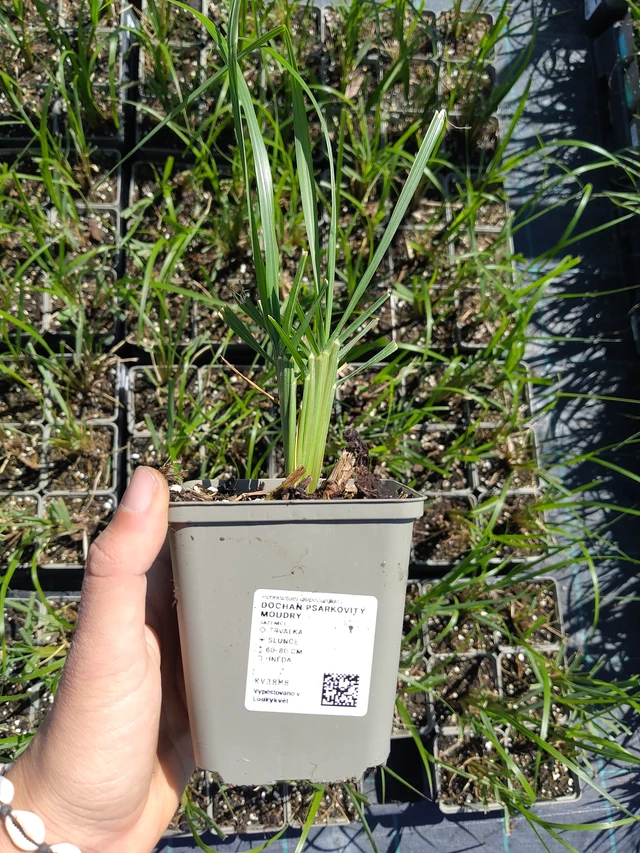
Fountain grass Moudry - 13. 5. 2025
13. 5. 2025
Fountain grass Moudry - 2024
2024

More products in category Fountain grass

Fountain grass Hameln, Loukykvět

Pennisetum alopecuroides

Fountain grasses originate from East Asia, where they grow in meadows and light forests. They form hemispherical clumps of narrow leaves which, like the flowers, color up in the autumn. They are suitable for the vase and for drying. The 'Hameln' cultivar is one of the most reliable bloomers in cooler regions. The inflorescences initially have a soft pink tinge, then change color to yellow-brown or reddish-brown.
4,29
More from 3,89
In Stock
Fountain Grass Hameln Gold, Loukykvět

Pennisetum alopecuroides

Fountain grasses originate from East Asia, where they grow in meadows and light forests. They form semi-spherical clumps of narrow leaves which, like the flowers, color up in autumn. They are suitable for vases and for drying. The cultivar Hameln Gold turns golden yellow in autumn.
4,29
More from 2,99
In Stock
Fountain grass Cassian, Loukykvět

Pennisetum alopecuroides

Fountain grasses originate from East Asia, where they grow in meadows and light forests. They form hemispherical clumps of narrow leaves which, like the flowers, color up in autumn. They are suitable for vases and for drying. Cassian is a variety valued for early and exceptionally abundant flowering; early in autumn, it reliably turns golden-orange with a red tinge.
4,29
More from 4,29
Coming Soon
Fountain Grass, Loukykvět

Pennisetum alopecuroides

Fountain grasses originate from East Asia, where they grow on meadows and in light forests. They form hemispherical clumps of narrow leaves, which, like the flowers, gain color in the autumn. They are suitable for vases and for drying.
4,29
More from 2,99
In Stock s doručením od 17. 8. 2026
Fountain grass viridescens, Loukykvět

Pennisetum alopecuroides var. viridescens

Fountain grasses originate from East Asia, where they grow in meadows and light forests. They form hemispherical clumps of narrow leaves which, like the flowers, color up in the autumn. They are suitable for the vase and for drying. We grow this cultivar for its distinctively dark flowers, which appear in large numbers especially after warm summers.
4,29
More from 2,99
In Stock
Fountain grass Rubens, Loukykvět
New

Pennisetum

A fast-growing ornamental grass with strikingly colored dark burgundy foliage. It blooms from July to October with pink to burgundy spikes that gradually fade to beige. It is interesting not only for its flowers but also for its overall habit and striking color contrast.
4,29
More from 3,89
Unavailable
Pro rok 2026 nedostupné
Fountain grass Rubrum, Loukykvět

Pennisetum

A fast-growing ornamental grass with strikingly colored dark burgundy foliage. It blooms from July to October with pink to burgundy spikes that gradually fade to beige. It is interesting not only for its flowers but also for its overall habit and striking color contrast.
4,29
More from 3,89
In Stock s doručením od 3. 8. 2026

More products in category Ornamental grasses

Feather grass Pony Tails, Loukykvět

Stipa tenuissima

Feather grass flowers capture attention in beds and bouquets with their lightness and delicacy. All feather grasses love full sun and dry, stony, well-drained soil. To look most natural in beds, it is good to plant them in loose groups of several pieces together with other drought-loving perennials and bulbs. Only then do their stems and inflorescences, set in motion by the slightest breath of wind, truly stand out. Stipa 'Ponny Tails' is a species native to the steppes of Mexico, Texas, and Patagonia. Airy, dense clumps of hair-like delicate leaves resemble horsehair. The leaves are green, turning up to straw-colored towards the flowers. In a suitable location, it also self-seeds.
3,79
More from 2,69
In Stock
Autumn Moor Grass, Loukykvět

Sesleria autumnalis

Autumn moor grass is an exceptionally hardy ornamental grass that introduces fresh greenery to the garden right from early spring. Native to the rocky slopes of the Balkans, it is well-adapted to free-draining soils, making it an ideal choice for novice gardeners. It forms neat clumps growing thirty to fifty centimeters tall. Its greatest asset is its bright green foliage, which emerges early and remains in pristine condition in the borders well into winter. The plant is untouched by diseases or pests and handles severe frosts superbly. In August and September, delicate creamy-beige flowers appear above the foliage. These rather subtle spikelets give the plant an elegant, refined look. In the garden, it acts as a perfect filler perennial for sunny or partially shaded spots. It looks absolutely stunning paired with calamint, airy gaura, or flowering oregano. Its delicate flowers and leaves are easily used as foliage filler in fresh bouquets, or they can be dried for small-scale floristry projects.
3,79
More from 2,69
In Stock s doručením od 10. 8. 2026
Feather Reed Grass Karl Förster, Loukykvět

Calamagrostis acutiflora

A tufted, upright growing grass. It sprouts very early. It is decorative due to its overall vertical habit and fine flower panicles, which bloom silvery-grey, turn yellow in summer, and transition to sandy beige. It decorates the garden until winter. You can plant it in mixed beds or use it as an element to rhythmically divide the space. Usable for bouquets and drying.
4,29
More from 3,89
In Stock
Fountain grass Hameln, Loukykvět

Pennisetum alopecuroides

Fountain grasses originate from East Asia, where they grow in meadows and light forests. They form hemispherical clumps of narrow leaves which, like the flowers, color up in the autumn. They are suitable for the vase and for drying. The 'Hameln' cultivar is one of the most reliable bloomers in cooler regions. The inflorescences initially have a soft pink tinge, then change color to yellow-brown or reddish-brown.
4,29
More from 3,89
In Stock
Tufted Hairgrass Goldschleier, Loukykvět

Deschampsia cespitosa

Tufted hairgrass is an undemanding native grass that remains green even in winter. In nature, it grows in meadows and forest clearings. It forms a compact tuft of leaves, from which grow fine, thin stems with transparent clouds of flowers. It adapts even to more difficult conditions, such as dry shade or compacted soil, and can handle waterlogging. Goldschleier has very tiny spikelets in light yellow panicles. The inflorescence forms a fluffy light yellow cloud above the tuft of leaves.
3,79
More from 2,69
In Stock
Dropseed, Loukykvět

Sporobolus heterolepis

Prairie dropseed originates from the vast North American prairies, where it forms a natural part of the wild and unbridled landscape. This ornamental grass grows in neat and very dense clumps of fresh green leaves, which turn bright yellow shades in autumn. During August and September, delicate clouds of pink and beige flowers hover above the clumps on sturdy stalks, reaching a height of up to seventy centimeters. The flowers also spread a very pleasant and unmistakable fragrance into their surroundings. In the garden, prairie dropseed stands out best when planted in a sunny spot in groups of multiple plants accompanied by other drought-tolerant perennials, with which it will create an impressive steppe scenery. The seedlings do not require any complicated care, they easily handle frosts down to minus twenty-eight degrees, and do not suffer from any diseases or pests. The airy and fragrant inflorescences are also perfectly suited for cutting into summer bouquets, to which they add unusual lightness and texture.
4,29
More from 2,99
In Stock s doručením od 7. 9. 2026
Tufted hairgrass Palava, Loukykvět

Deschampsia cespitosa

Tufted hairgrass is an undemanding native grass that remains green even in winter. In nature, it grows in meadows and forest clearings. It forms a neat clump of leaves, from which grow delicate thin stems with transparent clouds of flowers. It adapts even to more difficult conditions, such as dry shade or compacted soil, and can handle waterlogging too. The Czech cultivar 'Pálava' is valuable for its extra-long flowering time from July to October. Unlike other cultivars, its flowers are sterile and do not create any seedlings. It is stated that it resists drought best of all tufted hairgrasses.
3,49
More from 2,39
In Stock posledních 80 kusů
Blue Moor Grass, Loukykvět

Sesleria caerulea

Blue moor grass is an elegant and undemanding native grass that livens up the spring garden at a time when other plants are just waking up. In the wild, it naturally grows in warmer areas on rocks and sunny slopes with well-drained soil. It forms dense, neat clumps growing to a height of about thirty centimeters. Its main advantage is its striking grayish-green and dark green leaves, which, with sufficient moisture, remain evergreen all year round. During April and May, the moor grass blooms with interesting brown spikelets. Over time, these flowers naturally fade into soft beige tones, and when dried, they are perfectly suited as a delicate addition to small dry arrangements. In flowerbeds, it represents an ideal companion for spring bulbs, with which it forms very harmonious compositions. Cultivation can easily be managed even by a beginner, as the plant does not suffer from any diseases or pests and can withstand frosts down to minus twenty-eight degrees without damage. Simply transplant the supplied mature seedling to a sunny or partially shaded location, ideally maintaining a planting distance of around forty centimeters.
4,29
More from 2,99
In Stock posledních 57 kusů
Feather Reed Grass Overdam, Loukykvět

Calamagrostis acutiflora

A tufted, upright growing grass. It sprouts very early. Decorative with its overall vertical habit and fine panicles of flowers, which bloom silvery grey. Striking with its white variegated leaves. It adorns the garden until winter. You can plant it in mixed beds or use it as an element rhythmically dividing the space. Usable for bouquets and drying.
4,29
More from 3,89
In Stock
Muhly grass Ruby, Loukykvět

Muhlenbergia capillaris

A beautiful fine grass originating from the southern parts of North America. It has narrow gray-green leaves. The flowers bloom in fluffy clouds of deep pink color, creating the impression of a light haze over the flower bed. Beautiful for bouquets too.
3,79
More from 2,69
In Stock
Switchgrass Northwind, Loukykvět

Panicum virgatum

A perennial grass native to North American prairies. Switchgrass is very adaptable and long-lived. It adds clear structure to flower beds while also functioning as a softening element. This happens mainly after the veil-like flowers appear above the clumps of leaves. Northwind is a cultivar with an upright and slender growth habit. Its grey-blue-green leaves turn bright golden in the autumn.
4,29
More from 2,99
In Stock
Fountain Grass Hameln Gold, Loukykvět

Pennisetum alopecuroides

Fountain grasses originate from East Asia, where they grow in meadows and light forests. They form semi-spherical clumps of narrow leaves which, like the flowers, color up in autumn. They are suitable for vases and for drying. The cultivar Hameln Gold turns golden yellow in autumn.
4,29
More from 2,99
In Stock
Lovegrass, Loukykvět

Eragrostis spectabilis

Lovegrass originates from the sun-drenched plains of North America, where it naturally grows on dry and well-drained soils. This undemanding tufted grass is an ideal choice for beginner growers, as it does not suffer from any diseases or pests and easily handles frosts down to minus twenty-three degrees. During the season, its green leaves will catch your eye, gradually acquiring a warm orange to wine-red hue as autumn approaches. It stands out primarily in group plantings or in combination with drought-tolerant perennials, where it can beautifully soften and visually connect the entire composition. The real magic, however, lies in its blooming. During August and September, it creates literal clouds of tiny pink flower panicles above the leaf clumps, hovering at a height of around fifty centimeters. For its airiness and elegance, lovegrass is also exceptionally popular for cutting. Florists love to use it in summer and autumn bouquets, to which it adds lightness and volume. It is also perfect for drying, so you can preserve its charm for winter arrangements as well.
3,79
More from 2,69
In Stock
Melic grass Silky, Loukykvět

Melica ciliata

Melica ciliata grows wild on sunny and warm stony slopes. It blooms as early as May to June with creamy to silvery-white panicles; as they fade, they turn gray and thus harmonize with the gray-green leaves. Valuable for florists due to its early flowering and usability in both fresh and dried states.
3,79
More from 2,69
In Stock
Muhly grass Rosy, Loukykvět

Muhlenbergia reverchonii

A beautiful fine grass originating from Oklahoma and Texas. It has narrow gray-green leaves. The flowers bloom in fluffy clouds of pink color, creating the impression of a light haze over the flower bed. Beautiful for bouquets too.
3,79
More from 2,69
Unavailable
Pro rok 2026 nedostupné
Feather grass, Loukykvět

Stipa capillata

Feather grass flowers captivate in beds and bouquets with their lightness and delicacy. All Feather grasses love full sun and dry, stony, well-drained soil. To look most natural in beds, it is good to plant them in several pieces in loose groups together with other drought-loving perennials and bulbs. Only then will their stems and inflorescences, set in motion by the slightest breeze, stand out. *Stipa capillata* is a native steppe grass also widespread elsewhere in southern, central, and eastern Europe. It forms solid grey-green clumps with upright stems. The flowers, in the form of beige awns, stand almost horizontally away from the stem when ripening and twist interestingly.
4,29
More from 2,99
In Stock s doručením od 14. 9. 2026
Tufted hairgrass Tardiflora, Loukykvět

Deschampsia cespitosa

Tufted hairgrass is an undemanding native grass that remains green even in winter. In nature, it grows in meadows and forest clearings. It forms a neat clump of leaves, from which grow delicate thin stems with transparent clouds of flowers. It adapts even to more difficult conditions, such as dry shade or compacted soil, and can handle waterlogging too. 'Tardiflora' is, after 'Pálava', one of the most richly flowering tufted hairgrasses. It blooms a bit later than the others.
3,49
More from 2,39
In Stock
Tufted hairgrass Schottland, Loukykvět

Deschampsia cespitosa

Tufted hairgrass is an undemanding native grass that remains green even in winter. In nature, it grows in meadows and forest clearings. It forms a neat clump of leaves, from which grow delicate thin stems with transparent clouds of flowers. It adapts even to more difficult conditions, such as dry shade or compacted soil, and can handle waterlogging too. The flowers of the 'Schottland' cultivar are brown at the beginning of flowering, later turning gold. The leaf clumps grow up to 60 centimeters, the flower stems up to 120.
3,49
More from 2,39
In Stock
Quaking grass Limouzi, Loukykvět

Briza media

Quaking grass 'Limouzi' is an undemanding and very charming native grass that naturally grows in sunny meadows and pastures with poorer and well-drained soil. From May onwards, long thin stalks sprout from its dense green clumps, carrying delicate spikelets in the shape of small hearts swaying on them. They are colored in inconspicuous green and brown tones. It is their constant movement and rustling at the slightest breeze that gives the flower beds extraordinary dynamics and lightness. This short-lived perennial, growing to a height of around half a meter, is perfectly suited to complement colorful steppe plantings, where it creates a soft filler between more prominently flowering species. It will also find its use among beginner growers, as it does not suffer from diseases or pests and handles strong frosts without problems. The airy inflorescences of quaking grass are perfect for cutting into summer bouquets and for drying for various floristry purposes. After blooming, roughly at the end of summer, it is good to trim the clumps, which will encourage their fresh appearance. The 'Limouzi' cultivar is characterized by its abundant flower set and slightly more compact growth, which maintains its shape even in more demanding conditions.
3,49
More from 2,39
Coming Soon
Quaking grass Tinkerbell, Loukykvět

Briza media

Quaking grass 'Tinkerbell' is an undemanding native grass whose delicate appearance will enchant in any natural garden. It naturally grows in drier meadows across Europe, where it seeks poorer and well-drained soils. It easily handles less nutritious substrates, does not suffer from diseases, and effortlessly survives severe frosts. It forms dense green clumps from which thin stalks carrying unmistakable inflorescences sprout from May to July. The tiny spikelets in the shape of small plump hearts play with yellow and brown tones. They are famous for their trembling at the slightest breeze, which adds dynamics and lightness to flower beds. The compact 'Tinkerbell' variety grows to a height of fifty centimeters and behaves as a short-lived perennial. It perfectly complements drought-tolerant perennials in full sun. It remains very attractive until August, when it is good to trim it after blooming. For florists, it is an absolute treasure. The stalks are beautiful in fresh summer bouquets and are perfectly suited for drying, retaining their shape long-term in floristry arrangements.
3,49
More from 2,39
Coming Soon