
Eucalyptus cinerea
Eucalyptus Silver Dollar
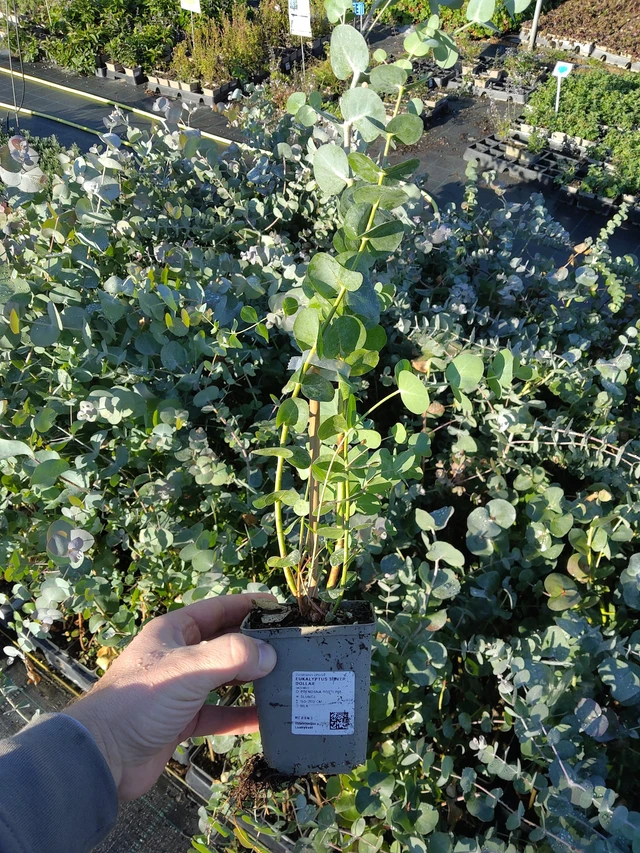
Seedling


Attracts pollinators 🐝
Difficulty
Diseases
Edible
Flower color
Flower color: Shade
Foliage color
Fragrant (aromatic) 👃
Frost resistance
Hardiness zone
Height
Moisture
Pests
Position
Soil
Spacing
Spacing: Plants per m²
Species
Suitable for cutting
Suitable for drying
Recommended products

Eucalyptus pulverulenta
Eucalyptus Baby Blue

Lavandula angustifolia
Lavender Rosea

Eucalyptus citriodora
Lemon Eucalyptus

Salvia nemorosa
Woodland Sage Ostfriesland

Achillea millefolium
Yarrow Summer Pastels

Erigeron karvinskianus
Fleabane Blütenmeer

Helleborus orientalis
Hellebore Double Ellen Yellow Spotted

Hydrangea arborescens
Smooth Hydrangea Annabelle

Gypsophila paniculata
Baby's Breath Snowflake

Salvia nemorosa
Woodland Sage Schneehügel

Achillea millefolium
Yarrow Lachsschönheit

Alchemilla mollis
Lady's mantle Irish Silk

Achillea millefolium
Yarrow Cassis

Anemone hybrida
Japanese Anemone Whirlwind

Helleborus orientalis
Hellebore Double Ellen White

Brunnera sibirica
Siberian Bugloss

Rosmarinus officinalis
Rosemary Blue Rain

Cosmos atrosanguineus
Chocolate Cosmos

Hydrangea paniculata
Panicle Hydrangea Silver Dollar

Verbena bonariensis
Verbena

Helleborus orientalis
Hellebore Double Ellen Picotee

Achillea millefolium
Yarrow Terracotta

Achillea filipendulina
Yarrow Parkers Varietät

Lavandula intermedia
Lavender Alba

Narcissus
Narcissus Ice King

Phlomis russeliana
Phlomis Russeliana

Limonium sinuatum
Statice QIS Pastel

Euphorbia myrsinites
Myrtle spurge

Hydrangea paniculata
Panicle Hydrangea Candlelight

Thymus vulgaris
Thyme Compactus
Cultivation
You will receive Eucalyptus Silver Dollar as a healthy, well-rooted seedling, which is best grown as a portable plant in a spacious container in our climate. This attractive, long-lived perennial literally loves full sun and will thrive on hot, sunny balconies or south-facing terraces. When planting in a pot, remember that eucalyptus strictly requires very well-drained soil; heavy, water-retentive soil would be harmful. If repotting is necessary, mix standard potting soil with sand to ensure optimal drainage. If you are planting the seedlings into larger outdoor troughs for the summer season, maintain a spacing of 80–100 centimeters (approximately 1-2 plants per square meter) so that each plant has enough space for free air circulation and healthy growth.
Watering requires a little practice at first; water the eucalyptus evenly. It dislikes overwatering, but long periods of the root ball drying out are also not beneficial. The surface of the soil should dry out slightly between waterings so the roots can breathe freely. During the main growing season, the rule is to fertilize older plants once every 14 days from April to August with a liquid fertilizer containing potassium. This will effectively support not only overall vitality and tissue strength but also the typical silvery-green color of the leaves. Fortunately, the plant does not suffer from any common diseases, and pests avoid it as well, so you will easily save time and money on preventive sprays. However, always keep in mind that eucalyptus is poisonous if ingested, so it is best to place it out of the reach of small children and free-roaming pets.
To ensure the plant maintains a highly compact and dense shape over the long term, regular pinching of the shoots is recommended for dense and even growth. This light pruning will also reliably support overall vitality and provide you with beautiful decorative material. The clipped branches with round leaves are highly aromatic and perfect for vases or for drying. Because the overall frost resistance of this exotic species in our region is limited to short-term temperatures down to -6 °C (zone 9a), it is absolutely essential to move the eucalyptus indoors from its outdoor location before the first autumn frosts arrive. Ideally, it should spend the winter in a frost-free, bright space, such as a glassed-in winter garden or a cool, glassed-in hallway, while significantly reducing watering to a bare minimum during this dormant period.
The information given is based on our experience, please use it as a guide only. Times may vary depending on the season, climate, location, sowing and transplanting dates and possibly also the conditions in the greenhouse/greenhouse. We always recommend testing how the plant performs in your conditions. Please do not take this as a guarantee.
Will Eucalyptus Silver Dollar survive a Czech winter outdoors in the garden?
Should I prune the plant to make it nice and bushy?
Does the eucalyptus grow to a large size and will it need support?
How many seedlings can I plant close together if I want to put them in a large window box?
How should I water the eucalyptus correctly?
Frequently asked questions
Characteristics
Does the plant have a typical scent, is it aromatic?
Does this eucalyptus bloom? If so, what color and when?
Is this plant safe for dogs, cats, and other pets?
Harvest
Can the cut stems be used in vases or dried in some way?
Planting site
What kind of location should I place the eucalyptus seedling in?
Interesting facts
Why is this interesting variety called Silver Dollar?
Growing
How often and with exactly what should I fertilize the eucalyptus?
What kind of soil should I transplant the seedling into after purchase?
Diseases & pests
Does the eucalyptus often suffer from any pests or leaf diseases?
Troubleshooting
Why have the leaves on my eucalyptus suddenly started drying up and falling off?
Photos in time
See how the seedling looks over the course of a year.


More products in category Eucalyptus
Eucalyptus pulverulenta
Eucalyptus Baby Blue

Eucalyptus websteriana
Eucalyptus Heart
Eucalyptus citriodora
Lemon Eucalyptus
More products in category Perennials
Alchemilla mollis
Lady's mantle Irish Silk
Achillea millefolium
Yarrow Summer Pastels
Verbena bonariensis
Verbena

Salvia nemorosa
Woodland Sage Caradonna

Perovskia atriplicifolia
Russian Sage

Gaura lindheimeri
Gaura Siskiyou Pink

Echinacea purpurea
Coneflower Rubinstern

Echinacea pallida
Echinacea pallida
Salvia nemorosa
Woodland Sage Ostfriesland

Eryngium planum
Sea Holly

Echinacea purpurea
Coneflower Magnus

Calamintha nepeta
Calamint Blue Cloud

Rudbeckia fulgida
Rudbeckia Goldsturm

Calamintha nepeta ssp. nepeta
Calamint

Gaura lindheimeri
Gaura Summer Breeze

Salvia nemorosa
Woodland Sage Amethyst

Leucanthemum vulgare
Daisy Maikönigin
Achillea millefolium
Yarrow Terracotta

Perovskia atriplicifolia
Russian sage Little Spire
Salvia nemorosa


