

Rosmarinus officinalis
Rosemary Blue Rain
Seedling
Attracts pollinators 🐝
Difficulty
Diseases
Edible
Flower color
Flower color: Shade
Foliage color
Fragrant (aromatic) 👃
Frost resistance
Hardiness zone
Height
Moisture
Pests
Position
Soil
Spacing
Spacing: Plants per m²
Recommended products

Achillea millefolium
Yarrow Summer Pastels

Sedum spectabile
Sedum Matrona

Leucanthemum vulgare
Daisy Maikönigin

Salvia nemorosa
Woodland Sage Ostfriesland

Mentha spicata
Moroccan mint

Sanguisorba officinalis
Great Burnet

Mentha spicata
Lemon mint

Mentha piperita
Mint Eau de Cologne

Anemone hybrida
Japanese Anemone Serenade

Thymus citriodorus
Thyme Silver King

Hydrangea arborescens
Smooth Hydrangea Annabelle

Achillea millefolium
Yarrow Lilac Beauty

Sedum telephium
Sedum Herbstfreude

Verbena bonariensis
Verbena

Achillea millefolium
Yarrow Terracotta

Thymus citriodorus
Thyme Doone Valley

Thymus vulgaris
Thyme Compactus

Origanum laevigatum
Oregano Herrenhausen

Salvia gregii
Salvia Joy

Papaver orientale
Oriental Poppy Royal Wedding

Echinops bannaticus
Globe thistle Blue Glow

Achillea millefolium
Yarrow Cassis

Artemisia ludoviciana
Artemisia Silver Queen

Deschampsia cespitosa
Tufted hairgrass Palava

Alchemilla mollis
Lady's mantle Irish Silk

Eucalyptus pulverulenta
Eucalyptus Baby Blue

Pennisetum alopecuroides
Fountain Grass Hameln Gold

Aster ericoides
Aster Schneetanne

Gypsophila paniculata
Baby's Breath Snowflake

Perovskia
Russian Sage Blue Spire
Cultivation
Rosemary 'Blue Rain' is a beautiful and very practical creeping cultivar that, thanks to its low-maintenance nature, is an absolutely ideal choice even for a complete beginner. Since this aromatic plant comes from the Mediterranean and North Africa, it loves hot, sunny spots and full sun all day long. Whether you decide to grow the seedling in a garden bed or on a balcony, the foundation of success is proper soil preparation. It requires lean and, above all, highly permeable soil. We highly recommend creating a thick drainage layer at the bottom of the planting hole or container, composed of pebbles, gravel, or expanded clay. You can then mix the substrate itself with pure sand or small stones for even better aeration and lightness. This step is crucial because water must not stay at the roots for long, otherwise, they could quickly rot.
Always plant the seedling with enough room to grow. The ideal spacing is around 50 centimeters, which in practice means about 3 to 5 plants per square meter. This generous spacing is very important to ensure good air circulation between the plants, which acts as the best natural prevention against fungal diseases, such as annoying powdery mildew. Rosemary is well-accustomed to drought from its homeland, so keep watering moderate and very careful. Water more heavily only when the top layer of soil has visibly dried out. Waterlogging is clearly its biggest enemy. Since it is a plant originally accustomed to rocky and very poor soils, it hardly needs fertilizing during the season. Alternatively, a very weak dose of natural herb fertilizer applied at the beginning of spring will suffice.
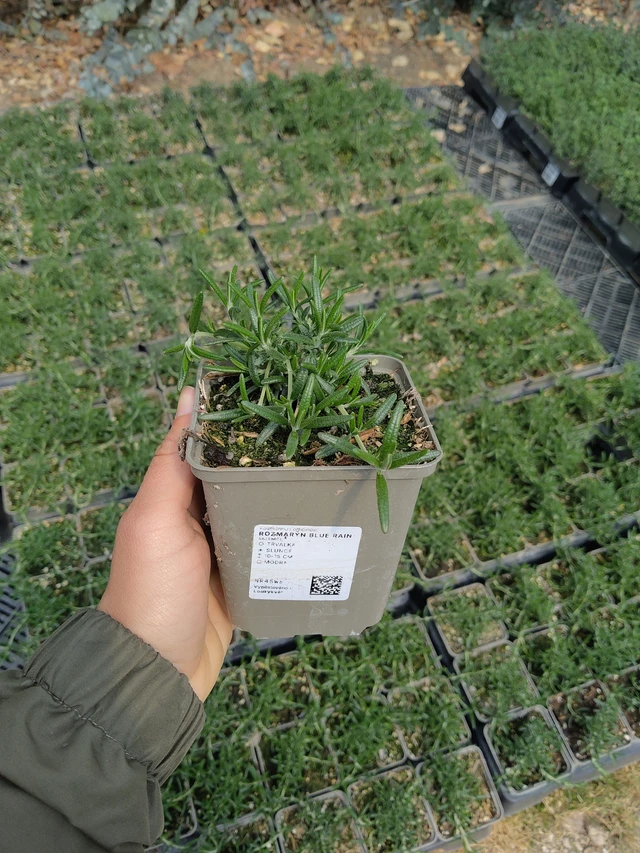
This cultivar grows to a height of only 10 to 15 centimeters and is characterized by an attractive trailing growth habit. From April to June, it will delight you with magnificent sky-blue flowers that are intensely fragrant and literally act as a magnet for bees and other beneficial pollinators. After flowering, we always recommend light pruning and regularly pinching young shoots during the summer. This intervention will promote much denser branching, more compact and healthier growth, and keep the plant in excellent condition. During the warm season, examine the plant carefully occasionally, as in a too dry and closed environment, the dark green leaves can be attacked by pests, most commonly spider mites, whiteflies, or scale insects. If detected early, you can deal with them very easily using common organic oil-based sprays.
Thanks to its creeping habit, the 'Blue Rain' cultivar is absolutely perfect for growing in containers and hanging baskets, where its cascading shoots look absolutely magical. The frost resistance of this cultivar reaches zone 8a, meaning it can handle short-term temperature drops to -10 °C. If you have it in a container, you must move it to a bright, unheated room with a temperature between 5 and 8 °C before the first stronger frosts arrive and limit watering to the absolute minimum so the substrate doesn't completely dry out. When grown in open ground, it requires finding a sheltered spot with as much sunshine as possible and protection from cold wind. In winter, it needs a thick covering of evergreen branches and protection against winter moisture at the roots. It will reward you with its evergreen appearance, which will add a beautiful winter effect to your garden.
The information given is based on our experience, please use it as a guide only. Times may vary depending on the season, climate, location, sowing and transplanting dates and possibly also the conditions in the greenhouse/greenhouse. We always recommend testing how the plant performs in your conditions. Please do not take this as a guarantee.
Can Blue Rain rosemary stay outdoors throughout the winter?
When and how should I properly prune this plant?
What is the recommended spacing if I want to plant rosemary in a flower bed?
How often does rosemary need to be watered?
Frequently asked questions
Harvest
Can this ornamental rosemary cultivar be used in the kitchen?
Is there an ideal time for harvesting the leaves for cooking?
Characteristics
Is the 'Blue Rain' variety suitable for growing in hanging baskets or window boxes?
Will rosemary look good in a flower bed even during the winter months?
Does this plant attract beneficial insects and pollinators to the garden?
Troubleshooting
Why are the leaves on my rosemary turning black, brown, or falling off?
Planting site
What other plants can I safely plant in the same window box with it?
Where is the best place to put a rosemary seedling?
What kind of soil should I transplant the seedling into?
Propagation
How can I easily propagate an adult rosemary plant?
Diseases & pests
What diseases and pests should I watch out for with rosemary?
Basic information
Is this herb easy enough for a complete beginner to grow?
What is 'Blue Rain' rosemary and what makes it special?
Photos in time
See how the seedling looks over the course of a year.
More products in category Rosemary

Rosmarinus officinalis
Rosemary Speedy

Rosmarinus officinalis
Rosemary Barbecue

Rosmarinus officinalis
Rosemary Upright Pink

Rosmarinus officinalis
Rosemary Blue Winter

Rosmarinus officinalis
Rosemary

Rosmarinus officinalis
Rosemary Hishtil Perigord

Rosmarinus officinalis
Rosemary Blue Cascade

Rosmarinus officinalis
Rosemary Fox tail

Rosmarinus officinalis
Rosemary Green Rosi
More products in category Herbs
Mentha spicata
Moroccan mint
Thymus vulgaris
Thyme Compactus

Thymus citriodorus
Thyme Lemon

Satureja montana
Winter Savory

Thymus serpyllum
Thyme Albus

Artemisia abrotanum var. maritima
Artemisia Coca Cola

Mentha piperita citrata
Chocolate mint

Thymus serphyllus
Thyme Coccineus

Lippia citriodora
Lemon verbena

Helichrysum angustifolia
Curry plant Tall Curry

Valeriana officinalis
Valerian

Origanum vulgare
Oregano Compactum

Levisticum officinale
Lovage
Thymus citriodorus
Thyme Doone Valley
Mentha spicata
Lemon mint

Coriandrum sativum
Coriander

Mentha spicata
Spanish Mint

Petroselinum hortense
Garden Parsley

Origanum rotundifolia
Ornamental oregano Kent Beauty

Anethum graveolens


