
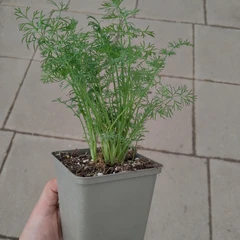
Anethum graveolens
Dill
Seedling

Attracts pollinators 🐝
Difficulty
Diseases
Edible
Flower color
Flower color: Shade
Foliage color
Fragrant (aromatic) 👃
Frost resistance
Hardiness zone
Height
Moisture
Pests
Position
Soil
Spacing
Spacing: Plants per m²
Recommended products

Mentha spicata
Moroccan mint

Petroselinum hortense
Garden Parsley

Aquilegia vulgaris
Columbine Kristall

Achillea millefolium
Yarrow Summer Pastels

Thymus vulgaris
Thyme Compactus

Dicentra spectabilis
Bleeding Heart

Geum chiloense
Avens Totally Tangerine

Echinacea purpurea
Coneflower White Swan

Centaurea montana
Mountain Cornflower

Dicentra spectabilis Alba
Bleeding Heart Alba

Salvia pratensis
Meadow Sage Rose Rhapsody

Geum rivale
Geum Mango Lassi

Gypsophila paniculata
Baby's breath Flamingo

Pennisetum alopecuroides
Fountain grass Hameln

Alcea rosea plena
Hollyhock Chaters Rosa

Mentha spicata
Lemon mint

Anemone hybrida
Japanese Anemone Whirlwind

Aquilegia vulgaris
Columbine Black Barlow

Thymus citriodorus
Thyme Doone Valley

Papaver orientale
Oriental Poppy Royal Wedding

Aquilegia vulgaris
Columbine Heidi

Leucanthemum
Daisy Christine Hagemann

Filipendula rubra
Meadowsweet Venusta

Liatris spicata
Liatris Floristan White

Salvia nemorosa
Woodland Sage Schneehügel

Gypsophila paniculata
Baby's Breath Snowflake

Achillea millefolium
Yarrow Terracotta

Hydrangea paniculata
Panicle Hydrangea Pink Diamond

Anemone hybrida
Japanese Anemone Königin Charlotte

Nepeta racemosa
Catmint Walker’s Low
Cultivation
Dill represents the ideal herb for any summer garden, which will additionally attract a multitude of useful pollinators. The basis for growing success is choosing a sunny and warm location. For its healthy development, the plant strictly requires humus-rich and excellently draining soil, which will guarantee optimal oxygen access to the roots and provide enough necessary nutrients. Although the above-ground leafy part requires direct sun for the formation of aromatic essential oils, the root system prefers a cooler and moister environment. You can very easily achieve this by planting the purchased seedling near other plants, whether alongside vegetables or lower perennials. This mixed planting will ensure shading for the lower part of the plant and help maintain stable soil moisture throughout the hot summer months.
When growing from our grown seedling, you avoid all the risks associated with sowing, and the plant will establish itself very quickly after transplanting. Plant the seedling in an outdoor flower bed only when the soil is sufficiently warmed up and there is no threat of late spring frosts. To ensure optimal conditions for growth, maintain a planting spacing of 40 centimeters. The plants will thus have enough space to form sturdy stems and will easily reach their normal height of 50 to 100 centimeters. This recommended distance also guarantees trouble-free airflow between the individual stalks. Good air circulation helps quickly dry the leaves after morning dew or rain, which naturally prevents the onset of any fungal diseases.
Subsequent care during the summer is very easy and time-efficient, so even a complete beginner can handle it without worry. The herb requires moderate watering, which is best applied early in the morning or in the evening hours. Make sure that the soil does not dry out deeply, but also avoid long-term accumulation of water in the root zone. A positive piece of news for every grower is the fact that this species completely lacks susceptibility to diseases and pests avoid it as well. The seedlings can also be grown very successfully in spacious pots or deep window boxes on a sunny terrace. When growing in a container, it is necessary to ensure a functional drainage layer at the bottom of the pot and anticipate the need for more frequent watering.
Since it is an annual plant, it does not overwinter and is not frost hardy. You therefore do not have to deal with any autumn covering with branches or moving it to a cold room, because with the arrival of frost its life cycle ends. However, the plant will have time to delight you with the formation of yellow, fully edible flowers that reliably enliven the garden. Regular cutting of leaves and young shoots also helps keep the plant vital throughout the whole season. Firm and straight stems find great use not only in cooking, but also as an interesting addition for cutting into summer bouquets for floristic purposes. If you let a few umbels fully mature on the flower bed, the seeds will fall out into the surroundings in autumn and take care of effortless spring self-seeding.
The information given is based on our experience, please use it as a guide only. Times may vary depending on the season, climate, location, sowing and transplanting dates and possibly also the conditions in the greenhouse/greenhouse. We always recommend testing how the plant performs in your conditions. Please do not take this as a guarantee.
Frequently
asked
questions
Diseases & pests
Is this plant prone to any specific diseases or pests?
Troubleshooting
Why did my dill seedling suddenly wilt after transplanting?
Why are the lower leaves of my plant starting to turn yellow and dry out?
Growing
Do dill seedlings need regular fertilization after planting?
How should I properly care for a dill seedling immediately after it arrives?
How often and how should I water a dill seedling?
Can I successfully grow dill on a balcony in a container or window box?
Characteristics
Is this plant dangerous to children or pets?
Will this annual attract bees and other pollinators to my garden?
Is dill suitable for cut flower arrangements and can it be dried afterwards?
Which parts of the plant are edible and what can they be used for?
Harvest
When and how can I harvest dill for kitchen use?
Basic information
Can a complete beginner handle growing dill from a seedling?
How long does dill last in the garden; is it a perennial?
Propagation
How can I ensure that I have dill in my garden in future years without having to constantly buy new seedlings?
Planting site
Where is the best place in the garden to plant dill?
Which other plants or vegetables grow best alongside dill in the same bed?
Photos
in time
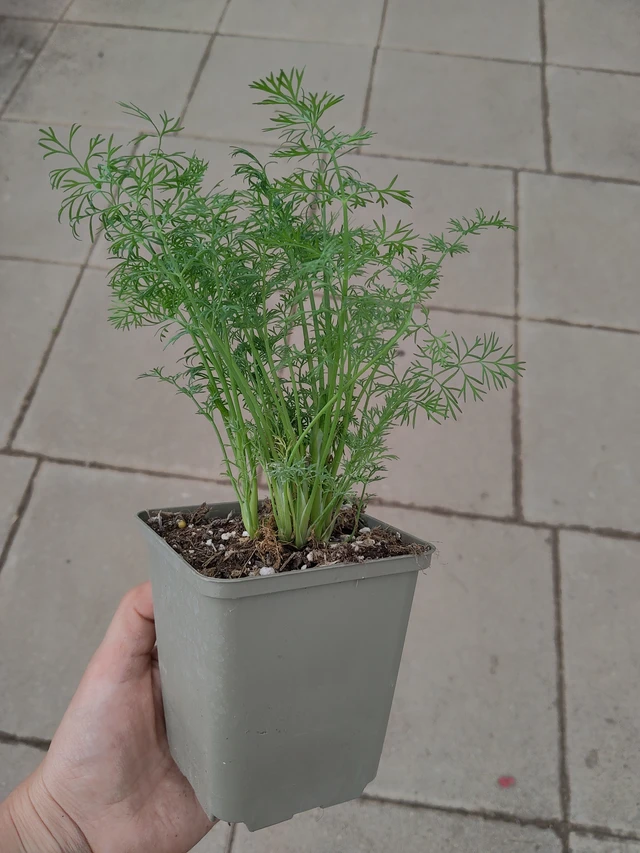
See how the seedling looks over the course of a year.

More products in category Herbs
Mentha spicata
Moroccan mint

Thymus citriodorus
Thyme Lemon
Thymus vulgaris
Thyme Compactus

Thymus serpyllum
Thyme Albus

Origanum laevigatum
Oregano Herrenhausen

Satureja montana
Winter Savory

Helichrysum angustifolia
Curry plant Tall Curry

Mentha piperita citrata
Chocolate mint

Thymus serphyllus
Thyme Coccineus

Artemisia abrotanum var. maritima
Artemisia Coca Cola

Lippia citriodora
Lemon verbena

Thymus praecox
Creeping Thyme Red Carpet

Valeriana officinalis
Valerian

Origanum majorana
Sweet Marjoram

Origanum vulgare
Oregano Compactum

Mentha spicata
Spanish Mint

Levisticum officinale
Lovage
Thymus citriodorus
Thyme Doone Valley

Coriandrum sativum
Coriander

Rosmarinus officinalis


