

Lippia citriodora
Lemon verbena
Seedling
Attracts pollinators 🐝
Difficulty
Diseases
Edible
Flower color
Flower color: Shade
Foliage color
Fragrant (aromatic) 👃
Frost resistance
Hardiness zone
Height
Moisture
Pests
Position
Soil
Spacing
Spacing: Plants per m²
Recommended products

Mentha spicata
Moroccan mint

Mentha spicata
Lemon mint

Geum chiloense
Avens Tempest Scarlet

Gypsophila paniculata
Baby's breath Flamingo

Artemisia abrotanum var. maritima
Artemisia Coca Cola

Salvia pratensis
Meadow Sage Rose Rhapsody

Dicentra spectabilis Alba
Bleeding Heart Alba

Aquilegia vulgaris
Columbine Kristall

Dicentra spectabilis
Bleeding Heart

Thymus citriodorus
Thyme Doone Valley

Alchemilla mollis
Lady's mantle Irish Silk

Thymus vulgaris
Thyme Compactus

Papaver orientale
Oriental Poppy Royal Wedding

Delphinium hybrida
Larkspur Benary’s Pacific Galahad

Achillea millefolium
Yarrow Lachsschönheit

Salvia nemorosa
Woodland Sage Ostfriesland

Verbascum chaixii
Mullein Sixteen Candles

Geum chiloense
Avens Totally Tangerine

Achillea millefolium
Yarrow Cerise Queen

Mentha piperita
Mint Eau de Cologne

Briza media
Quaking grass Tinkerbell

Alcea rosea plena
Hollyhock Chaters Rosa

Achillea millefolium
Yarrow Terracotta

Salvia nemorosa
Woodland Sage Schneehügel

Achillea millefolium
Yarrow Summer Pastels

Geum rivale
Geum Mango Lassi

Paeonia
Peony Red Sarah Bernhardt

Lavandula angustifolia
Lavender Rosea

Thymus citriodorus
Thyme Silver King

Achillea ptarmica
Yarrow The Pearl
Cultivation
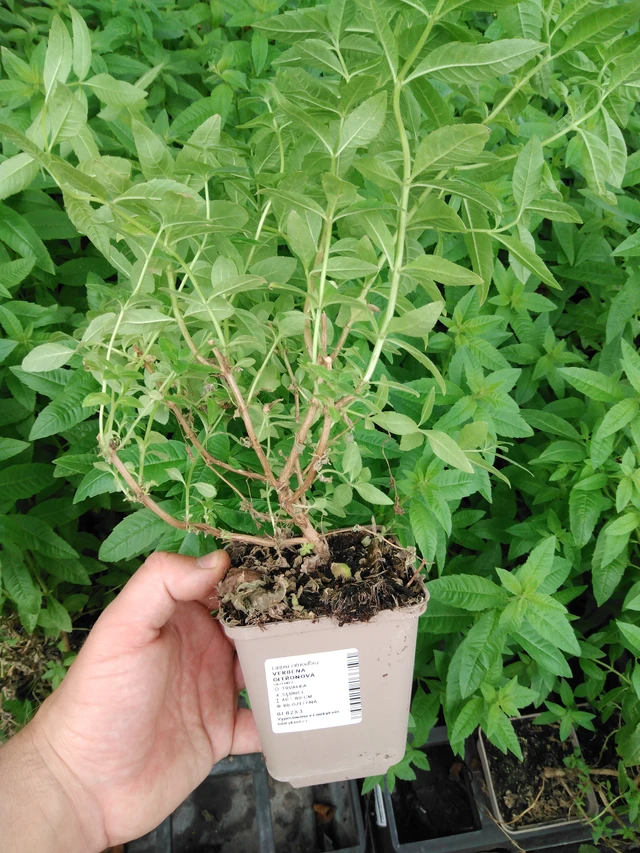
Growing lemon verbena is a sheer joy, and thanks to its high natural resistance to common diseases and garden pests, it is a carefree choice for beginner growers. Your new seedling will be absolutely happiest if you permanently place it in a larger and spacious pot or planter soon after receiving it. The location should be hot and in full sun. Indeed, growing in containers is the most reliable way here to successfully keep this perennial herb alive for many years. The preparation before planting is crucial – the soil must be beautifully light, airy, and maximally well-drained. Therefore, always pour a sufficient layer of drainage at the bottom of your growing container, because this plant absolutely cannot tolerate waterlogging and heavy, permanently wet soils.
During the summer, you can safely place the planted pot on a sunny terrace or straight into the garden. During July and August, tiny white flowers will appear, which will reliably attract bees and other beneficial pollinators to your surroundings. During sunny days, do not forget adequate watering and regular fertilizing throughout the growing season so that the plant has enough nutrients. If you want to maintain its attractive and compact shape and at the same time encourage the formation of new, young, and fragrant shoots, definitely do not be afraid to regularly cut and shape the plant. Lemon verbena tolerates even a harder pruning exceptionally well, after which it will always willingly and richly branch out. Moreover, you will immediately put the acquired cut green sprigs to practical use in your kitchen to prepare refreshing drinks.
As the first stronger frosts slowly begin to approach in autumn, it is the right time to safely winterize the plant. Although lemon verbena theoretically tolerates a short-term drop in temperatures down to minus twelve degrees, it would certainly not survive a Central European winter outside in a flowerbed. For winter, therefore, transfer it in time to a cool but sufficiently bright place with a temperature ideally in the range of 5 and 10 °C. If you were to try to overwinter it in an overly warm and heated living room, it would not stop its growth and would become unattractively leggy from a lack of light. In this cool wintering spot, water it only very carefully and sparingly. Just make sure that the substrate in the pot does not dry out completely to dust, and in the spring, after the frosts, you can again move it out into the sun with a clear conscience.
The information given is based on our experience, please use it as a guide only. Times may vary depending on the season, climate, location, sowing and transplanting dates and possibly also the conditions in the greenhouse/greenhouse. We always recommend testing how the plant performs in your conditions. Please do not take this as a guarantee.
Frequently
asked
questions
Planting site
Where is the best place to put lemon verbena?
Harvest
When and how can I harvest the fragrant leaves?
Characteristics
When does verbena bloom and does it attract any insects?
Is lemon verbena edible and how can I use it in the kitchen?
Growing
Do I need to trim or prune the plant in any way?
How often should I water and fertilize the plant?
How should I care for the seedling after I receive it?
Can lemon verbena be grown together with other herbs in the same window box?
How should I properly overwinter lemon verbena?
Basic information
What about the plant's toxicity, is it safe for pets?
Does this herb have any other interesting uses besides in the kitchen?
How big will this plant grow?
Diseases & pests
Is the plant prone to any diseases or pests?
Troubleshooting
Why are the leaves on my verbena falling off or turning yellow?
Propagation
Is it possible to propagate lemon verbena at home?
Photos
in time
See how the seedling looks over the course of a year.
More products in category Herbs
Mentha spicata
Moroccan mint
Thymus vulgaris
Thyme Compactus

Thymus serpyllum
Thyme Albus

Thymus citriodorus
Thyme Lemon

Satureja montana
Winter Savory

Mentha piperita citrata
Chocolate mint

Thymus serphyllus
Thyme Coccineus
Artemisia abrotanum var. maritima
Artemisia Coca Cola

Helichrysum angustifolia
Curry plant Tall Curry

Valeriana officinalis
Valerian

Origanum vulgare
Oregano Compactum

Levisticum officinale
Lovage
Thymus citriodorus
Thyme Doone Valley

Coriandrum sativum
Coriander

Mentha spicata
Spanish Mint

Salvia officinalis
Sage Maxima

Petroselinum hortense
Garden Parsley

Origanum rotundifolia
Ornamental oregano Kent Beauty

Anethum graveolens
Dill

Thymus citriodorus


