
Mentha piperita
Mint Eau de Cologne
Seedling


Attracts pollinators 🐝
Difficulty
Diseases
Edible
Flower color
Flower color: Shade
Foliage color
Fragrant (aromatic) 👃
Frost resistance
Hardiness zone
Height
Moisture
Pests
Position
Soil
Spacing
Spacing: Plants per m²
Recommended products

Thymus citriodorus
Thyme Doone Valley

Mentha spicata
Lemon mint

Mentha spicata
Moroccan mint

Thymus vulgaris
Thyme Compactus

Mentha suaveolens
Apple mint

Alchemilla mollis
Lady's mantle Irish Silk

Rosmarinus officinalis
Rosemary Blue Rain

Geum rivale
Geum Mango Lassi

Dicentra spectabilis
Bleeding Heart

Papaver orientale
Oriental Poppy Royal Wedding

Artemisia abrotanum var. maritima
Artemisia Coca Cola

Dicentra spectabilis Alba
Bleeding Heart Alba

Verbena bonariensis
Verbena

Verbascum nigrum var. album
Black Mullein

Achillea millefolium
Yarrow Summer Pastels

Petroselinum hortense
Garden Parsley

Sedum telephium
Sedum Herbstfreude

Salvia nemorosa
Woodland sage Schwellenburg

Hyssopus officinalis
Hyssop Albus

Salvia pratensis
Meadow Sage Rose Rhapsody

Aquilegia vulgaris
Columbine Heidi

Sedum spectabile
Sedum Matrona

Verbascum chaixii Album
Mullein Wedding Candles

Briza media
Quaking grass Tinkerbell

Clematis heracleifolia
Clematis Mrs R. Brydon

Helleborus orientalis
Hellebore Double Ellen White Spotted

Helleborus orientalis
Hellebore Double Ellen Picotee

Liatris spicata
Liatris Floristan White

Salvia pratensis
Meadow Sage Swan Lake

Bouteloua gracilis
Mosquito Grass
Cultivation
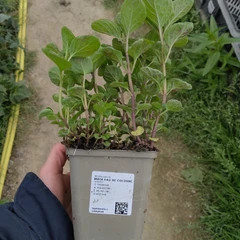
As soon as we deliver the strong and healthy Eau de Cologne mint seedling to you, you can get straight to planting. This herb is absolutely ideal for beginners. Choose a location ideally in partial shade for it, but it will also thrive in the sun if you provide more frequent watering. Mint requires standard loamy and humus-rich soil that naturally retains slight moisture. When planting in a flower bed, maintain a spacing of about 40 centimeters, thanks to which approximately six plants will fit in one square meter. Proper spacing is important for good airflow around the dark green leaves and acts as excellent prevention to maintain the plant's vitality.
All types of mint are robust perennials that like to spread into their surroundings. You should therefore give them plenty of space in the garden or use root barriers so they don't restrict other species. If you don't have space in the garden, containers will solve it. You can also grow them in sufficiently large pots with moist, nutrient-rich soil. When growing in a pot or window box, however, make sure that the container has drainage holes at the bottom. Do not forget regular watering and occasional fertilizing, as the substrate in a confined space dries out and loses important nutrients much faster than open soil in a classic flower bed.
During the season, the mint will reward you with a height of 40 to 60 cm and, from July to September, with beautiful pink and purple flowers that are a huge attraction for pollinators. After the first wave of blooming, we recommend a cutback. Thanks to it, the plant will thicken nicely and push out new, fresh leaves. This perennial is highly resilient and develops completely disease-free. Rarely, the mint leaf beetle may appear, which simply needs to be removed manually. With the arrival of winter, you do not need to protect the plant in any way. It is extremely frost hardy down to -28 °C, so it is enough to shorten the old above-ground shoots in autumn or early spring, and the roots will safely overwinter.
The information given is based on our experience, please use it as a guide only. Times may vary depending on the season, climate, location, sowing and transplanting dates and possibly also the conditions in the greenhouse/greenhouse. We always recommend testing how the plant performs in your conditions. Please do not take this as a guarantee.
What should I do after the first bloom to keep the plant nice and bushy?
Can I grow this mint in a pot on my balcony?
How often should I water mint and what kind of soil does it need?
Do I need to protect the mint from frost over the winter?
How far apart should I plant the seedlings?
Frequently asked questions
Characteristics
When does mint bloom and is it attractive to beneficial insects?
How does the 'Eau de Cologne' variety differ from common mint and what is it best used for?
Are the leaves and flowers of this mint suitable for cut flower bouquets?
Basic information
Is Eau de Cologne mint edible, and can I use it in the kitchen?
Is this aromatic herb safe for pets?
Diseases & pests
What pests might I find on the plant and how can I get rid of them?
Is this herb susceptible to any molds, fungi, or other serious diseases?
Propagation
How can I easily propagate an established mint plant?
Troubleshooting
What should I watch out for so that mint doesn't spread uncontrollably all over the garden?
Harvest
When and how should I harvest mint so that it lasts as long as possible?
Planting site
What is the ideal location for Eau de Cologne mint?
Photos in time
See how the seedling looks over the course of a year.


More products in category Mint
Mentha spicata
Moroccan mint

Mentha piperita citrata
Chocolate mint
Mentha spicata
Lemon mint

Mentha spicata
Spanish Mint

Mentha spicata
Mint Kentucky Colonel

Mentha requienii
Corsican mint

Mentha piperita
Mint After Eight

Mentha thai
Thai Mint
Mentha suaveolens
Apple mint

Mentha gracilis
Ginger mint
Mentha piperita citrata
Basil Mint

Mentha rotundifolia
Mint Variegata

Mentha arvensis
Strawberry Mint

Menta spp.
Currant Mint

Menta spp.
Mint Berries and Cream
More products in category Herbs
Mentha spicata
Moroccan mint
Thymus vulgaris
Thyme Compactus

Thymus citriodorus
Thyme Lemon

Satureja montana
Winter Savory

Thymus serpyllum
Thyme Albus
Artemisia abrotanum var. maritima
Artemisia Coca Cola
Mentha piperita citrata
Chocolate mint

Thymus serphyllus
Thyme Coccineus

Lippia citriodora
Lemon verbena

Helichrysum angustifolia
Curry plant Tall Curry

Valeriana officinalis
Valerian

Origanum vulgare
Oregano Compactum

Levisticum officinale
Lovage
Thymus citriodorus
Thyme Doone Valley
Mentha spicata
Lemon mint

Coriandrum sativum
Coriander
Mentha spicata
Spanish Mint
Petroselinum hortense
Garden Parsley

Origanum rotundifolia
Ornamental oregano Kent Beauty

Anethum graveolens


