

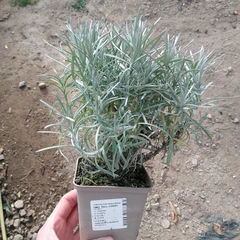
Helichrysum angustifolia
Curry plant Tall Curry
Seedling


Attracts pollinators 🐝
Difficulty
Diseases
Edible
Flower color
Flower color: Shade
Foliage color
Fragrant (aromatic) 👃
Frost resistance
Hardiness zone
Height
Moisture
Pests
Position
Soil
Spacing
Spacing: Plants per m²
Recommended products

Thymus vulgaris
Thyme Compactus

Alchemilla mollis
Lady's mantle Irish Silk

Mentha spicata
Moroccan mint

Thymus citriodorus
Thyme Doone Valley

Achillea millefolium
Yarrow Summer Pastels

Thymus citriodorus
Thyme Silver King

Salvia nemorosa
Woodland Sage Schneehügel

Mentha spicata
Lemon mint

Dicentra spectabilis
Bleeding Heart

Achillea millefolium
Yarrow Terracotta

Calamintha nepeta ssp. nepeta
Calamint

Salvia nemorosa
Woodland Sage Ostfriesland

Perovskia
Russian Sage Blue Spire

Leucanthemum vulgare
Daisy Maikönigin

Lavandula angustifolia
Lavender Rosea

Echinacea purpurea
Coneflower White Swan

Nepeta racemosa
Catmint Walker’s Low

Lavandula angustifolia
Lavender Hidcote

Artemisia ludoviciana
Artemisia Silver Queen

Petroselinum hortense
Garden Parsley

Dicentra spectabilis Alba
Bleeding Heart Alba

Lupinus
Lupine Band of Nobles Kastellan

Echinops bannaticus
Globe thistle Blue Glow

Aster ericoides
Aster Schneetanne

Ruta graveolens
Common Rue

Bouteloua gracilis
Mosquito Grass

Verbascum nigrum var. album
Black Mullein

Leucanthemum
Daisy Christine Hagemann

Lavandula intermedia
Lavender Edelweiss

Salvia nemorosa
Salvia Mainacht
Cultivation
You will receive the curry plant as an already beautifully grown seedling, which you can plant directly in its permanent location once the spring frosts have passed. This Mediterranean herb enjoys full sun and thrives best in drier, very well-drained, and rather poor soil. If you have heavy soil in your garden, be sure to mix gravel or sand into the planting hole so that water can drain quickly. When planting in a flowerbed, we recommend maintaining a spacing of 40 centimeters, which corresponds to roughly six plants per square meter. The plants will thus have plenty of space for healthy growth, and good air circulation will support their overall condition.
This herb is an ideal choice for beginner growers because it requires almost no complicated maintenance. A huge advantage is that the curry plant does not suffer from any common diseases and is completely avoided by hordes of garden pests. It requires watering only after transplanting until it is well rooted, and subsequently only during very long periods of drought. You don't have to worry about fertilizing; poorer soil, on the contrary, will encourage a more intensive release of essential oils and a stronger fragrance. During the summer, you can regularly cut the flowering stems for vases, which naturally shapes the plant. After the main blooming at the turn of summer and autumn, it is advisable to trim the shrub slightly so that it maintains a compact upright shape.
Customers often ask us if it is possible to grow the curry plant in containers. Growing in a pot is absolutely ideal for this herb. Although the plant can tolerate frosts down to minus eighteen degrees, it is very sensitive to winter waterlogging of the soil in our conditions. If you grow it as a portable plant on a terrace or balcony, you just need to provide a container with a drainage hole and pour a drainage layer of pebbles at the bottom. Before strong frosts and rains arrive, simply move the container to a bright room with a temperature between 5 and 10 °C. During this wintering, reduce watering to the absolute minimum, just so the substrate does not dry out completely.
The information given is based on our experience, please use it as a guide only. Times may vary depending on the season, climate, location, sowing and transplanting dates and possibly also the conditions in the greenhouse/greenhouse. We always recommend testing how the plant performs in your conditions. Please do not take this as a guarantee.
Frequently
asked
questions
Planting site
What type of soil does this herb require?
Where is the best place to plant the Helichrysum seedling?
Can Helichrysum be grown in a pot on a balcony?
Which herbs should I combine it with?
Characteristics
Is this plant an insect attractor?
How can I use Helichrysum in cooking? Is the whole plant edible?
Is it suitable for vases and for drying?
Growing
How should I prepare Helichrysum for winter? Will it survive our frosts?
How often and how much should I water the Helichrysum?
When and how should I prune the plant?
Propagation
Can I easily propagate Helichrysum from an existing seedling?
Basic information
Is Helichrysum toxic to pets?
Troubleshooting
Why have the leaves of my Helichrysum started to yellow and rot, even though it's supposed to be indestructible?
Harvest
When is the best time to harvest the leaves and flowers for kitchen use?
Diseases & pests
Should I be concerned about any pests or diseases?
Photos
in time
See how the seedling looks over the course of a year.


More products in category Strawflower

Helichrysum italicum
Curry Plant Dwarf
More products in category Herbs
Mentha spicata
Moroccan mint
Thymus vulgaris
Thyme Compactus

Thymus serpyllum
Thyme Albus

Thymus citriodorus
Thyme Lemon

Satureja montana
Winter Savory

Mentha piperita citrata
Chocolate mint

Thymus serphyllus
Thyme Coccineus

Artemisia abrotanum var. maritima
Artemisia Coca Cola

Lippia citriodora
Lemon verbena

Valeriana officinalis
Valerian

Origanum vulgare
Oregano Compactum

Levisticum officinale
Lovage
Thymus citriodorus
Thyme Doone Valley

Coriandrum sativum
Coriander

Mentha spicata
Spanish Mint

Salvia officinalis
Sage Maxima
Petroselinum hortense
Garden Parsley

Origanum rotundifolia
Ornamental oregano Kent Beauty

Anethum graveolens
Dill

Thymus citriodorus


