
Rosmarinus officinalis
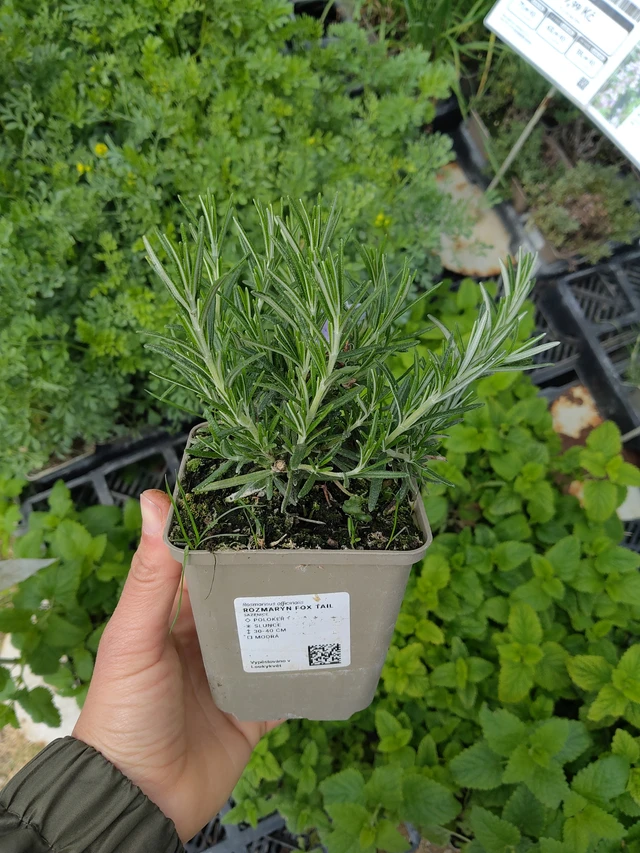
Rosemary Fox tail
Seedling


Attracts pollinators 🐝
Difficulty
Diseases
Edible
Flower color
Flower color: Shade
Foliage color
Fragrant (aromatic) 👃
Frost resistance
Hardiness zone
Height
Moisture
Pests
Position
Soil
Spacing
Spacing: Plants per m²
Recommended products

Thymus vulgaris
Thyme Compactus

Mentha spicata
Moroccan mint

Salvia pratensis
Meadow Sage Rose Rhapsody

Thymus citriodorus
Thyme Doone Valley

Verbena bonariensis
Verbena

Dicentra spectabilis
Bleeding Heart

Centaurea montana
Mountain Cornflower

Geum chiloense
Avens Totally Tangerine

Geum chiloense
Avens Tempest Scarlet

Nepeta faassenii
Catmint Alba

Salvia pratensis
Meadow Sage Swan Lake

Mentha spicata
Lemon mint

Dicentra spectabilis Alba
Bleeding Heart Alba

Hydrangea paniculata
Panicle Hydrangea Silver Dollar

Papaver orientale
Oriental Poppy Royal Wedding

Origanum laevigatum
Oregano Herrenhausen

Geum rivale
Geum Mango Lassi

Silene schafta
Catchfly Splendens

Anemone hybrida
Japanese Anemone Serenade

Liatris spicata
Liatris Floristan White

Petroselinum hortense
Garden Parsley

Aquilegia vulgaris
Columbine Heidi

Helianthus microcephalus
Sunflower Lemon Queen

Mentha piperita
Mint Eau de Cologne

Perovskia
Russian Sage Blue Spire

Filipendula hybridum
Meadowsweet Kahome

Sedum spectabile
Sedum Matrona

Aquilegia vulgaris
Columbine Kristall

Aquilegia vulgaris
Columbine Black Barlow

Thymus citriodorus
Thyme Silver King
Cultivation
Once you unwrap your new 'Fox tail' rosemary seedling, you can plant it immediately in its new home. This edible, aromatic subshrub grows to a height of 30 to 40 cm and has a semi-trailing habit, making it perfect for cascading over edges. This is a very practical feature for growing in window boxes and containers. To ensure healthy growth, you must provide it with what it is accustomed to from the Mediterranean: maximum sun and heat. Choose a sheltered location, preferably south-facing. The soil should be well-drained and sandy. Drainage at the bottom of the pot, consisting of a layer of gravel, is an absolute must. This will reliably prevent root rot and create the ideal environment for its happy growth.
During spring and summer, rosemary requires specific but very simple care that will promote branching and flowering. Watering must be very careful, as the plant prefers to dry out rather than be permanently waterlogged.
- When planting in open ground, maintain a spacing of 50 cm. Free airflow is the most important defense against powdery mildew, a white fungal coating on the leaves.
- During May and June, the plant blooms with light blue flowers, which are frequently visited by bees. Pinching young shoots encourages healthy branching.
- Each year after flowering, a deeper pruning is recommended to maintain vitality, a compact shape, and a rich production of high-quality green leaves.
With the arrival of winter, do not forget that the frost resistance of this popular plant ends at -10 °C. Planting directly in the garden is therefore only possible in warmer wine-growing regions. As a rule, it is recommended to overwinter containers inside the house. In autumn, move the rosemary in time to a bright, unheated room where the temperature stays between 5 and 8 °C, and water it only symbolically so that the root ball does not dry out. It is during overwintering that the plant is a bit more susceptible to sucking pests. Whiteflies, tiny spider mites that form webs, or firmly attached scale insects often appear. Therefore, check the undersides of the leaves regularly and, at the first signs of trouble, gently treat the plant with a suitable spray.
The information given is based on our experience, please use it as a guide only. Times may vary depending on the season, climate, location, sowing and transplanting dates and possibly also the conditions in the greenhouse/greenhouse. We always recommend testing how the plant performs in your conditions. Please do not take this as a guarantee.
How often should I water my rosemary?
What should I do after receiving the 'Fox Tail' rosemary seedling?
What kind of soil does rosemary need for healthy growth?
When and how should I prune rosemary to keep it nice and bushy?
Can 'Fox Tail' rosemary survive a Czech winter outdoors?
Frequently asked questions
Characteristics
When does rosemary bloom and what do the flowers look like?
How big does this cultivar grow?
Planting site
What kind of location is ideal for this rosemary?
Which herbs can I grow with rosemary in the same planter?
Diseases & pests
What diseases and pests should I watch out for with rosemary?
Harvest
Can 'Fox Tail' be used in the kitchen?
Troubleshooting
Why are the leaves on my rosemary turning brown and falling off?
Propagation
Can I propagate rosemary from a purchased seedling?
Growing
Is it necessary to fertilize the rosemary?
Photos in time
See how the seedling looks over the course of a year.


More products in category Rosemary

Rosmarinus officinalis
Rosemary Speedy

Rosmarinus officinalis
Rosemary Barbecue

Rosmarinus officinalis
Rosemary Hishtil Perigord

Rosmarinus officinalis
Rosemary Blue Rain

Rosmarinus officinalis
Rosemary Upright Pink

Rosmarinus officinalis
Rosemary Blue Winter

Rosmarinus officinalis
Rosemary

Rosmarinus officinalis
Rosemary Blue Cascade

Rosmarinus officinalis
Rosemary Green Rosi
More products in category Herbs
Mentha spicata
Moroccan mint
Thymus vulgaris
Thyme Compactus

Thymus citriodorus
Thyme Lemon

Thymus serpyllum
Thyme Albus

Lippia citriodora
Lemon verbena

Satureja montana
Winter Savory

Mentha piperita citrata
Chocolate mint

Thymus serphyllus
Thyme Coccineus

Helichrysum angustifolia
Curry plant Tall Curry

Artemisia abrotanum var. maritima
Artemisia Coca Cola
Thymus citriodorus
Thyme Doone Valley

Thymus praecox
Creeping Thyme Red Carpet

Valeriana officinalis
Valerian

Origanum vulgare
Oregano Compactum

Origanum majorana
Sweet Marjoram
Rosmarinus officinalis
Rosemary Speedy

Mentha spicata
Spanish Mint

Thymus praecox
Creeping Thyme Albiflorus

Levisticum officinale
Lovage

Melissa officinalis


