Ireland
🟢 The e-shop for seedlings is open again. 🌱 I also have dahlia seedlings and eucalyptus. 🟢
Ireland
🟢 The e-shop for seedlings is open again. 🌱 I also have dahlia seedlings and eucalyptus. 🟢
Lemon balm, Loukykvět

Melissa officinalis

Lemon balm

Lemon balm is an essential part of any herb garden, immediately enchanting you with its fresh lemon scent. It originally comes from the Mediterranean and Asia Minor, where it grows in sunny locations. In our climate, it will do great in ordinary loamy soil in full sun or partial shade. We send customers a grown seedling in a pot, which just needs to be transplanted directly into the flowerbed with a spacing of forty-five centimeters. It will soon form a vigorous clump reaching a height of up to eighty centimeters. The plant is completely undemanding to grow, easily handling severe frosts dropping even below thirty degrees, and does not suffer from diseases or pests. Furthermore, from June to August, tiny white little flowers appear on the stems, acting as a magnet for bees, bumblebees, and butterflies. The green leaves are fully edible and you can use them in refreshing drinks and soothing teas. For drying, collect them before blooming; that is when they have the most valuable essential oils. The long green stems have also found their place in floristry as a fragrant bouquet filler, and you can cut them practically anytime during the summer. Show full description

Seedling

Květináč K9 (9×9×9,5 cm)
1-2 kusy
3,09/ks
3-8 kusů
2,79/ks
9-17 kusů
2,49/ks
18+ kusů
2,19/ks
Skladem 0 ks
Připravujeme 500 ks

Attracts pollinators 🐝

Ano

Difficulty

Beginner

Diseases

Disease-free 🙂

Edible

Ano
?
Information on whether the plant is edible.

Flower color

White

Flower color: Shade

Pure white

Foliage color

Green

Fragrant (aromatic) 👃

Ano

Frost resistance

-34
?
The temperature down to which the plant is frost hardy.

Hardiness zone

4a (-34.4 °C to -31.7 °C)

Height

50-80 cm

Moisture

💧💧

Pests

Pest-free 🙂

Position

Sun, partial shade

Soil

Loamy

Spacing

45-45 cm
?
Recommended planting spacing.

Spacing: Plants per m²

4-6
1
2
3
4
5
6
7
8
9
10
11
12
Flowering
June
August

Recommended products

Fragrant

Mentha spicata

Mentha spicata, known as Moroccan mint, will bring not only a wonderful fragrance to your garden but also a piece of honest herbalist tradition. In the wild, it seeks out slightly moist habitats in partial shade, but it can also handle direct sun without problems. At your home, it will thrive best in humous and loamy soil with plenty of moisture. We will deliver an already mature seedling in a pot, which you can easily transplant to the flowerbed after unpacking. The plant grows to a height of up to sixty centimeters and is extremely resistant to severe frost and common diseases, so it brings joy without unnecessary effort. It will require your attention perhaps only in the event of an unexpected occurrence of the mint leaf beetle. It is an indispensable part of fragrant herbal compositions, but it will also fit perfectly alongside other ornamental perennials. Throughout the summer, stems with tiny purple flowers rise from the clumps. These not only look nice but attract a wide range of pollinators from bees to colorful butterflies. Its fresh green and highly aromatic leaves are edible and directly invite use in the summer kitchen. Gardeners and florists swear by it. The stems of Moroccan mint are excellent for cutting into live arrangements, giving them an unmistakable scent and delicate structure. In a summer vase, this green beauty will keep you company for about a week.
3,09
More from 2,19
Coming Soon
Fragrant

Thymus vulgaris

Common thyme is an indispensable herb and a small perennial that will scent any sun-drenched garden. Its original home is the sunny Mediterranean, where it grows on dry, rocky hillsides. Therefore, it will also grow best in your garden in full sun and well-drained, rather sandy soil. Once planted, it becomes a hardy plant that can even withstand our frosts down to minus twenty-three degrees. In flower beds, it acts as a ground cover and reliably complements drought-tolerant plantings. During June and July, it transforms into a flood of tiny lilac-purple flowers that act as a magnet for bees, bumblebees, and butterflies. It is a completely undemanding plant suitable for beginners, which does not suffer from diseases or pests. You will receive a beautifully grown seedling in a pot from us, which you can simply transplant right away. The 'Compactus' variety is characterized by its dense growth, reaching a height of only ten to twenty centimeters. It impresses with its light purple flowers and very tiny, deep green leaves with an extraordinarily intense fragrance. The entire plant is edible and has a wide range of uses in the kitchen. It responds very well to pruning, so you can easily shape it into a firm mound. You can dry the cut aromatic sprigs to stock up, or use them fresh.
3,29
More from 2,29
Coming Soon
Fragrant

Mentha spicata

Lemon mint is an indispensable perennial for anyone looking for undemanding greenery for their garden. Its homeland is the moister edges of meadows, where it grows in the sun as well as in partial shade. In our conditions, it thrives best in humous and loamy soil with adequate moisture. It can easily withstand frosts down to minus twenty-eight degrees and, apart from the occasional occurrence of the mint leaf beetle, it does not suffer from diseases. From us, you will receive a grown seedling in a pot, which you just need to transplant into the flowerbed. Mints are well-known perennials and herbs, used in floristry as fragrant greenery. Spearmint with fresh green leaves and a strong menthol-lemon aroma also stands out with its flowers. From July to September, it is covered in purple flowers that attract bees and butterflies. Fresh stems are suitable for cutting into bouquets and the leaves can be dried for fragrant decorations. In addition, it has a wide range of uses in the kitchen, being perfectly suited for iced drinks and summer desserts.
2,99
More from 2,09
Coming Soon
Fragrant

Satureja montana

Winter savory is an essential part of every sunny herb garden, where it delights as a useful culinary ingredient as well as an ornamental perennial. It originally comes from the dry rocky hillsides of the Mediterranean. Thanks to its origin, it will do best in your garden in full sun in poorer, well-drained soil. You will receive a grown seedling in a pot from us, which you just need to transplant straight into the flower bed, where it will quickly form a dense bush reaching a height of around thirty centimeters. In appearance and growth, it is very reminiscent of thyme. During August and September, it blooms with a flood of tiny white and purple flowers that act as a magnet for pollinators. The plant is undemanding, withstands frosts down to minus twenty-three degrees, and does not suffer from diseases or pests. The tiny green leaves and flowers are edible and form the basis of Mediterranean dishes, perfectly enhancing legume meals. Furthermore, savory is excellently suited for cutting into summer bouquets, giving them a delicate structure and spicy scent.
2,79
More from 1,99
Coming Soon

Verbena bonariensis

A verbena species originally from South America. In our country, it is often used as an annual, but in mild winters it can overwinter and reproduce by self-seeding. The firm, airy stems beautifully soften perennial beds and make them special with their purple color. It beautifully complements steppe plantings with grasses and rose beds.
3,29
More from 2,29
In Stock

Anethum graveolens

Dill is an indispensable annual whose fragrance belongs to summer. It originates from the Mediterranean and the Middle East, where it grows in sunny locations. In our gardens, it thrives best in direct sun in well-draining, humus-rich soil with moderate watering. You will receive a grown seedling in a pot from us, which you simply transplant directly to your chosen spot with a spacing of about forty centimeters. The plant grows to a height of fifty to one hundred centimeters. Dill appreciates slight shading of its roots, so it does excellently in mixed plantings together with vegetables and ornamental perennials. During the summer, it forms striking umbels composed of tiny yellow edible flowers. These are a strong attraction for beneficial insects and reliably attract pollinators. It is a completely undemanding plant for beginners, and it does not suffer from pests or diseases. You can use the sturdy stems for cutting into fresh summer bouquets, or you can easily dry them for floristry purposes. In suitable places, it will maintain itself through natural self-seeding.
2,16
1,39
More from 0,99
Unavailable
Pro rok 2026 nedostupné
Fragrant

Rosmarinus officinalis

Rosemary comes from the Mediterranean and North Africa, where it grows wild on dry, rocky, and fully sunny sites. In the Mediterranean, it is grown for essential oil extraction and as an ornamental plant used for stabilizing slopes and for hedges. Here, we most often grow it as a portable potted plant; alternatively, in a more protected spot, we can try growing hardier species in open beds. Speedy is an aromatic and fast-growing variety.
3,29
More from 2,29
Coming Soon

Coriandrum sativum

Coriander is a popular annual for all lovers of diverse gastronomy, from Asian and Indian to Latin American cuisine. It originates in the warm regions of the Middle East and the Mediterranean, where it grows in sunny and drier places. The history of this herb is shrouded in mystery; in the Middle Ages, it was an important ingredient in love potions, and in ancient China, it was even worshipped as a plant of immortality. You will receive a grown seedling in a pot from us, which you simply transplant directly into the garden at your chosen spot. It will thrive best in full sun with humus-rich and well-draining soil, where it has adequate watering. In the garden bed, it grows to a height of around forty to sixty centimeters and forms fresh green, distinctly aromatic leaves. These are popular for their unmistakable culinary use, where they enrich many recipes. During June and July, tiny white flowers arranged in delicate umbels appear above the clump of leaves. These flowers act as a great attraction for bees, bumblebees, and other pollinators. Growing coriander is very undemanding; it does not suffer from common diseases or pests, so even beginners can handle the care. Maintain a planting distance of about forty centimeters. Although coriander is grown mainly as an herb, its delicate white inflorescence also has a firm place in floristry. It is excellent for cutting into summer bouquets, giving them a natural and airy look in a vase. If you leave the flowers in the bed until autumn, you can later harvest the aromatic seeds as well, which will perfectly complement your home spice collection.
2,16
1,39
More from 0,99
Unavailable
Pro rok 2026 nedostupné
Fragrant

Thymus citriodorus

Lemon creeping thyme is a fragrant perennial that will instantly surprise you with its fresh citrus scent. The native species grow on sunny, dry rocky slopes, which is why it performs best here in full sun and well-drained, rather sandy soil. It forms dense, low cushions twenty to thirty centimeters high, which become covered in a profusion of tiny pink flowers from June to July. These provide a rich source of nectar, attracting bees, bumblebees, and other pollinators. You will receive an established seedling in a pot, ready to be planted directly into the border or a large patio container. Creeping thyme is low-maintenance, pest- and disease-free, and easy for beginners to look after. It survives frosts down to minus eighteen degrees, provided it is planted in a drier spot to avoid winter waterlogging. It pairs beautifully with other herbs and finer drought-tolerant perennials in borders. Its green leaves are edible and useful in the kitchen for summer drinks and flavoring dishes. You can also dry them, as they retain excellent aroma. In the garden, it functions wonderfully as both a ground cover and a fragrant sensory element.
3,29
More from 2,29
Coming Soon
Fragrant

Thymus vulgaris

Common thyme is an absolute must-have for every lover of good food and fragrant herbs. Its original home is the sunny regions around the Mediterranean Sea, where it grows on dry and rocky slopes. Thanks to this, it is exceptionally hardy and will benefit most in our gardens from full sun and well-drained, rather sandy soil. It forms compact small bushes reaching a height of around twenty to thirty centimeters, which can be shaped very well by regular pruning. Moreover, from June to July, it is covered in tiny pink flowers. At that moment, it becomes a huge attraction for bees, bumblebees, and butterflies, providing them with rich pasture. From the supplied seedling in a pot, a strong perennial will grow after transplanting, which can easily handle frosts down to minus twenty-three degrees. You can harvest the green aromatic leaves throughout the season for use in the kitchen. It is an undemanding plant that does not suffer from pests or diseases, so even complete beginners can handle its care. It can also be easily grown in containers on a balcony or terrace.
3,29
More from 2,29
Coming Soon

Lippia citriodora

Lemon verbena, also known as aloysia, will immediately enchant you with its intense and refreshing lemon scent. It originally comes from the warm regions of South America, and therefore it requires full sun and well-drained soil in our climate too. Because it only tolerates frosts down to minus twelve degrees, it is most often grown here as a portable container plant that you hide in a cooler, bright room for the winter. You will receive a grown seedling in a pot from us, which you just need to transplant into a larger container or a protected flowerbed. During July and August, the plant blooms with tiny white flowers, which act as a reliable attraction for bees and other pollinators. Verbena does not suffer from pests or diseases, so even beginners can handle growing it. Since the seventeenth century in Europe, it has been used as a valuable source of essential oils for perfume production. You can harvest the green leaves and use them as a culinary herb in summer dishes or as a fragrant addition to teas. Aromatic sprigs can also be cut and added to summer bouquets.
3,29
More from 2,29
Coming Soon
New
Fragrant

Rosmarinus officinalis

Rosemary originates from the Mediterranean and North Africa, where it grows wild in dry, rocky, and fully sunny habitats. In the Mediterranean, it is grown for extracting fragrant essential oils and as an ornamental plant used for stabilizing slopes and for hedges. Here, we most often grow it as a portable plant in a pot; alternatively, in a protected spot, we can try growing hardier species in an open flower bed. Hishtil Perigord is a fast-growing variety with greyish-green leaves and blue flowers.
1,49
Coming Soon

Allium schoenoprasum

Allium schoenoprasum, known as coastal chives, surprises with its tenacity and wide range of applications. Its original homeland is the sunny banks of watercourses and moister grassy areas, thanks to which it is naturally vigorous and accustomed to various conditions. In the garden, it will welcome full sun and well-drained, rather sandy or loamy soil. From us, you will get a well-rooted seedling in a pot, which you can immediately transplant to your favorite spot. During June and July, spherical inflorescences in delicate pink and purple tones will appear above the aromatic green clumps. These flowers act as a literal magnet for pollinators and are guaranteed to liven up any space. All parts of the plant are moreover fully edible and bring a fresh taste to your kitchen. Chives require almost no attention, reliably resisting severe frosts and common diseases. Its hardiness makes it a perfect choice for unconventional plantings, such as green roofs or more drought-tolerant gravel beds. We plant the seedlings about twenty-five centimeters apart. Although it is not used for cutting into the interior, outdoors it will delight with its neat clumps, which grow to a height of about twenty-five to thirty-five centimeters. Absolutely anyone can grow it regardless of previous experience.
2,80
1,89
More from 1,29
Coming Soon
New

Origanum majorana

We grow marjoram as an aromatic medicinal annual. It belongs among the most frequently used herbs in the kitchen. It can grow in a pot, freely in flower beds, or in rock gardens.
3,29
More from 2,29
Coming Soon
Fragrant

Salvia officinalis

Common sage is an indispensable perennial for any lover of herb gardens and naturalistic planting. Its native home is the dry Mediterranean region, where it naturally colonizes sunny rocky slopes. It requires the same conditions here, so give it full sun and well-drained, rather poor soil. The established potted seedling you receive will quickly bulk up after planting, forming a vigorous shrub that easily tolerates winter frosts down to minus twenty-three degrees. The Maxima cultivar is exceptional for its velvety, grayish-green leaves, which grow up to three times larger than those of standard varieties. We grow it primarily for these massive, highly aromatic leaves, which have a wide range of uses in the kitchen and in tea blends. During June and July, it produces violet-blue flowers that draw in pollinators. However, if you want to retain maximum aroma in the foliage, we recommend pinching out the emerging flowers. The sturdy stems are brilliant for cutting into summer bouquets, lasting around a week, or drying for winter floristry displays.
2,99
More from 2,09
Coming Soon
Fragrant

Mentha spicata

Spanish mint, also known as spearmint, is an indispensable perennial for all lovers of herbs and fragrant gardens. It naturally grows in wetter meadows and on the banks of watercourses across Europe, so it does best in the garden in loamy and humous soil with plenty of moisture. It thrives in full sun as well as in partial shade, where it quickly forms a dense clump of fresh green leaves reaching a height of forty to sixty centimeters. You will receive a beautifully grown seedling in a pot from us, which you just need to transplant directly into the flower bed or a spacious container. When planting in the soil, we recommend maintaining a spacing of about forty centimeters so that it has enough space to grow. It is an exceptionally resilient and undemanding plant that even complete beginners can handle without problems. It can even withstand severe frosts dropping down to minus twenty-eight degrees and does not suffer from common diseases; it is only occasionally necessary to watch out for the mint leaf beetle. During the summer, from July to September, the flower bed turns into a feast for pollinators. The mint blooms with tiny purple flowers that act as a magnet for bees and bumblebees. The entire plant contains strong essential oils, giving it an unmistakable and strong mint aroma. The leaves and flowers are fully edible, so you can use them in the preparation of refreshing drinks, teas, or as a garnish for summer desserts. However, Spanish mint also has a firm place in floristry. Its straight stems are very popular filler greenery for fresh bouquets, to which they add not only an interesting structure but above all a wonderful fragrance. In addition, you can easily dry the flowers and leaves for later use in herbal blends or small fragrant decorations.
3,09
More from 2,19
Unavailable
Pro rok 2026 nedostupné
Fragrant

Thymus citriodorus

Doone Valley creeping thyme is a fragrant ground-cover perennial that will enliven any sunny spot in the garden. The native species grow on dry hillsides, so this variety also thrives best in direct sun and well-drained, rather sandy soil. It is a completely low-maintenance plant that even beginners can easily grow. It is disease-free, avoided by pests, and easily survives frosts down to minus twenty-three degrees. From the potted seedling you receive, it will quickly establish into a dense carpet after planting. This variety catches the eye immediately with its yellow-green variegated foliage and lemon scent. From June to July, the display is enhanced by pink flowers, which act as a reliable magnet for bees and other pollinators. It is perfectly suited for edging borders, dry stone walls, or softening pathway edges. Both flowers and leaves are excellent for drying and culinary use. A major bonus is its changing winter appearance, when low temperatures turn the entire plant into stunning dusty pink tones.
3,29
More from 2,29
Coming Soon
Fragrant

Ocimum basilicum

Aromatic annual basil with upright growth and light green, medium-sized leaves. It blooms white.
2,79
More from 1,99
Unavailable
Pro rok 2026 nedostupné
Fragrant

Mentha piperita

Peppermint is a perennial popular for centuries, originating in the temperate regions of Europe, where it naturally seeks out moister, nutrient-rich soils. From us, you will receive an already grown seedling in a pot, which you just need to transplant directly into your garden. It will thrive best in a sunny or partially shaded location with normal loamy or humous soil and regular watering. You don't need to worry about winterizing it at all, as it can easily withstand frosts down to minus twenty-eight degrees. Mint is very vigorous and spreads quickly, so it will soon form a dense stand reaching a height between forty and sixty centimeters. Caring for it is so easy that even a complete beginner can handle it effortlessly. Moreover, it does not suffer from common diseases; occasionally, only the mint leaf beetle might feast on it, which you can easily collect. The After Eight cultivar is sought after by growers for its entirely unmistakable chocolate-mint fragrance. It forms smooth and glossy dark green leaves, the undersides of which, along with the sturdy stems, have an attractive reddish tinge. In addition, from July to September, tiny pink and purple inflorescences appear on the tips. These flowers are literally a magnet for pollinators, so bees and bumblebees will soon liven up your garden. Mint finds its use in herb beds, works excellently as an undergrowth beneath taller shrubs, or as a fragrant border for pathways. We recommend maintaining a planting distance of about forty centimeters. For all lovers of mint-chocolate combinations, this herb will bring joy primarily in the kitchen. Its edible and strongly aromatic leaves perfectly refresh iced drinks, garnish summer fruit salads, and fine-tune sweet desserts. But it also offers interesting uses for lovers of fresh bouquets. The sturdy and fragrant stems perfectly complement summer floral arrangements in a vase, where they serve as interesting and original greenery. If you want to preserve a piece of summer even for the colder months, you can simply dry whole stems and use them later in fragrant blends or dry decorations.
2,99
More from 2,09
In Stock posledních 15 kusů
Fragrant

Rosmarinus officinalis

Rosemary originates from the Mediterranean and North Africa, where it grows wild in dry, rocky, and fully sunny habitats. In the Mediterranean, it is grown for extracting fragrant essential oils and as an ornamental plant used for stabilizing slopes and for hedges. Here, we most often grow it as a portable plant in a pot; alternatively, in a protected spot, we can try growing hardier species in an open flower bed. Barbecue is an upright growing cultivar with narrower, distinctly aromatic leaves.
2,99
More from 2,09
Coming Soon
New
Fragrant

Mentha arvensis

Strawberry mint is an absolute must-have herb for anyone who loves fresh scents and is looking for reliable greenery for the garden. Naturally, these aromatic perennials grow in the damper regions of the temperate zone along watercourses and on light woodland edges. For this reason, they also thrive best in the garden in humus-rich and loamy soil that can retain stable moisture. They do best in full sun or light partial shade, where they completely survive even very harsh winters with temperatures dropping to minus twenty-eight degrees without any problems. From us, you will receive a strong and grown seedling in a pot, which you just need to transplant to your chosen spot in an herb or perennial bed. It is ideal to place the plants with a spacing of around forty centimeters so they have enough space for their vital growth. Mints are well-known perennials and herbs, used in floristry as fragrant greenery. Strawberry mint is a perennial with a delicate strawberry and menthol scent, forming dense clumps of green leaves reaching a height of up to sixty centimeters. It is absolutely ideal for growing even for complete beginners, does not suffer from diseases, and does not need any complicated care. The only thing it is occasionally good to watch out for is a tiny pest, the mint leaf beetle. From July to the end of September, it blooms with tiny purple flowers, which act as a literal magnet for bees, butterflies, and other pollinators. If you like creating your own bouquets, you will certainly appreciate its stems for cutting. It will bring volume and an unmistakable fragrance to a vase and also serves well for drying for floristic purposes. Furthermore, you can safely use the green leaves in the kitchen, as the entire plant is edible and wonderfully livens up summer drinks.
3,29
More from 2,29
Coming Soon

Helichrysum angustifolia

Curry plant Tall Curry is an indispensable herb and ornamental perennial for every sun-drenched garden. Its homeland is the dry slopes of Southern Europe, which is why it requires full sun and well-drained, rather poor soil. From our grown seedling, a fifty-centimeter tall small bush will quickly grow for you after transplanting. The curry plant is a popular aromatic plant that emits an intense fragrance resembling curry. It also captivates with its silvery-grey foliage, which will add structure to the garden. Even beginners can easily handle its cultivation. It does not suffer from diseases or pests and can easily withstand frosts down to minus eighteen degrees. From July to September, tiny yellow inflorescences bloom, acting as a magnet for bees, bumblebees, and butterflies. In flowerbeds, the curry plant is perfect in combination with drought-tolerant perennials and herbs. Moreover, you can use its edible flowers and leaves in summer cooking. The Tall Curry variety stands out for its upright growth, making it an ideal plant for cutting. The yellow flowers will bring an interesting color element to bouquets and will last fresh in a vase for many days. They are also great for drying for floristry, as they retain their shape and color for a long time.
2,99
More from 2,09
Coming Soon

Gaura lindheimeri

Gaura Siskiyou Pink is a charming perennial that brings lightness and airiness to the garden. Its original native area is in the warm regions of Texas and Louisiana, which is why it thrives in full sun and well-drained sandy soil. It grows in clumps and from June until the autumn frosts produces tiny raspberry-pink flowers that resemble fluttering butterflies. An interesting detail of this variety is the green leaves with a bronze tint and red spots. It is an absolutely undemanding plant, does not suffer from diseases or pests, and even beginners can handle its care. You will receive a grown seedling in a pot from us, which you simply need to transplant directly into the flowerbed. Here it complements ornamental grasses perfectly and acts as an attraction for bees and bumblebees. Although it grows more as a short-lived perennial in our climate, in a suitable place it reliably self-seeds. Occasional pinching will encourage richer branching. Gaura is excellent for summer bouquets. We cut the stems for a vase as soon as the first two to three little flowers open.
2,99
More from 2,09
In Stock
Fragrant

Mentha spicata

Kentucky Colonel spearmint is a popular perennial that brings life to any outdoor space. Originating from moister temperate regions, it appreciates a semi-shady or sunny spot with well-drained, humus-rich, loamy soil. You will receive a well-rooted seedling in a pot, which you can easily transplant directly into your border. The Kentucky Colonel cultivar features large green leaves and a strong minty aroma. It grows to around half a meter tall and forms a vigorous patch. Cultivation is incredibly easy and perfect for beginners. The plant overwinters without issues, withstanding frosts down to minus twenty-eight degrees. In summer, tiny white inflorescences appear above the foliage, acting as a beacon for bees and bumblebees. Mints are highly sought after in floristry as fragrant foliage for bouquets. Both the green leaves and flowers are edible, perfect for mixing into summer drinks. This perennial is disease-free; occasionally, the mint leaf beetle might appear, which can simply be picked off.
3,09
More from 2,19
Coming Soon

Allium tuberosum

Chinese chives, also known as garlic chives, originate from the sunny steppes and meadows of East Asia. Therefore, in our gardens, they thrive best in sunny or semi-shady locations with well-drained, loamy to sandy soil. It is an exceptionally low-maintenance perennial that easily withstands frosts down to minus twenty-three degrees and is avoided by common pests and diseases. You will receive an established seedling in a pot from us, which you simply transplant directly to your chosen spot, where it will quickly form a dense clump reaching a height of around half a meter. Its leaves are narrow and flat. From August to October, it blooms with striking white flowers featuring a green throat and vein, which attract bees and butterflies. It is a perfect herb for both the kitchen and the ornamental garden. The leaves and flowers are fully edible and add a pleasant garlic flavor to dishes. Its sturdy stems are also excellent for cutting into autumn bouquets, bringing a very interesting and unique structure to them.
2,80
1,89
More from 1,29
Coming Soon
Fragrant

Salvia officinalis

Grower's Friend common sage is an aromatic and extremely hardy perennial that is a must-have for any herb garden. Its native habitat is the sunny, dry slopes of the Mediterranean, which is why it thrives best in direct sun and well-drained, rather poor soil. You will receive a beautifully established seedling in a pot, ready to be planted straight into the border, where it will quickly form a compact bush reaching about half a meter in height. It is a completely low-maintenance plant that is free from diseases and pests, effortlessly handles frosts down to minus twenty-three degrees, and is easy for complete beginners to care for. During June and July, it blooms with tiny violet-blue flowers that act as an absolute magnet for bees, bumblebees, and butterflies. It fits perfectly into drought-tolerant gravel beds, where it naturally complements ornamental grasses and other herbs. The flowers on sturdy stems are excellent for cutting into summer bouquets and for drying for floristry. The Grower's Friend variety stands out with its velvety, grayish-green leaves that have an exceptionally high concentration of essential oils. These edible leaves are fantastic in the kitchen and in homemade tea blends. If you want to maximize the aromatic strength of the leaves, we recommend regularly removing the emerging flowers.
2,79
More from 1,99
Coming Soon

Perovskia atriplicifolia

Russian sage reliably brings a touch of sunny steppes into the garden and places almost no demands on care. These sparsely branched subshrubs originally come from harsh, rocky areas from Afghanistan to Tibet, where they grow on open sun-drenched plains. Thanks to its origin, it delights in full sun and poor, well-drained sandy soil with minimal moisture. You will receive from us a well-rooted seedling in a pot, which just needs to be transplanted straight to the chosen spot in the flower bed. It does not need support, is avoided by common pests and diseases, and will survive frosts down to minus twenty-eight degrees. It grows up to one hundred and twenty centimeters and forms striking white felted shoots with silvery grey aromatic leaves. From July to October, it blooms with tiny blue-purple flowers that act as a lure for bees and butterflies and are even edible. Russian sage stands out next to drought-tolerant perennials. The flowers are suitable for cutting and drying for winter arrangements. Moreover, the silvery stems will ensure a beautiful winter effect in the flower bed.
2,99
More from 2,09
In Stock

Stipa tenuissima

Feather grass flowers capture attention in beds and bouquets with their lightness and delicacy. All feather grasses love full sun and dry, stony, well-drained soil. To look most natural in beds, it is good to plant them in loose groups of several pieces together with other drought-loving perennials and bulbs. Only then do their stems and inflorescences, set in motion by the slightest breath of wind, truly stand out. Stipa 'Ponny Tails' is a species native to the steppes of Mexico, Texas, and Patagonia. Airy, dense clumps of hair-like delicate leaves resemble horsehair. The leaves are green, turning up to straw-colored towards the flowers. In a suitable location, it also self-seeds.
3,79
More from 2,69
In Stock
New
Fragrant

Rosmarinus officinalis

Rosemary originates from the Mediterranean and North Africa, where it grows wild on dry, rocky, and fully sunny sites. In the Mediterranean, it is cultivated for obtaining fragrant essential oil and as an ornamental plant used for stabilizing slopes and for hedges. Here, we grow it most often as a portable plant in a pot, or in a more sheltered spot, we can try growing hardier species in an open bed. The Fox Tail cultivar is characterized by a semi-trailing type of growth and is suitable for growing in pots.
2,99
More from 2,09
Coming Soon

Cultivation

Meduňku lékařskou obdržíte jako již krásně vzrostlou sazenici, kterou můžete ihned bez obav vysadit na její trvalé místo na zahradě. Nejlépe se jí bude dařit na slunném až polostinném stanovišti. Meduňka bude obzvláště vděčná za teplou, kyprou a na vápno bohatou půdu. Ideální je běžná hlinitá zemina, která dobře drží potřebnou vlhkost, ale zároveň je dostatečně propustná. Při výsadbě na záhon dodržujte spon zhruba čtyřicet pět centimetrů, což odpovídá čtyřem až šesti rostlinám na metr čtvereční. Tento rozestup zajistí rostlinám dostatek prostoru pro vytvoření bohatých trsů dorůstajících výšky padesát až osmdesát centimetrů a zároveň zaručí velmi dobrou cirkulaci vzduchu.

Tato oblíbená bylinka vyžaduje pravidelnou střední zálivku. Během horkých letních dnů dbejte na to, aby půda zcela nevyschla, ale vyhněte se trvalému přemokření, které by mohlo vést k uhnívání citlivých kořenů. Pokud nemáte k dispozici zahradu, pěstování v nádobách je skvělou alternativou pro každého. Pro pěstování v květináči nebo prostorném truhlíku na balkoně zvolte nádobu s odtokovými otvory a na dno nasypte kvalitní drenážní vrstvu. V omezeném prostoru nádoby bude meduňka pochopitelně vyžadovat o něco častější zálivku a také pravidelné přihnojování jemným organickým hnojivem během celé vegetační sezóny.

Péče během sezóny je naprosto nenáročná a zvládne ji opravdu každý. Zelené aromatické lístky můžete sklízet průběžně po celé léto, ale pro následné sušení je nejlepší provést sklizeň ještě před samotným nakvetením, kdy obsahují nejvíce vonných silic. Od června do srpna rostlina tvoří drobná čistě bílá kvítka, která doslova fungují jako magnet pro včely, čmeláky a motýly. Intenzivní řez po odkvětu velmi doporučujeme – nejenže výrazně podporuje nový a vitální růst listů, ale také spolehlivě zabraňuje nechtěnému samovýsevu po celé vaší zahradě.

S blížící se zimou si nemusíte dělat vůbec žádné starosti. Meduňka lékařská je totiž plně mrazuvzdorná trvalka, která bez nejmenších problémů snese extrémní mrazy klesající až k -34 °C. Na zimu nadzemní část rostliny přirozeně odumírá, proto není potřeba žádná speciální zimní ochrana ani přikrývání. Na jaře z kořenů opět spolehlivě obrazí a potěší vás novými lístky. Obrovskou výhodou pro každého pěstitele je také fakt, že tato silná rostlina netrpí žádnými běžnými chorobami ani škůdci. Můžete se tak dlouhodobě těšit ze zdravé a voňavé bylinky bez nutnosti chemických postřiků.

The information given is based on our experience, please use it as a guide only. Times may vary depending on the season, climate, location, sowing and transplanting dates and possibly also the conditions in the greenhouse/greenhouse. We always recommend testing how the plant performs in your conditions. Please do not take this as a guarantee.

Show all

Click to view the full growing instructions.

Frequently
asked
questions

Stanoviště

Pěstování

Vlastnosti

Množení

Základní informace

Nemoci & škudci

Sklizeň

Problémy

Photos
in time

See how the seedling looks over the course of a year.
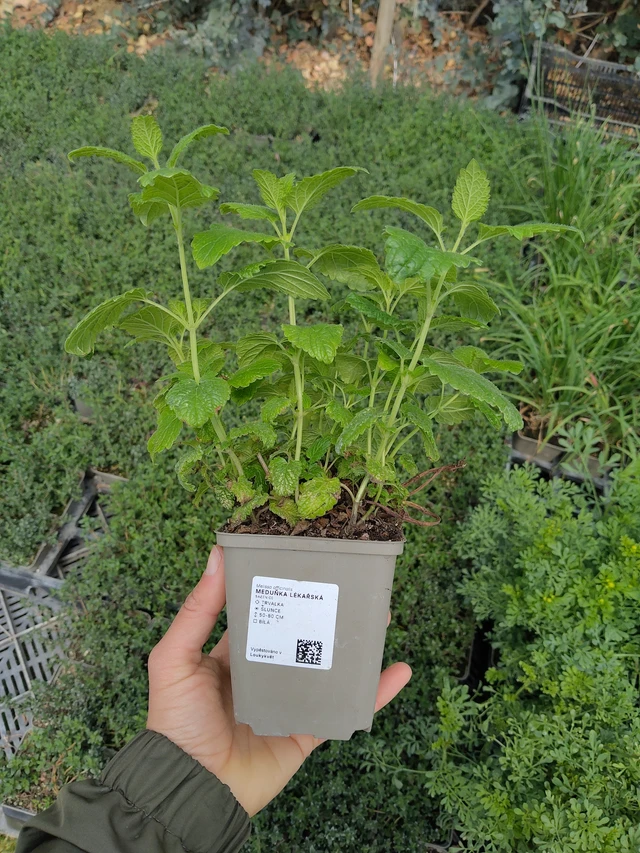
Lemon balm - 13. 5. 2026
13. 5. 2026
Lemon balm - 27. 3. 2026
27. 3. 2026
Lemon balm - 31. 10. 2025
31. 10. 2025
Lemon balm - 13. 10. 2025
13. 10. 2025
Lemon balm - 10. 9. 2025
10. 9. 2025
Lemon balm - 19. 8. 2025
19. 8. 2025
Lemon balm - 1. 8. 2025
1. 8. 2025
Lemon balm - 17. 7. 2025
17. 7. 2025
Lemon balm - 1. 7. 2025
1. 7. 2025

More products in category Lemon balm

New
Fragrant

Melissa officinalis

The refreshing lemon aroma makes Limonii lemon balm a herb suitable for every sunny flowerbed. It naturally occurs in the warm Mediterranean, which is why it thrives best in the sun or partial shade with humous, well-drained, and loamy soil. We will deliver a strong seedling in a pot, which you can easily plant in your chosen spot after unpacking. The plant will soon establish itself and grow up to forty centimeters in height. It is fully frost-resistant, does not suffer from diseases, and its cultivation can be easily managed even by beginners. From July to September, it forms tiny white flowers that serve as an important pasture for bees and bumblebees. The Limonii cultivar stands out with a specific taste with a clear hint of lime, making it ideal for refreshing lemonades or evening teas. You will get the most flavor from the green leaves by harvesting them just before blooming. At the same time, the stems are excellently suited for cutting into fresh bouquets. Anytime during the season, you can add them to a vase with other flowers, to which they will add a beautiful structure, or easily dry whole sprigs in stock for floristic purposes and winter cooking.
2,99
More from 2,09
Coming Soon

More products in category Herbs

Fragrant

Mentha spicata

Mentha spicata, known as Moroccan mint, will bring not only a wonderful fragrance to your garden but also a piece of honest herbalist tradition. In the wild, it seeks out slightly moist habitats in partial shade, but it can also handle direct sun without problems. At your home, it will thrive best in humous and loamy soil with plenty of moisture. We will deliver an already mature seedling in a pot, which you can easily transplant to the flowerbed after unpacking. The plant grows to a height of up to sixty centimeters and is extremely resistant to severe frost and common diseases, so it brings joy without unnecessary effort. It will require your attention perhaps only in the event of an unexpected occurrence of the mint leaf beetle. It is an indispensable part of fragrant herbal compositions, but it will also fit perfectly alongside other ornamental perennials. Throughout the summer, stems with tiny purple flowers rise from the clumps. These not only look nice but attract a wide range of pollinators from bees to colorful butterflies. Its fresh green and highly aromatic leaves are edible and directly invite use in the summer kitchen. Gardeners and florists swear by it. The stems of Moroccan mint are excellent for cutting into live arrangements, giving them an unmistakable scent and delicate structure. In a summer vase, this green beauty will keep you company for about a week.
3,09
More from 2,19
Coming Soon
Fragrant

Thymus vulgaris

Common thyme is an indispensable herb and a small perennial that will scent any sun-drenched garden. Its original home is the sunny Mediterranean, where it grows on dry, rocky hillsides. Therefore, it will also grow best in your garden in full sun and well-drained, rather sandy soil. Once planted, it becomes a hardy plant that can even withstand our frosts down to minus twenty-three degrees. In flower beds, it acts as a ground cover and reliably complements drought-tolerant plantings. During June and July, it transforms into a flood of tiny lilac-purple flowers that act as a magnet for bees, bumblebees, and butterflies. It is a completely undemanding plant suitable for beginners, which does not suffer from diseases or pests. You will receive a beautifully grown seedling in a pot from us, which you can simply transplant right away. The 'Compactus' variety is characterized by its dense growth, reaching a height of only ten to twenty centimeters. It impresses with its light purple flowers and very tiny, deep green leaves with an extraordinarily intense fragrance. The entire plant is edible and has a wide range of uses in the kitchen. It responds very well to pruning, so you can easily shape it into a firm mound. You can dry the cut aromatic sprigs to stock up, or use them fresh.
3,29
More from 2,29
Coming Soon
Fragrant

Mentha piperita citrata

Chocolate mint is an indispensable herb for all lovers of unusual scents and dark colors. Originally, these moisture-loving perennials inhabited the banks of streams across the temperate zone, so in your garden, they will also appreciate loamy and humous soil. A strong bush will quickly grow from our mature seedling, which you can easily transplant from the pot directly into the bed. The cultivar captivates with deeply reddish leaves and black stems that bring an unusual look to herb plantings. The sweet menthol scent directly invites culinary use; the edible leaves will perfectly flavor lemonades and desserts. During the summer, purple flowers appear, on which butterflies and bees love to feast. It easily survives our winters, not even minding frosts down to minus twenty-eight degrees. It is exceptionally undemanding and does not suffer from diseases; you just need to watch out for the mint leaf beetle. Chocolate mint is excellent for floristic purposes and works as wonderfully fragrant supplementary greenery in a vase.
3,09
More from 2,19
In Stock posledních 10 kusů
Fragrant

Satureja montana

Winter savory is an essential part of every sunny herb garden, where it delights as a useful culinary ingredient as well as an ornamental perennial. It originally comes from the dry rocky hillsides of the Mediterranean. Thanks to its origin, it will do best in your garden in full sun in poorer, well-drained soil. You will receive a grown seedling in a pot from us, which you just need to transplant straight into the flower bed, where it will quickly form a dense bush reaching a height of around thirty centimeters. In appearance and growth, it is very reminiscent of thyme. During August and September, it blooms with a flood of tiny white and purple flowers that act as a magnet for pollinators. The plant is undemanding, withstands frosts down to minus twenty-three degrees, and does not suffer from diseases or pests. The tiny green leaves and flowers are edible and form the basis of Mediterranean dishes, perfectly enhancing legume meals. Furthermore, savory is excellently suited for cutting into summer bouquets, giving them a delicate structure and spicy scent.
2,79
More from 1,99
Coming Soon
New
Fragrant

Thymus serpyllum

Wild thyme, better known by its Latin name Thymus serpyllum, is a tiny aromatic perennial that intrinsically belongs to sunny summer days. Its original homeland is the dry, sandy, and sunny hillsides and rocky steppes across Europe. Therefore, it will thrive best in full sun in well-draining and rather poor soil. From the supplied seedling in a pot, a low and dense cushion will grow very quickly in your garden, reaching a height of barely five centimeters. It is an extremely resilient plant, effortlessly handling harsh frosts and not suffering from diseases or pests. The Albus cultivar stands out with tiny, pure white flowers that appear during July and August. These flowers, combined with tiny dark green leaves, create a beautiful compact carpet. Its delicate appearance makes it an ideal choice for planting between stepping stones, in paving joints, or on green roofs. In addition, it emits a typical spicy scent that reliably attracts bees. Given its height, it is not suitable for cutting into a vase, but you can dry the flowering stems.
2,79
More from 1,99
Unavailable
Pro rok 2026 nedostupné
Fragrant

Thymus citriodorus

Lemon creeping thyme is a fragrant perennial that will instantly surprise you with its fresh citrus scent. The native species grow on sunny, dry rocky slopes, which is why it performs best here in full sun and well-drained, rather sandy soil. It forms dense, low cushions twenty to thirty centimeters high, which become covered in a profusion of tiny pink flowers from June to July. These provide a rich source of nectar, attracting bees, bumblebees, and other pollinators. You will receive an established seedling in a pot, ready to be planted directly into the border or a large patio container. Creeping thyme is low-maintenance, pest- and disease-free, and easy for beginners to look after. It survives frosts down to minus eighteen degrees, provided it is planted in a drier spot to avoid winter waterlogging. It pairs beautifully with other herbs and finer drought-tolerant perennials in borders. Its green leaves are edible and useful in the kitchen for summer drinks and flavoring dishes. You can also dry them, as they retain excellent aroma. In the garden, it functions wonderfully as both a ground cover and a fragrant sensory element.
3,29
More from 2,29
Coming Soon

Lippia citriodora

Lemon verbena, also known as aloysia, will immediately enchant you with its intense and refreshing lemon scent. It originally comes from the warm regions of South America, and therefore it requires full sun and well-drained soil in our climate too. Because it only tolerates frosts down to minus twelve degrees, it is most often grown here as a portable container plant that you hide in a cooler, bright room for the winter. You will receive a grown seedling in a pot from us, which you just need to transplant into a larger container or a protected flowerbed. During July and August, the plant blooms with tiny white flowers, which act as a reliable attraction for bees and other pollinators. Verbena does not suffer from pests or diseases, so even beginners can handle growing it. Since the seventeenth century in Europe, it has been used as a valuable source of essential oils for perfume production. You can harvest the green leaves and use them as a culinary herb in summer dishes or as a fragrant addition to teas. Aromatic sprigs can also be cut and added to summer bouquets.
3,29
More from 2,29
Coming Soon
Fragrant

Thymus citriodorus

Doone Valley creeping thyme is a fragrant ground-cover perennial that will enliven any sunny spot in the garden. The native species grow on dry hillsides, so this variety also thrives best in direct sun and well-drained, rather sandy soil. It is a completely low-maintenance plant that even beginners can easily grow. It is disease-free, avoided by pests, and easily survives frosts down to minus twenty-three degrees. From the potted seedling you receive, it will quickly establish into a dense carpet after planting. This variety catches the eye immediately with its yellow-green variegated foliage and lemon scent. From June to July, the display is enhanced by pink flowers, which act as a reliable magnet for bees and other pollinators. It is perfectly suited for edging borders, dry stone walls, or softening pathway edges. Both flowers and leaves are excellent for drying and culinary use. A major bonus is its changing winter appearance, when low temperatures turn the entire plant into stunning dusty pink tones.
3,29
More from 2,29
Coming Soon

Helichrysum angustifolia

Curry plant Tall Curry is an indispensable herb and ornamental perennial for every sun-drenched garden. Its homeland is the dry slopes of Southern Europe, which is why it requires full sun and well-drained, rather poor soil. From our grown seedling, a fifty-centimeter tall small bush will quickly grow for you after transplanting. The curry plant is a popular aromatic plant that emits an intense fragrance resembling curry. It also captivates with its silvery-grey foliage, which will add structure to the garden. Even beginners can easily handle its cultivation. It does not suffer from diseases or pests and can easily withstand frosts down to minus eighteen degrees. From July to September, tiny yellow inflorescences bloom, acting as a magnet for bees, bumblebees, and butterflies. In flowerbeds, the curry plant is perfect in combination with drought-tolerant perennials and herbs. Moreover, you can use its edible flowers and leaves in summer cooking. The Tall Curry variety stands out for its upright growth, making it an ideal plant for cutting. The yellow flowers will bring an interesting color element to bouquets and will last fresh in a vase for many days. They are also great for drying for floristry, as they retain their shape and color for a long time.
2,99
More from 2,09
Coming Soon

Valeriana officinalis

Valerian is an important medicinal herb that has accompanied humanity with its effects for centuries. In nature, you will most often find it in damper meadows and light forests of Europe. Therefore, it will grow best for you in a sunny location with humus-rich and loamy soil. It handles our winters and frosts down to minus twenty-three degrees with ease. From us, you will receive a grown seedling in a pot, which you just need to transplant directly into the flowerbed, ideally with a spacing of sixty centimeters. Thanks to its unpretentiousness, valerian is ideal for beginners, though it occasionally attracts aphids. During the summer, it forms sturdy stems with green leaves reaching a height of up to one hundred and fifty centimeters. Tiny white and pink inflorescences bloom on them. The plant is highly aromatic and emits a specific scent favored by cats. The flowers are edible and reliably attract bees. Valerian is excellently suited for damper herb beds, where it willingly self-seeds. For bouquets, we collect the stems when the first little flowers open; they will last five days in a vase.
2,79
More from 1,99
In Stock posledních 19 kusů
Fragrant

Artemisia abrotanum var. maritima

Southernwood, also known as Lad's Love. Originally a heat-loving perennial from southern Europe. Interesting not only for its scent but also for its delicate airy appearance and silvery coloring. It will act nicely in combination with herbs and delicate drought-tolerant perennials and grasses.
3,79
More from 2,19
Coming Soon
Fragrant

Origanum vulgare

Oregano Compactum represents an ideal choice for the sunny and drier corners of your garden. The original species come from rocky hillsides, so it is accustomed to modest conditions and will appreciate poorer, well-draining soil in full sun. It does not require complex care, avoids pests, and resists severe frosts. We will deliver a well-rooted seedling in a pot ready for planting in the flowerbed. During the summer, it forms a flood of tiny pink flowers that attract plenty of pollinators. It works excellently in gravel plantings alongside drought-tolerant perennials, where it creates dense green carpets, especially if you plant the seedlings about twenty-five centimeters apart. Both the green leaves and flowers are edible and form the aromatic base of many dishes. The flowering stems serve very well as cut flowers in fresh bouquets and retain their color even after drying in floristic arrangements. The Compactum cultivar differs from the basic species primarily by its disciplined growth. It is much lower, grows in neat cushions, and, unlike the wild form, does not tend to self-seed into its surroundings.
2,99
More from 2,09
Coming Soon
Fragrant

Thymus serphyllus

Creeping thyme Coccineus is a tiny but unmissable perennial that brings a wonderful fragrance and a flood of colors to the garden. In the wild, it grows on sunny and dry hillsides, rocks, and sandy places, so it will appreciate similar conditions in your garden as well. It thrives best in full sun in well-draining, poorer sandy soil. It is a completely low-maintenance plant that even beginners can handle without worry. It requires almost no watering, does not suffer from diseases or pests, and easily withstands severe frosts down to minus twenty-eight degrees. This creeping plant reaches a height of only five to ten centimeters and quickly forms dense green cushions. From June to August, the Coccineus cultivar is draped in striking crimson-pink flowers that smell intensely. It is a huge attraction for bees, bumblebees, and butterflies, providing them with a rich pasture. It is excellently suited for rock gardens, dry stone walls, troughs, or as a fragrant edging for sunny beds and walkways. You will receive a grown seedling in a pot from us, which just needs to be transplanted straight to your chosen spot. Furthermore, the flowers and aromatic leaves of this creeping thyme are edible. They will serve excellently in the kitchen when flavoring summer dishes, preparing herbal teas, or as an edible decoration on the plate. Although it is not a typical plant for cutting into large vases due to its small height, you can add tiny fragrant sprigs to small summer bouquets or dry them, because they retain their unmistakable aroma for a long time even after drying.
3,29
More from 2,29
Coming Soon

Levisticum officinale

The strongly aromatic lovage represents a classic from our grandmothers' gardens, and even a complete beginner can handle growing it. Its natural home is the moister edges of meadows in the Middle East, so here it does best in loamy soil rich in humus, in full sun or light partial shade. You will receive a well-rooted seedling in a pot from us, which you simply transplant straight into a bed, where it very quickly forms a massive clump. This robust plant does not require special care, doesn't suffer from pests, and withstands deep frosts without any problems. Due to its vigorous growth, it is best planted as a solitary specimen; otherwise, it might suppress more delicate neighboring plants. If you only have a balcony available, plant it in a spacious container with a volume of at least fifteen liters. During the summer, lovage blooms abundantly with tiny yellow flowers that are a great attraction for bees and bumblebees. Its tasty, fragrant green leaves will enliven many dishes, while the sturdy stems with flowers perfectly complement rustic vases, where they last for about a week, and after drying, they will scent any floral arrangement.
2,16
1,39
More from 0,99
In Stock posledních 39 kusů

Coriandrum sativum

Coriander is a popular annual for all lovers of diverse gastronomy, from Asian and Indian to Latin American cuisine. It originates in the warm regions of the Middle East and the Mediterranean, where it grows in sunny and drier places. The history of this herb is shrouded in mystery; in the Middle Ages, it was an important ingredient in love potions, and in ancient China, it was even worshipped as a plant of immortality. You will receive a grown seedling in a pot from us, which you simply transplant directly into the garden at your chosen spot. It will thrive best in full sun with humus-rich and well-draining soil, where it has adequate watering. In the garden bed, it grows to a height of around forty to sixty centimeters and forms fresh green, distinctly aromatic leaves. These are popular for their unmistakable culinary use, where they enrich many recipes. During June and July, tiny white flowers arranged in delicate umbels appear above the clump of leaves. These flowers act as a great attraction for bees, bumblebees, and other pollinators. Growing coriander is very undemanding; it does not suffer from common diseases or pests, so even beginners can handle the care. Maintain a planting distance of about forty centimeters. Although coriander is grown mainly as an herb, its delicate white inflorescence also has a firm place in floristry. It is excellent for cutting into summer bouquets, giving them a natural and airy look in a vase. If you leave the flowers in the bed until autumn, you can later harvest the aromatic seeds as well, which will perfectly complement your home spice collection.
2,16
1,39
More from 0,99
Unavailable
Pro rok 2026 nedostupné
Fragrant

Mentha spicata

Spanish mint, also known as spearmint, is an indispensable perennial for all lovers of herbs and fragrant gardens. It naturally grows in wetter meadows and on the banks of watercourses across Europe, so it does best in the garden in loamy and humous soil with plenty of moisture. It thrives in full sun as well as in partial shade, where it quickly forms a dense clump of fresh green leaves reaching a height of forty to sixty centimeters. You will receive a beautifully grown seedling in a pot from us, which you just need to transplant directly into the flower bed or a spacious container. When planting in the soil, we recommend maintaining a spacing of about forty centimeters so that it has enough space to grow. It is an exceptionally resilient and undemanding plant that even complete beginners can handle without problems. It can even withstand severe frosts dropping down to minus twenty-eight degrees and does not suffer from common diseases; it is only occasionally necessary to watch out for the mint leaf beetle. During the summer, from July to September, the flower bed turns into a feast for pollinators. The mint blooms with tiny purple flowers that act as a magnet for bees and bumblebees. The entire plant contains strong essential oils, giving it an unmistakable and strong mint aroma. The leaves and flowers are fully edible, so you can use them in the preparation of refreshing drinks, teas, or as a garnish for summer desserts. However, Spanish mint also has a firm place in floristry. Its straight stems are very popular filler greenery for fresh bouquets, to which they add not only an interesting structure but above all a wonderful fragrance. In addition, you can easily dry the flowers and leaves for later use in herbal blends or small fragrant decorations.
3,09
More from 2,19
Unavailable
Pro rok 2026 nedostupné
New
Fragrant

Rosmarinus officinalis

Rosemary originates from the Mediterranean and North Africa, where it grows wild in dry, rocky, and fully sunny habitats. In the Mediterranean, it is grown for extracting fragrant essential oils and as an ornamental plant used for stabilizing slopes and for hedges. Here, we most often grow it as a portable plant in a pot; alternatively, in a protected spot, we can try growing hardier species in an open flower bed. Hishtil Perigord is a fast-growing variety with greyish-green leaves and blue flowers.
1,49
Coming Soon
New
Fragrant

Thymus praecox

The 'Albiflorus' Creeping Thyme is a beautiful, low-growing perennial that will scent your garden and create a dense green carpet. It naturally grows on sunny and dry rocky slopes or pastures, so it will appreciate full sun and poorer, well-drained soil at your home as well. It is a completely undemanding plant that even beginners can easily handle. It does not mind drought, does not suffer from diseases or pests, and easily copes with severe frosts. From the received seedling in a pot, a cushion-like bush growing to a height of up to ten centimeters will soon grow after transplanting to the flowerbed. During June and July, the green leaves literally hide under a flood of tiny, pure white flowers, which are typical for the 'Albiflorus' cultivar. In the garden, it is perfect for rockeries, on the edges of dry low walls, or as underplanting beneath taller plants in very dry places. It perfectly complements other drought-loving perennials and becomes an attraction for bees and butterflies. You can easily cut and dry its aromatic stems to create fragrant sachets for wardrobes or small herbal decorations.
1,69
Coming Soon

Anethum graveolens

Dill is an indispensable annual whose fragrance belongs to summer. It originates from the Mediterranean and the Middle East, where it grows in sunny locations. In our gardens, it thrives best in direct sun in well-draining, humus-rich soil with moderate watering. You will receive a grown seedling in a pot from us, which you simply transplant directly to your chosen spot with a spacing of about forty centimeters. The plant grows to a height of fifty to one hundred centimeters. Dill appreciates slight shading of its roots, so it does excellently in mixed plantings together with vegetables and ornamental perennials. During the summer, it forms striking umbels composed of tiny yellow edible flowers. These are a strong attraction for beneficial insects and reliably attract pollinators. It is a completely undemanding plant for beginners, and it does not suffer from pests or diseases. You can use the sturdy stems for cutting into fresh summer bouquets, or you can easily dry them for floristry purposes. In suitable places, it will maintain itself through natural self-seeding.
2,16
1,39
More from 0,99
Unavailable
Pro rok 2026 nedostupné

Petroselinum hortense

Parsley has been used and cultivated since antiquity. You can plant it in containers as well as in beds, and nothing prevents combining it with edible perennials and vegetables. Parsley reportedly enhances the scent of roses and is said to get along well in a shared bed with radishes. It is valuable for its content of aromatic substances as well as vitamins C and A.
2,16
1,39
More from 2,19
Unavailable
Pro rok 2026 nedostupné