
Thymus praecox
Creeping Thyme Red Carpet
Seedling
Attracts pollinators 🐝
Difficulty
Diseases
Edible
Flower color
Flower color: Shade
Foliage color
Fragrant (aromatic) 👃
Frost resistance
Hardiness zone
Height
Moisture
Pests
Position
Soil
Spacing
Spacing: Plants per m²
Recommended products

Thymus praecox
Creeping Thyme Albiflorus

Salvia pratensis
Meadow Sage Rose Rhapsody

Nepeta faassenii
Catmint Alba

Geum chiloense
Avens Totally Tangerine

Geum rivale
Geum Mango Lassi

Nepeta racemosa
Catmint Walker’s Low

Mentha spicata
Lemon mint

Alchemilla mollis
Lady's mantle Irish Silk

Deschampsia cespitosa
Tufted hairgrass Palava

Thymus citriodorus
Thyme Doone Valley

Dicentra spectabilis
Bleeding Heart

Mentha spicata
Moroccan mint

Gaura lindheimeri
Gaura

Geum chiloense
Avens Tempest Scarlet

Aquilegia vulgaris
Columbine Black Barlow

Papaver orientale
Oriental Poppy Royal Wedding

Agastache rugosa
Agastache

Hydrangea paniculata
Panicle Hydrangea Phantom

Achillea millefolium
Yarrow Terracotta

Aquilegia vulgaris
Columbine Nora Barlow

Dicentra spectabilis Alba
Bleeding Heart Alba

Silene schafta
Catchfly Splendens

Petroselinum hortense
Garden Parsley


Catananche caerulea
Shoofly plant Blue

Aquilegia vulgaris
Columbine Kristall

Thymus vulgaris
Thyme Compactus

Leucanthemum vulgare
Daisy Maikönigin

Leucanthemum
Daisy Christine Hagemann

Mentha piperita
Mint Eau de Cologne
Cultivation
For planting the grown seedling of early creeping thyme, choose the sunniest spot you can find in your garden. This creeping perennial is tailor-made for dry walls, rockeries, or sunny borders of flowerbeds, where its low growth of three to five centimetres will fully stand out. The soil should be rather poor in nutrients, permeable, and drier, ideally loamy with a higher proportion of gravel or sand. Rich and humous soils rather harm it; the plant loses its compact shape in them and its typical spicy fragrance weakens. When planting, keep a spacing of around 30 centimetres so that each bush has enough space to spread and good air circulation.
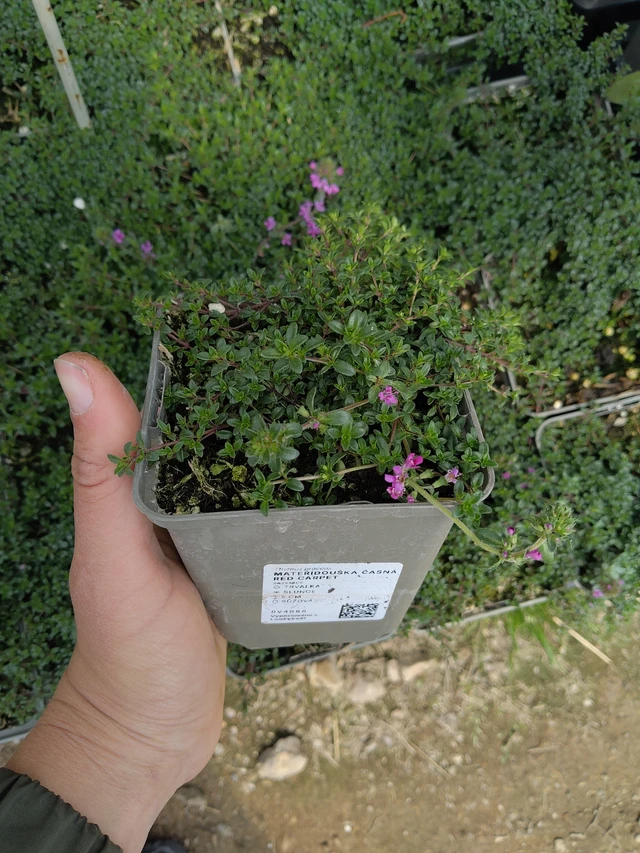
Care during the growing season is absolutely minimal and can easily be handled by any beginner. Thyme does not require any fertilizing and, thanks to its origin from dry steppe areas, it will make do with natural rainfall after taking root. Apply artificial watering only in periods of extreme drought. The fundamental advantage of the 'Red Carpet' variety is its natural resistance – it does not suffer from any usual diseases and pests avoid it altogether. During June and July, the plant will reward you with a flood of pink to purple flowers, which will attract a multitude of pollinators to the garden, especially bees and bumblebees.
The key task for maintaining a beautiful appearance in the long term is regular pruning back. After flowering at the turn of July and August, cut the whole plant back by about a third. By removing the faded tops, you prevent the formation of seeds and support the thickening of the green carpet. Regarding overwintering, thyme is extremely hardy and will withstand frosts down to -28 °C without problems. There is no need to cover it with pine branches or fabric for the winter. It is only important to ensure that it does not stand in wet soil in the winter months, which could lead to root rot.
If you don't own a garden, the 'Red Carpet' variety is a fantastic choice for growing in containers and window boxes on sunny balconies. Here are a few basic rules for success:
- Choose a sufficiently wide container, thyme likes to creep sideways.
- Create a strong drainage layer of expanded clay or gravel at the bottom of the pot and ensure drainage holes.
- Mix the substrate with sand in a 2:1 ratio in favour of the substrate to ensure maximum permeability.
- Water very sparingly, only when the substrate is completely dry to the touch.
The information given is based on our experience, please use it as a guide only. Times may vary depending on the season, climate, location, sowing and transplanting dates and possibly also the conditions in the greenhouse/greenhouse. We always recommend testing how the plant performs in your conditions. Please do not take this as a guarantee.
How often should I water the thyme and do I need to fertilize it?
Do I need to prune or trim the plant in any way?
How should I prepare the plant for winter? Will it survive our frosts?
Frequently asked questions
Troubleshooting
What should I do if the plant's roots start to rot?
Why is the plant losing its compact shape and not smelling as strong?
Harvest
Can this thyme be used in the kitchen?
Can thyme be used for anything after harvesting?
Planting site
What type of soil does the plant require?
Can I grow this variety in a pot on the balcony?
Where is the best place to plant a thyme seedling?
Basic information
How far apart should I plant the seedlings?
Characteristics
When does the 'Red Carpet' variety bloom and what color is it?
Does thyme attract pollinators to the garden?
Is this plant toxic to pets?
Diseases & pests
Is the 'Red Carpet' variety prone to any pests or diseases?
Propagation
How can I propagate an older plant at home?
Photos in time
See how the seedling looks over the course of a year.
More products in category Wild thyme

Thymus citriodorus
Thyme Lemon

Thymus serpyllum
Thyme Albus

Thymus serphyllus
Thyme Coccineus
Thymus citriodorus
Thyme Doone Valley

Thymus citriodorus
Thyme Silver King
Thymus praecox
Creeping Thyme Albiflorus

Thymus
Creeping Thyme Caborn Wine and Roses

Thymus spp.
Thyme Rose

Thymus citriodorus
Creeping Thyme Silver Queen

Thymus citriodorus
Thyme Aureus

Thymus citriodorus
Creeping Thyme Prostrate

Thymus serpyllum
Thyme Snowdrift

Thymus pulegioides
Thyme Archer's Gold

Thymus serpyllum
Thyme Pink Chintz

Thymus pseudolanuginosus
Woolly Thyme
More products in category Herbs
Mentha spicata
Moroccan mint
Thymus vulgaris
Thyme Compactus
Thymus citriodorus
Thyme Lemon

Satureja montana
Winter Savory
Thymus serpyllum
Thyme Albus

Mentha piperita citrata
Chocolate mint
Thymus serphyllus
Thyme Coccineus

Artemisia abrotanum var. maritima
Artemisia Coca Cola

Lippia citriodora
Lemon verbena

Helichrysum angustifolia
Curry plant Tall Curry

Valeriana officinalis
Valerian

Origanum vulgare
Oregano Compactum

Levisticum officinale
Lovage
Thymus citriodorus
Thyme Doone Valley

Coriandrum sativum
Coriander

Mentha spicata
Spanish Mint

Origanum vulgare
Oregano Supreme
Petroselinum hortense
Garden Parsley

Origanum rotundifolia
Ornamental oregano Kent Beauty

Anethum graveolens


