
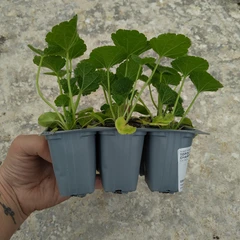
Alcea rosea plena
Hollyhock Chaters Chamois
Six-pack
Attracts pollinators 🐝
Blooming period
Difficulty
Diseases
Edible
Flower color
Flower color: Shade
Foliage color
Frost resistance
Hardiness zone
Height
Moisture
Pests
Position
Self-seeding
Short-lived perennial
Soil
Spacing
Spacing: Plants per m²
Species
Suitable for cutting
Support
Recommended products

Geum chiloense
Avens Tempest Scarlet

Nepeta racemosa
Catmint Superba

Mentha piperita
Mint Eau de Cologne

Salvia pratensis
Meadow Sage Swan Lake

Geum rivale
Geum Mango Lassi

Mentha spicata
Moroccan mint

Paeonia
Peony Coral Charm

Lythrum salicaria
Loosestrife Blush

Dicentra spectabilis
Bleeding Heart

Papaver orientale
Oriental Poppy Royal Wedding

Verbascum nigrum var. album
Black Mullein

Geum chiloense
Avens Totally Tangerine

Deschampsia cespitosa
Tufted hairgrass Schottland

Paeonia
Peony Shirley Temple

Sesleria caerulea
Blue Moor Grass

Cynoglossum amabile
Chinese forget-me-not Pinks & Clouds Mix

Paeonia
Peony Monsieur Jules Elie

Petroselinum hortense
Garden Parsley

Polemonium caeruleum
Jacob's Ladder Blue Pearl

Aquilegia vulgaris
Columbine Black Barlow

Echinacea purpurea
Coneflower Rubinstern

Physostegia virginiana
Obedient plant Alba

Liatris spicata
Liatris Floristan White

Nepeta faassenii
Catmint Alba

Salvia pratensis
Meadow Sage Rose Rhapsody

Achillea millefolium
Yarrow Lilac Beauty

Paeonia
Peony Marie Lemoine

Lavatera olbia
Tree mallow Candy Floss

Paeonia
Peony Duchesse de Nemours

Paeonia
Peony Sarah Bernhardt
Cultivation
A natural characteristic of hollyhocks is their short lifespan. For the longest possible lifespan, we select the most suitable location. It should be a sunny, warm place protected from the wind. The soil must be permeable, sandy-loam. When planting, we leave larger spaces between plants and preferably combine them with lower species to naturally prevent the spread of rust. If diseased leaves do appear, we remove them. At the end of September, we can cut the hollyhocks back; this will strengthen them and help the formation of strong shoots next year.
The information given is based on our experience, please use it as a guide only. Times may vary depending on the season, climate, location, sowing and transplanting dates and possibly also the conditions in the greenhouse/greenhouse. We always recommend testing how the plant performs in your conditions. Please do not take this as a guarantee.
More products in category Hollyhock

Alcea rosea hybr.
Hollyhock Spotlight Radiant Rose

Alcea rosea plena
Hollyhock Chaters Rosa
More products in category Six-packs


Callistephus chinensis
China aster Lady Coral Chamois

Helichrysum bracteatum
Strawflower silvery pink

Cosmos bipinnatus
Cosmos Cupcakes White

Scabiosa atropurpurea
Scabiosa QIS Dark Blue

Cosmos bipinnatus
Cosmos Cupcakes Blush


Helichrysum bracteatum
Strawflower Salmon

Cosmos bipinnatus
Cosmos Velouette

Callistephus chinensis
China aster Valkyrie Holländer Salmon

Helichrysum bracteatum
Strawflower White


Callistephus chinensis
China aster Matsumoto Yellow

Scabiosa atropurpurea
Scabiosa QIS Deep Red

Cosmos bipinnatus
Cosmos Double Click Snow Puff


Helichrysum bracteatum
Strawflower Orange


