

Astrantia
Masterwort Star of Love
Seedling

Attracts pollinators 🐝
Difficulty
Diseases
Edible
Flower color
Flower color: Shade
Foliage color
Fragrant (aromatic) 👃
Frost resistance
Hardiness zone
Height
Moisture
Pests
Position
Soil
Spacing
Spacing: Plants per m²
Species
Suitable for cutting
Suitable for drying
Recommended products

Veronica longifolia
Speedwell First Love

Lythrum salicaria
Loosestrife Blush

Anemone hybrida
Japanese Anemone Whirlwind

Clematis heracleifolia
Clematis Mrs R. Brydon

Helleborus orientalis
Hellebore Double Ellen Picotee

Alchemilla mollis
Lady's mantle Irish Silk

Sedum telephium
Sedum Herbstfreude

Anemone hybrida
Japanese anemone Lorelei

Achillea millefolium
Yarrow Cassis

Helleborus orientalis
Hellebore Double Ellen Yellow Spotted

Helleborus orientalis
Hellebore Double Ellen White

Lavandula angustifolia
Lavender Rosea

Aster pringlei
Aster Pink Star

Catananche caerulea
Cupid's Dart Alba

Echinacea purpurea
Coneflower Rubinstern

Knautia macedonica
Knautia Red Knight

Cephalaria gigantea
Giant scabious

Papaver orientale
Oriental Poppy Royal Wedding

Omphalodes verna
Blue-eyed Mary

Anemone hybrida
Japanese Anemone Königin Charlotte

Anemone hybrida
Japanese Anemone Serenade

Persicaria amplexicaulis
Persicaria Speciosa

Aster ericoides
Aster Pink Cloud

Anemone hupehensis
Anemone Praecox

Panicum virgatum
Switchgrass Northwind

Sedum spectabile
Sedum Matrona

Astilbe arendsii
Astilbe Fanal

Anaphalis triplinervis
Pearly Everlasting

Helleborus orientalis
Hellebore Double Ellen Pink Spotted

Echinacea hybrida
Coneflower Aloha
Cultivation
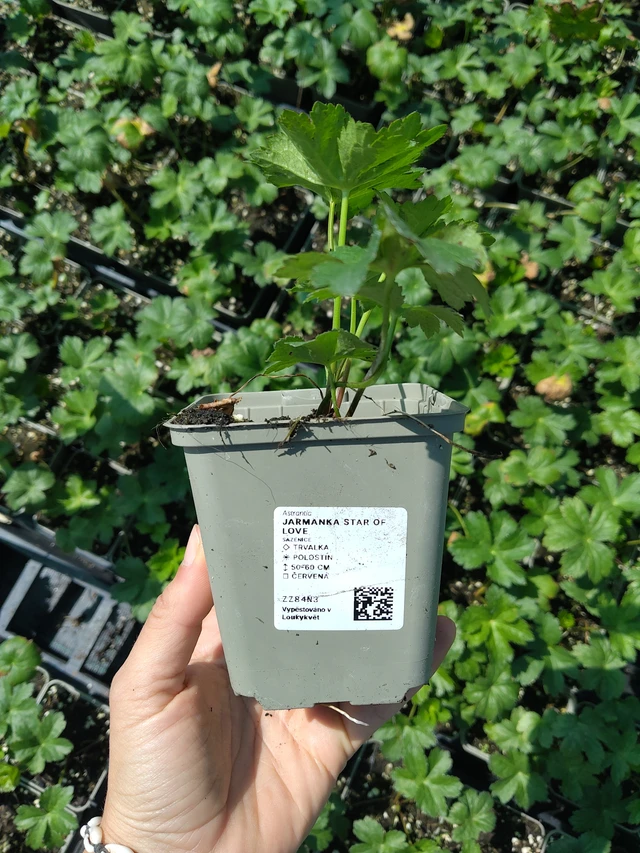
Astrantia Star of Love is a long-lived perennial that you will receive from us as a strong seedling ready directly for planting. It thrives best in semi-shade, but it will handle full sun without any problems if you provide it with more generous and frequent watering. The key to success is humous, well-draining, and loamy soil that can retain moisture well, but is not permanently waterlogged. Plant the seedlings at a distance of 35 to 45 centimeters, which corresponds to roughly seven to nine plants per square meter. This sufficient spacing is very important to ensure good air circulation.
During the summer, masterwort requires regular watering so the soil remains slightly moist. Customers very often ask us if this perennial can also be grown in containers. The good news is, yes! Choose a sufficiently spacious pot with drainage holes at the bottom and use a high-quality substrate rich in nutrients. When growing in a container, however, do not forget that the confined space dries out much faster than open ground in a flowerbed, so regular watering is an absolute necessity. To encourage healthy growth and abundant blooming, you can occasionally add a standard liquid fertilizer for flowering perennials to the watering during the season.
This variety grows to a height of 50 to 60 centimeters and forms very sturdy stems, so it needs no support even in windier places. It blooms from June to the end of August, and its burgundy flowers reliably attract bees and other pollinators from the surrounding area. During the season, we recommend continuously removing faded stems. This simple cut will save the plant energy and encourage it to form new buds. The flowers are wonderfully suited for cutting into a vase; you can dry them, and since they are not toxic, but actually edible, they will also serve as an original decoration for summer desserts. Regarding pest protection, pay attention primarily to the spring period, when slugs and snails like to attack the freshly sprouting young leaves.
With the arrival of autumn, the plant gradually dies back. You can cut off the dried leaves and stems just above the ground either late in the autumn or early in the spring before the plant begins to sprout again. Astrantia is extremely frost-resistant and easily tolerates temperatures dropping down to minus 34 degrees Celsius. In an open flowerbed, therefore, it needs absolutely no special winter protection. Only in the case of growing in a pot do we recommend wrapping the container with jute or non-woven fabric so that freezing from the sides does not damage the root ball.
The information given is based on our experience, please use it as a guide only. Times may vary depending on the season, climate, location, sowing and transplanting dates and possibly also the conditions in the greenhouse/greenhouse. We always recommend testing how the plant performs in your conditions. Please do not take this as a guarantee.
Frequently
asked
questions
Diseases & pests
Which pests most commonly attack this plant?
Does Astrantia suffer from any diseases?
Growing
What kind of soil and watering does the plant need?
Do I need to cover and protect Astrantia for the winter?
Does the plant need support to prevent it from falling over?
What is the best way to care for Astrantia after it has finished flowering?
At what spacing should I plant the seedlings?
Characteristics
Does Astrantia attract bees and butterflies to the garden?
Can Astrantia flowers be eaten and used in the kitchen?
Is Astrantia poisonous to children or pets?
When and how long does the Star of Love variety bloom?
Harvest
Are the flowers suitable for cutting for a vase or for drying?
Troubleshooting
Why are the leaves on my Astrantia turning brown or drying out?
Propagation
How can I propagate Astrantia?
Planting site
Where is the best place to plant the Astrantia seedling?
Can Astrantia also be grown in a pot on a balcony?
Photos
in time
See how the seedling looks over the course of a year.

More products in category Masterwort

Astrantia major
Astrantia

Astrantia major
Masterwort Alba

Astrantia major
Astrantia Shaggy

Astrantia major
Astrantia Roma
More products in category Perennials
Alchemilla mollis
Lady's mantle Irish Silk

Achillea millefolium
Yarrow Summer Pastels

Verbena bonariensis
Verbena

Salvia nemorosa
Woodland Sage Caradonna

Perovskia atriplicifolia
Russian Sage

Gaura lindheimeri
Gaura Siskiyou Pink
Echinacea purpurea
Coneflower Rubinstern

Echinacea pallida
Echinacea pallida

Eryngium planum
Sea Holly

Echinacea purpurea
Coneflower Magnus

Calamintha nepeta
Calamint Blue Cloud

Salvia nemorosa
Woodland Sage Ostfriesland

Rudbeckia fulgida
Rudbeckia Goldsturm

Gaura lindheimeri
Gaura Summer Breeze

Calamintha nepeta ssp. nepeta
Calamint

Salvia nemorosa
Woodland Sage Amethyst

Leucanthemum vulgare
Daisy Maikönigin

Perovskia atriplicifolia
Russian sage Little Spire

Achillea millefolium
Yarrow Terracotta

Salvia nemorosa


