

Gaura lindheimeri
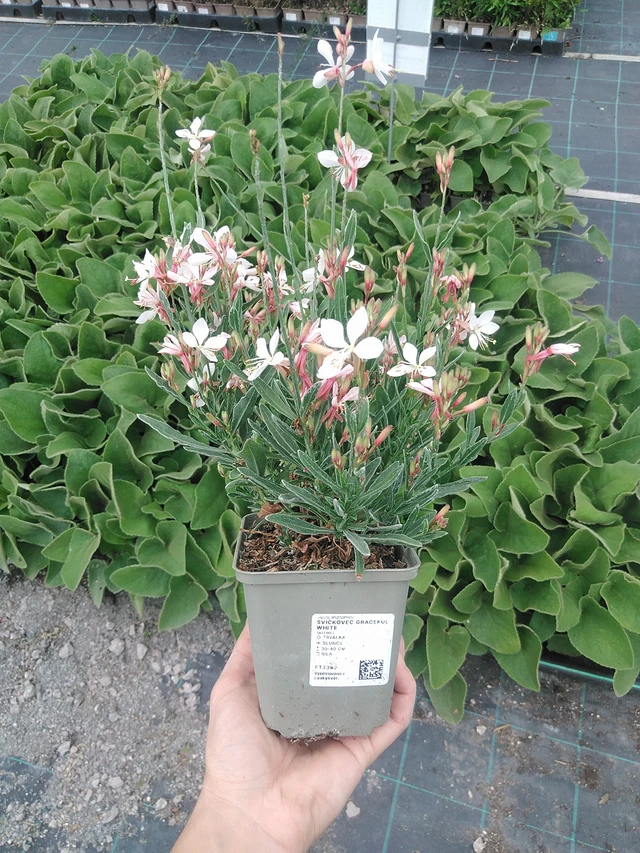
Gaura Graceful White
Seedling


Attracts pollinators 🐝
Difficulty
Diseases
Edible
Flower color
Flower color: Shade
Foliage color
Fragrant (aromatic) 👃
Frost resistance
Hardiness zone
Height
Moisture
Pests
Position
Soil
Spacing
Spacing: Plants per m²
Species
Suitable for cutting
Suitable for drying
Recommended products

Pennisetum alopecuroides
Fountain grass Hameln

Salvia nemorosa
Woodland Sage Schneehügel

Salvia nemorosa
Woodland Sage Ostfriesland

Calamagrostis acutiflora
Feather Reed Grass Karl Förster

Salvia nemorosa
Woodland sage Schwellenburg

Achillea millefolium
Yarrow Summer Pastels

Petroselinum hortense
Garden Parsley

Achillea millefolium
Yarrow Lilac Beauty

Coreopsis verticillata
Coreopsis Moonbeam

Achillea millefolium
Yarrow Terracotta

Alchemilla mollis
Lady's mantle Irish Silk

Verbena bonariensis
Verbena

Filipendula hybridum
Meadowsweet Kahome

Perovskia
Russian Sage Blue Spire

Sedum spectabile
Sedum Matrona

Salvia nemorosa
Salvia Mainacht

Hyssopus officinalis
Hyssop Albus

Calamintha nepeta ssp. nepeta
Calamint

Achillea millefolium
Yarrow Lachsschönheit

Aster novi-belgii
Aster novi-belgii Marie Ballard

Geum rivale
Geum Mango Lassi

Gaura lindheimeri
Gaura

Salvia pratensis
Meadow Sage Rose Rhapsody

Helleborus orientalis
Hellebore Double Ellen Yellow Spotted

Scabiosa columbaria
Scabiosa Pink Mist

Coreopsis verticillata
Coreopsis Zagreb

Anemone tomentosa
Anemone Robustissima

Lavandula angustifolia
Lavender Rosea

Knautia macedonica
Knautia Red Knight

Aster novi-belgii
Aster novi-belgii Fellowship
Cultivation
Gaura is a plant that will bring lightness and elegance to your garden, with minimal maintenance requirements, which will be especially appreciated by beginner growers. Plant this seedling exclusively in full sun, where its stems will not stretch for light and will maintain their compact, firm shape. Soil conditions for Gaura are specific in that it prefers to be rather "starved" – dry, sandy, and even gravelly soil suits it well. In heavy and wet ground, the roots would quickly rot, so avoid places where water collects after rain. When planting, maintain a spacing of about 40 cm so that the plants form a closed canopy but do not compete with each other. Because it is a plant with a taproot, consider the planting location carefully – Gaura is difficult to transplant later.
Care during the growing season is very easy, as the plant is naturally accustomed to harsh conditions. Limit watering to a minimum; Gaura is one of the plants that tolerates drought excellently, and excessive moisture is rather harmful to it. Fertilization is basically not needed, or only very sparingly at the beginning of the season, so you do not encourage excessive growth of green mass at the expense of flowering. The beauty of the 'Graceful White' cultivar lies in a flood of white flowers from summer to autumn. If you want to prolong and intensify the blooming even further, you can cut back the spent stems in mid-summer; the plant will quickly resprout and set new buds. Moreover, the plant is completely free of pests and diseases, so there is no need to worry about chemical protection.
When growing in containers, for which this shorter cultivar is perfect, ensure that the container has sufficient volume and, above all, functional water drainage. Use a substrate for balcony plants mixed with perlite or sand for better drainage. While Gaura is fully frost-hardy in the flowerbed (up to -23 °C), in a container the roots are exposed to frost from all sides, so it is necessary to insulate the pots for the winter or sink them into the ground. As for overwintering in the flowerbed, do not remove the above-ground part of the plant until spring. The dry stems and leaves act as natural insulation and protect the plant's crown from winter moisture, which is more risky for Gaura than the frost itself. Although it is a short-lived perennial, it is often maintained in its habitat by self-seeding, so you can enjoy its delicate flowers for many years.
The information given is based on our experience, please use it as a guide only. Times may vary depending on the season, climate, location, sowing and transplanting dates and possibly also the conditions in the greenhouse/greenhouse. We always recommend testing how the plant performs in your conditions. Please do not take this as a guarantee.
How often do I need to water this Gaura?
Is 'Graceful White' Gaura frost-hardy?
Do I need to fertilize Gaura?
What is the recommended planting spacing for these seedlings?
When and how should I prune Gaura?
Frequently asked questions
Planting site
What is the best location for Gaura 'Graceful White'?
Can this cultivar be grown in a pot?
What kind of soil should I prepare for Gaura?
Diseases & pests
Is Gaura prone to any pests or diseases?
Characteristics
Does Gaura attract bees and butterflies?
Is it true that Gaura is a short-lived perennial?
How long does Gaura bloom?
Harvest
Are Gaura flowers suitable for cutting?
Photos in time
See how the seedling looks over the course of a year.


More products in category Gaura

Gaura lindheimeri
Gaura Siskiyou Pink

Gaura lindheimeri
Gaura Summer Breeze
Gaura lindheimeri
Gaura

Gaura lindheimeri
Gaura Whirling Butterflies

Gaura lindheimeri
Gaura Rosy Jane

Gaura lindheimeri
Gaura Cool Breeze

Gaura lindheimeri
Gaura Sparkle White

Gaura lindheimeri
Gaura Graceful Blush

Gaura lindheimeri
Gaura Geyser® White

Gaura lindheimeri
Gaura Geyser® Pink
More products in category Perennials
Alchemilla mollis
Lady's mantle Irish Silk
Achillea millefolium
Yarrow Summer Pastels
Verbena bonariensis
Verbena

Salvia nemorosa
Woodland Sage Caradonna

Perovskia atriplicifolia
Russian Sage
Gaura lindheimeri
Gaura Siskiyou Pink

Echinacea purpurea
Coneflower Rubinstern

Echinacea pallida
Echinacea pallida
Salvia nemorosa
Woodland Sage Ostfriesland

Eryngium planum
Sea Holly

Echinacea purpurea
Coneflower Magnus

Calamintha nepeta
Calamint Blue Cloud

Rudbeckia fulgida
Rudbeckia Goldsturm
Calamintha nepeta ssp. nepeta
Calamint
Gaura lindheimeri
Gaura Summer Breeze

Salvia nemorosa
Woodland Sage Amethyst

Leucanthemum vulgare
Daisy Maikönigin
Achillea millefolium
Yarrow Terracotta

Perovskia atriplicifolia
Russian sage Little Spire
Salvia nemorosa


