
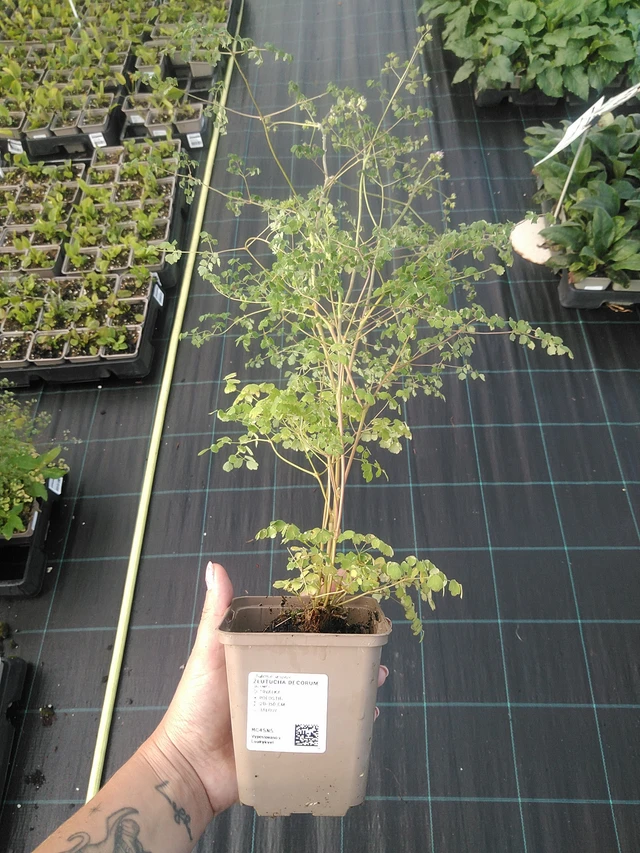
Thalictrum delavayi
Meadow rue Decorum
Seedling


Attracts pollinators 🐝
Difficulty
Diseases
Edible
Flower color
Flower color: Shade
Foliage color
Fragrant (aromatic) 👃
Frost resistance
Hardiness zone
Height
Moisture
Pests
Position
Soil
Spacing
Spacing: Plants per m²
Species
Suitable for cutting
Suitable for drying
Recommended products

Helleborus orientalis
Hellebore Double Ellen Picotee

Helleborus orientalis
Hellebore Double Ellen Yellow Spotted

Anemone hybrida
Japanese Anemone Serenade

Anemone hybrida
Japanese Anemone Andrea Atkinson

Anemone hybrida
Japanese Anemone Whirlwind

Filipendula hybridum
Meadowsweet Kahome

Aquilegia vulgaris
Columbine Rose Barlow

Helleborus orientalis
Hellebore Double Ellen White

Anemone hybrida
Japanese anemone Lorelei

Alchemilla mollis
Lady's mantle Irish Silk

Achillea millefolium
Yarrow Summer Pastels

Clematis heracleifolia
Clematis Mrs R. Brydon

Luzula nivea
Snowy Woodrush

Helleborus orientalis
Hellebore Pretty Ellen Pink

Clematis heracleifolia
Clematis New Love

Helleborus orientalis
Hellebore Pretty Ellen Red

Geranium pratense
Cranesbill Midnight Reiter

Thalictrum aquilegiifolium
Columbine meadow-rue

Achillea millefolium
Yarrow Lilac Beauty

Phlox paniculata
Phlox Franz Schubert

Physostegia virginiana
Obedient Plant Rosea

Leucanthemum vulgare
Daisy Maikönigin

Dicentra spectabilis Alba
Bleeding Heart Alba

Catananche caerulea
Shoofly plant Blue

Knautia macedonica
Knautia Red Knight

Salvia nemorosa
Woodland sage Schwellenburg

Papaver orientale
Oriental Poppy Royal Wedding

Achillea millefolium
Yarrow Cerise Queen

Verbascum nigrum var. album
Black Mullein

Nepeta racemosa
Catmint Walker’s Low
Cultivation
Meadow rue is an aristocrat among perennials that will bring lightness and elegance to your garden, but for it to thrive, it requires a slightly specific approach to water and light. Ideally, plant the seedling in spring or autumn in well-prepared, loose soil. It loves a spot where it has "feet in the shade and head in the sun" – meaning moist, cooler soil, but plenty of light for the flowers. If you plant it in full sun, you must be very disciplined with watering. In partial shade, care is a bit easier. The soil must be humous and nutritious; poor sandy soils will not suit it without a massive addition of compost or leaf mold. When planting, keep sufficient spacing; although the plant appears slender, it takes up quite a bit of space in adulthood and needs air circulation so as not to suffer from fungal diseases, even though it is naturally very resistant to them.
During the summer, especially in the blooming period from July to September, meadow rue becomes a magnet for bees and other pollinators. During this period, make sure the plant does not suffer from thirst – drooping leaves are the first sign of water shortage. If you are growing meadow rue in a container, which is a great choice for east- or west-facing terraces, choose a pot with a diameter of at least 40 cm. Put a layer of expanded clay or gravel at the bottom of the pot to drain excess water, and use a high-quality gardening substrate mixed with compost. The risk of the roots overheating is higher in containers, so do not place the pot on hot concrete and regularly check the moisture of the substrate. Watch out, a plant in a pot is more susceptible to the freezing of the root ball, so wrap it in jute or move it to a protected spot for the winter.
In terms of maintenance, meadow rue is an undemanding, long-lived perennial. After blooming, you can remove dry inflorescences if they bother you aesthetically, but the main pruning is done only after the entire above-ground part has dried, ideally at the end of winter before new shoots emerge. The plant is frost-hardy and does not need to be covered with evergreen branches for the winter in the bed. Although it looks like a fragile fairy, it is a resilient perennial. Given its height, it is advisable to place it so that it is protected from strong gusts of wind. Do not forget that it is a poisonous plant, which is good news for resistance to animal browsing, but it requires caution if you have curious pets in the garden.
The information given is based on our experience, please use it as a guide only. Times may vary depending on the season, climate, location, sowing and transplanting dates and possibly also the conditions in the greenhouse/greenhouse. We always recommend testing how the plant performs in your conditions. Please do not take this as a guarantee.
When and how should I prune the Thalictrum?
How often does the Thalictrum need to be watered?
How far apart should I plant the individual plants?
Is the meadow rue frost-hardy, or do I need to cover it for the winter?
Frequently asked questions
Planting site
What is the best location for Thalictrum decorum?
What type of soil should I plant the seedling in?
Characteristics
Are the Thalictrum flowers suitable for cutting for a vase?
Is this plant beneficial for bees and butterflies?
Diseases & pests
Does Thalictrum suffer from any pests or diseases?
Basic information
When will I see flowers and what color are they?
Where does it fit best in a flower bed in terms of composition?
Photos in time
See how the seedling looks over the course of a year.



More products in category Meadow rue

Thalictrum delavayi
Meadow-rue
Thalictrum aquilegiifolium
Columbine meadow-rue

Thalictrum delavayi
Meadow-rue Splendide

Thalictrum delavayi
Meadow-rue Splendide White

Thalictrum delavayi
Meadow-rue Album
More products in category Perennials
Alchemilla mollis
Lady's mantle Irish Silk
Achillea millefolium
Yarrow Summer Pastels

Verbena bonariensis
Verbena

Salvia nemorosa
Woodland Sage Caradonna

Perovskia atriplicifolia
Russian Sage

Gaura lindheimeri
Gaura Siskiyou Pink

Echinacea purpurea
Coneflower Rubinstern

Echinacea pallida
Echinacea pallida

Eryngium planum
Sea Holly

Echinacea purpurea
Coneflower Magnus

Salvia nemorosa
Woodland Sage Ostfriesland

Calamintha nepeta
Calamint Blue Cloud

Rudbeckia fulgida
Rudbeckia Goldsturm

Calamintha nepeta ssp. nepeta
Calamint

Gaura lindheimeri
Gaura Summer Breeze

Salvia nemorosa
Woodland Sage Amethyst
Leucanthemum vulgare
Daisy Maikönigin

Achillea millefolium
Yarrow Terracotta

Perovskia atriplicifolia
Russian sage Little Spire

Salvia nemorosa


