Ireland
🟢 The e-shop for seedlings is open again. 🌱 I also have dahlia seedlings and eucalyptus. 🟢
Ireland
🟢 The e-shop for seedlings is open again. 🌱 I also have dahlia seedlings and eucalyptus. 🟢
Melinis Karoo Queen, Loukykvět

Melinis nerviglumis

Melinis Karoo Queen

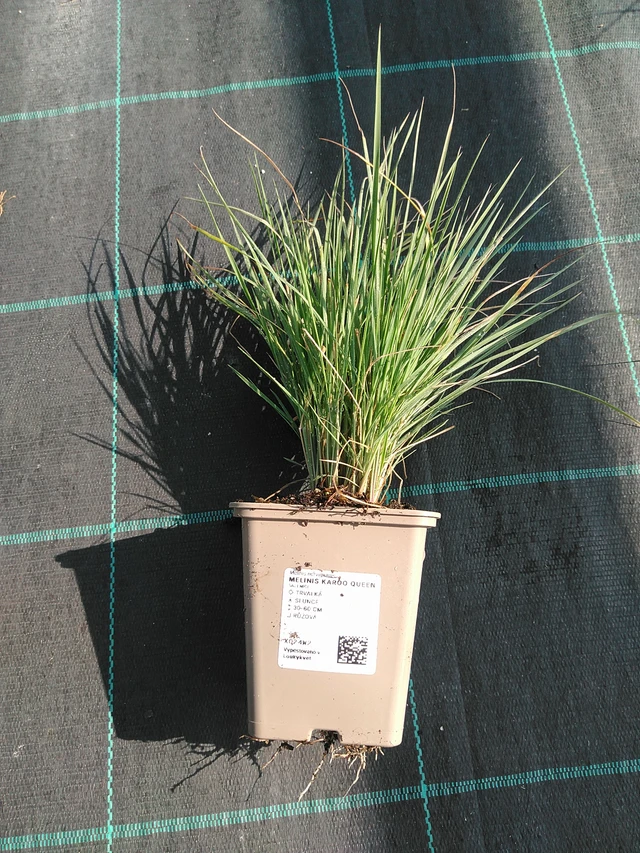
Melinis Karoo Queen comes from the dry regions of Africa. It impresses with its feathery pink-reddish spikelets and overall airy appearance. It beautifully softens flowerbeds with drought-loving perennials and is used in floristry, both fresh and dried. It is not fully hardy here, so it is suitable for growing in containers on sunny terraces. It is most often grown as an annual, but when grown in containers, overwintering in protected bright spaces is worth trying. Show full description

Seedling

Květináč K9 (9×9×9,5 cm)
Seedling
1-2 kusy
3,79/ks
3-8 kusů
3,39/ks
9-17 kusů
3,09/ks
18+ kusů
2,69/ks
Add to cart
Skladem 378 ks

Difficulty

Beginner

Diseases

Disease-free 🙂

Flower color

Red, pink

Foliage color

Grey-green

Frost resistance

-12
?
The temperature down to which the plant is frost hardy.

Hardiness zone

8a (-12.2 °C to -9.4 °C)

Height

30-60 cm

Pests

Pest-free 🙂

Position

Sun

Soil

Sandy, well-drained

Spacing

40-40 cm
?
Recommended planting spacing.

Spacing: Plants per m²

6

Species

Perennial

Suitable for cutting

Ano

Suitable for drying

Ano
1
2
3
4
5
6
7
8
9
10
11
12
Flowering
½ July
½ October

Recommended products

Woodland Sage Amethyst, Loukykvět

Salvia nemorosa

This species of sage originates from the steppe regions of Central and Eastern Europe. It forms profusely flowering small clumps with straight, upright stems. In flower beds, it looks best in groups. It is traditionally planted as a companion to roses due to the matching flowering time. However, it looks equally good in mixed drought-tolerant steppe plantings with grasses. It is an excellent food source for bees. Lasts 7 days in a vase. Amethyst is an elegant variety with long stems and a pink flower color that is unusual for sages.
2,99
More from 2,09
In Stock s doručením od 3. 8. 2026
Clematis Mrs R. Brydon, Loukykvět

Clematis heracleifolia

Clematis 'Mrs R. Brydon' is an unusual and very resilient perennial that brings softness and color to the garden just as summer transitions into autumn. The original species comes from the shrubby and forest edges of East Asia, which is why a location in the sun or partial shade suits it well here too. It will thrive in loamy and humus-rich soil with regular watering. An interesting feature of this clematis is its variable growth. If you provide it with support in the form of a fence or trellis, it will willingly climb up to a height of two and a half meters. However, if you leave it to grow freely without support, it grows like a carpet and forms a dense shrub. You will receive a grown seedling in a pot from us, which you can simply transplant straight into the garden. Care is easy, it doesn't suffer from diseases or pests, and even beginners can easily manage it. During August and September, it gets covered in an abundance of flowers in a gorgeous lavender-blue shade, which react to the ambient temperature and can interestingly fade or darken. The flowers reliably attract bees and are suitable for cutting into bouquets. When handling, remember that the plant is poisonous.
3,89
More from 2,89
In Stock posledních 65 kusů
Gaura Siskiyou Pink, Loukykvět

Gaura lindheimeri

Gaura Siskiyou Pink is a charming perennial that brings lightness and airiness to the garden. Its original native area is in the warm regions of Texas and Louisiana, which is why it thrives in full sun and well-drained sandy soil. It grows in clumps and from June until the autumn frosts produces tiny raspberry-pink flowers that resemble fluttering butterflies. An interesting detail of this variety is the green leaves with a bronze tint and red spots. It is an absolutely undemanding plant, does not suffer from diseases or pests, and even beginners can handle its care. You will receive a grown seedling in a pot from us, which you simply need to transplant directly into the flowerbed. Here it complements ornamental grasses perfectly and acts as an attraction for bees and bumblebees. Although it grows more as a short-lived perennial in our climate, in a suitable place it reliably self-seeds. Occasional pinching will encourage richer branching. Gaura is excellent for summer bouquets. We cut the stems for a vase as soon as the first two to three little flowers open.
2,99
More from 2,09
In Stock
Gaura Summer Breeze, Loukykvět

Gaura lindheimeri

The charming gaura comes from the sun-drenched plains of Texas and Louisiana and represents exactly the plant that can liven up any drought-tolerant planting. It is a naturally profusely blooming perennial that delights in full sun and well-drained, sandy, and nutrient-poor soil. You will receive from us an already grown seedling in a pot, which will quickly form a vigorous clump after being transplanted into the garden. From early summer until late autumn, it will delight you with a flood of tiny flowers in pure white and delicate pink tones. The flowers gently sway in the breeze and with their appearance resemble a flock of tiny butterflies, which also really like to land on the plant, as do bees and bumblebees. Although gaura is known as a short-lived perennial, thanks to its willing self-seeding, it will last for many years in your garden. Caring for it is completely undemanding, it is avoided by most diseases and pests, and it can handle frosts down to eighteen degrees below zero without any problems. It is often used in mixed borders, where it beautifully softens the overall impression, and perfectly matches various types of ornamental grasses. The Summer Breeze variety is popular for its strong and healthy growth as well as its exceptionally generous set of flowers, which grow to about one meter. If you like to create your own bouquets, do not hesitate to cut gaura for a vase. Harvesting is best done the moment the first small flowers on the stem begin to open. These delicate flowers are not suitable for drying into dried arrangements, but they will beautifully lighten up fresh bouquets.
2,99
More from 2,09
In Stock s doručením od 7. 9. 2026
Dahlia L.A.T.E., Loukykvět
4,77
3,79
More from 2,69
Unavailable
Pro rok 2026 nedostupné
Smooth Hydrangea Annabelle, Loukykvět

Hydrangea arborescens

A dense hemispherical shrub with smooth fresh green leaves that are lighter on the underside. Flowers in convex to hemispherical inflorescences with a diameter of 15–30 cm gradually change color from pale green and cream to pure white.
4,29
More from 3,89
In Stock
Panicle Hydrangea Pink Diamond, Loukykvět

Hydrangea paniculata

Panicle hydrangeas are beautiful shrubs originating from China and Japan, where their bark was used, among other things, to make paper. We grow them for their impressive conical inflorescences. They are undemanding and richly flowering plants suitable for planting in beds and larger containers. Pink Diamond has 30 cm large inflorescences, initially cream-colored, which later change to pink.
4,29
More from 3,89
In Stock
Panicle Hydrangea Silver Dollar, Loukykvět

Hydrangea paniculata

Panicle hydrangeas are beautiful shrubs originating from China and Japan, where their bark was used, among other things, to make paper. We grow them for their impressive conical inflorescences. They are undemanding and richly flowering plants suitable for planting in beds and larger containers. The large inflorescences of the Silver Dollar cultivar gradually change color from fresh green to white. In autumn, they turn only subtly pink.
3,89
More from 2,89
In Stock
Black Mullein, Loukykvět

Verbascum nigrum var. album

Dark mullein is a native perennial and a popular medicinal herb that will bring a piece of unbridled nature into your garden. Its natural home is found on sunny slopes, embankments, and roadsides, which is why it thrives best in our gardens in full sun, in well-drained and rather sandy soil. It can handle longer periods of drought and easily survives frosts down to minus twenty-three degrees. It forms a neat basal rosette of dark green leaves, from which sturdy stems over a meter tall emerge in May and June. While the original wild species blooms yellow, this exceptional var. album form boasts pure white flowers cleverly decorated with purple and finely hairy stamens. These flowers act literally as a magnet for bees and other beneficial pollinators. Although it is a short-lived perennial, if it likes it at your place, it will reliably take care of new seedlings and grow in the same spot in the following years. In a flowerbed, it perfectly complements drought-tolerant grasses and fits beautifully into naturally styled plantings. You can also confidently cut the sturdy, tall flower stems for a vase, where they will look stunning for several days, and they serve as an unconventional element in summer bouquets. Mullein does not require any complicated care, and generally does not suffer from pests or diseases, so even complete beginners can grow it without any trouble.
2,79
More from 1,99
In Stock posledních 69 kusů
Japanese Anemone Königin Charlotte, Loukykvět

Anemone hybrida

Anemones come from the same family as buttercups. With their elegant flowers on long slender stems, they can enliven and brighten up late summer and autumn flowerbeds. They stand out against the darker background of shrub groups and will also appreciate their partial shade. The Czech Perennial Association chose autumn anemones as the perennial of the season for 2022. They last 7 days in a vase. Königin Charlotte is a massive taller variety bred as early as 1898. It has strong, firm stems and semi-double large violet-pink flowers. The outer sides of the silky smooth petals are colored violet.
4,79
More from 3,59
In Stock
Great Burnet, Loukykvět
Perennial of the Season 2026

Sanguisorba officinalis

Great burnet is a native meadow plant that naturally grows in wet meadows, where it forms dense clumps of dark green pinnate leaves. In the middle of summer, tall, richly branched stems grow from them, topped with tiny dark red to burgundy flower heads that gently sway in the breeze. This perennial is absolutely indispensable for the life cycle of the rare scarce large blue butterfly, which it will reliably attract to your garden with its flowers. In perennial beds, it stands out especially in naturalistic compositions, where in combination with ornamental grasses it creates an airy and light effect. The inflorescences are also an excellent material for florists, adding an unusual structure and color accent to bouquets, while staying fresh for seven to ten days in a vase. If you don't harvest them fresh, you can dry them for winter decorations, as they hold their shape for a long time.
2,79
More from 1,99
In Stock
Russian Sage, Loukykvět

Perovskia atriplicifolia

Russian sage reliably brings a touch of sunny steppes into the garden and places almost no demands on care. These sparsely branched subshrubs originally come from harsh, rocky areas from Afghanistan to Tibet, where they grow on open sun-drenched plains. Thanks to its origin, it delights in full sun and poor, well-drained sandy soil with minimal moisture. You will receive from us a well-rooted seedling in a pot, which just needs to be transplanted straight to the chosen spot in the flower bed. It does not need support, is avoided by common pests and diseases, and will survive frosts down to minus twenty-eight degrees. It grows up to one hundred and twenty centimeters and forms striking white felted shoots with silvery grey aromatic leaves. From July to October, it blooms with tiny blue-purple flowers that act as a lure for bees and butterflies and are even edible. Russian sage stands out next to drought-tolerant perennials. The flowers are suitable for cutting and drying for winter arrangements. Moreover, the silvery stems will ensure a beautiful winter effect in the flower bed.
2,99
More from 2,09
In Stock
Baby's Breath Snowflake, Loukykvět
For drying

Gypsophila paniculata

Baby's breath Snowflake is an absolute classic that should not be missing in any traditional or modern garden. This perennial plant originally comes from the sandy steppes and sunny slopes of southern Europe and Central Asia, which predestines it to love full sun and well-drained, even sandy soil. It has been grown in botanical gardens since the eighteenth century, and thanks to its low maintenance, it quickly found its way into private gardens as well. It forms rich, airy clumps that look like white clouds when in bloom and bring a unique lightness to flower beds. The Snowflake variety stands out with a flood of pure white, mostly double flowers that appear from June to August. It is an ideal plant for modern steppe plantings, where it perfectly complements ornamental grasses and drought-tolerant perennials, but it is also traditionally planted as a delicate companion to roses. For florists, baby's breath is indispensable. It is excellent for cutting into fresh bouquets, where it adds volume and softens the overall impression, and it can just as well be dried for winter decorations. The plant is frost-hardy and long-lived, so it will bring you joy in the garden for many years.
3,09
More from 2,19
Coming Soon
Hyssop Roseus, Loukykvět

Hyssopus officinalis

The Roseus hyssop is an aromatic subshrub whose structure and requirements strongly resemble the popular lavender. It originally comes from the sunny and dry regions of the Mediterranean and Asia Minor, so it thrives best in direct sun here as well. It favors well-drained, sandy, and even nutrient-poor soil, where it easily copes with a lack of moisture. You will receive a grown seedling in a pot from us, which you simply transplant straight into the flower bed, where it will very soon form a neat, richly branched bush reaching a height of around fifty centimeters. It is an absolutely undemanding plant that is not bothered by diseases or pests, so its cultivation can be easily handled even by complete beginners. It comfortably withstands severe frosts down to minus twenty-three degrees Celsius. In the garden, hyssop finds wide application. It fits perfectly into steppe-character gravel beds and beautifully complements roses or lower ornamental grasses. During the summer until early autumn, the Roseus variety will delight you with a flood of tiny flowers in a delicate light pink shade. These flowers, as well as the narrow green leaves, emit a pleasant spicy fragrance and reliably act as a huge lure for bees, bumblebees, and butterflies. Since all parts of the plant are edible, you can also use hyssop in the kitchen as a herb to flavor dishes or prepare a medicinal tea from it. You can also cut the long flowering stems for a vase, where they will add a fine texture and lightness to summer bouquets. Although the flowers are not suitable for drying for floral purposes, the plant will please you in the flower bed even out of season. The inflorescences form an interesting structure which, after the leaves fall and are covered by morning frost, creates a beautiful winter effect. Furthermore, if you provide hyssop with ideal conditions, it will reliably self-seed in its location and remain a solid part of your garden for many years.
2,79
More from 1,99
In Stock
Calamagrostis villosa, Loukykvět

Calamagrostis brachytricha

Korean feather reed grass originates from East Asia. It is grown for its beautiful fluffy panicles on strong upright stems. Arching leaves sprout early in spring and take on a bronze tint in autumn. Spectacular on misty autumn mornings when dew drops get caught in the panicles and sparkle in the sun. Hence its name – diamond grass. Lasts up to 10 days in a vase.
4,29
More from 2,99
In Stock
Rudbeckia Goldsturm, Loukykvět

Rudbeckia fulgida

Rudbeckia Goldsturm is a reliable and long-lived perennial that will bring the warm tones of late summer and autumn into your garden. It originally comes from the open plains and prairies of North America, so it delights most in sunny locations with common garden soil, whether it is loamy, humus-rich, or clayey. You will receive from us an already grown seedling in a pot, which you just need to transplant to the chosen spot in the flower bed. It is a completely undemanding plant, does not suffer from diseases or pests, and easily survives severe frosts. The Goldsturm cultivar grows to a height of about seventy centimeters and does not need support. From August to October, it produces a flood of golden-yellow flowers with distinctly dark centers. These edible flowers attract pollinators and fit perfectly into both prairie and rustic plantings. Rudbeckia is also great for cutting, lasting around ten days in a vase. In addition, the distinctive dark centers can be easily dried. If you leave them in the flower bed over the winter, they will provide a wonderful spectacle.
2,79
More from 1,99
In Stock
Coreopsis Moonbeam, Loukykvět

Coreopsis verticillata

If you are looking for a delicate and long-blooming plant for full sun, whorled tickseed is a great choice. The basic species originates from North America, and here it thrives best in a sunny spot and well-drained, rather drier loamy soil. Although it is a short-lived perennial, with the right care and a well-chosen location, it can bring joy for several years. A distinctive feature of this species is its rich foliage of very tiny leaves, which form low, about forty-centimeter-tall bushes. After transplanting from the pot, the mature seedling is perfectly suited for the edges of flower beds or mixed drought-tolerant compositions, where it beautifully softens the overall look. In addition, the plant is fully frost-hardy, requires no special care, and is free from diseases. The 'Moonbeam' variety stands out with countless smaller, creamy-yellow flowers. These appear in mid-summer and continue to decorate the garden until early autumn, providing rich pasture for pollinators. You can easily cut the delicate stems with flowers to bring home. They will add an informal meadow touch to bouquets and will maintain their freshness in a vase for about seven days.
2,99
More from 2,09
In Stock
Spiked Speedwell Alba, Loukykvět

Veronica spicata

A carpet-forming species of speedwell. In the warmest and driest areas, it grows naturally even here. Ideal for south-facing slopes, rock gardens, but also for containers on roof gardens and dry lawns. A cultivar of the native species with pure white flowers arranged in candle-like inflorescences.
2,99
More from 2,09
Unavailable
Pro rok 2026 nedostupné
Speedwell Blue Feathers, Loukykvět

Veronica pinnata

Originally from Siberia, this is an unusual species of speedwell with fine, filigree-like foliage and light blue flowers. It grows well in rock gardens, flower beds, and containers. It is not very tall, is suitable for cutting, and thanks to its delicate leaves, remains attractive even when not in bloom.
2,99
More from 2,09
In Stock
Bluebeard Heavenly Blue, Loukykvět

Caryopteris clandonensis

Bluebeard Heavenly Blue is a charming smaller shrub that will prolong the summer atmosphere of your garden deep into autumn. The original species of this shrub come from the dry and warm regions of East Asia, which is why it enjoys full sun and well-drained, sandy or loamy soil the most here too. It tolerates drought and heat excellently, so it fits perfectly into steppe and Mediterranean-style plantings. It forms compact small shrubs reaching a height of around one meter. It is adorned with fragrant gray-green leaves and shoots, which in themselves bring an interesting texture to flowerbeds. During August and September, it then blooms with striking blue flowers clustered in dense panicles. These are a literal magnet for bees, bumblebees, and butterflies. It is an exceptionally resilient plant that even complete beginners can manage to grow. It does not suffer from any diseases or pests and easily handles frosts down to -23 °C. You will receive a grown seedling in a pot from us, which you simply need to transplant straight into your chosen spot. Bluebeard Heavenly Blue is also an excellent choice for florists. It is suitable for cutting into summer and autumn bouquets, where its blue flowers will stand out beautifully. If you do not harvest the flowers, the shrub remains ornamental even after fading, thanks to its decorative seed heads, which create a beautiful winter effect in the flowerbed.
3,89
More from 2,89
In Stock
Bluebeard Sterling Silver, Loukykvět

Caryopteris clandonensis

Caryopteris clandonensis is an undemanding smaller shrub that will bring a summer mood to your garden and maintain it until autumn. The original species come from East Asia, where they grow in sunny and drier places. Therefore, here it will appreciate full sun and well-drained, even sandy soil. It handles drought excellently and loves warmth. From August to September, it blooms with dense panicles of blue flowers that smell pleasant and act as an attraction for pollinators. It is a problem-free plant, does not suffer from diseases, and can withstand frosts down to minus twenty-three degrees. The 'Sterling Silver' cultivar stands out with its silvery gray-green leaves. It will perfectly fit into Mediterranean-style drought-tolerant beds. You will receive a mature potted seedling from us, which you just need to transplant outdoors. The blue flowers are suitable for cutting into bouquets. The shrub does not lose its ornamental function even after blooming; you can use the dried seed heads for floristic purposes, and they create a nice winter effect in the flowerbed.
5,19
More from 3,19
In Stock
Brunnera macrophylla, Loukykvět

Brunnera macrophylla

The largeleaf brunnera comes from the moist mountain forests of the Caucasus, where it forms dense undergrowth. It is an ideal perennial for shady and semi-shady corners of your garden, where it will thrive in humus-rich, moist soil. It resembles classic forget-me-nots in appearance, but don't be fooled, its leaves are much larger, heart-shaped, and rough to the touch. Thanks to them, it acts as a great groundcover plant that sprouts early in the spring and reliably covers bare soil with its leaves until late autumn. It thus forms a natural contrasting background for the delicate, tiny flowers. Tiny sky-blue flowers appear in April, May, and June, creating a beautiful delicate veil over the green carpet of leaves. The flower clusters are also suitable for cutting into spring hand-tied bouquets, where they look very tender. Just watch out for snails and slugs, who like to feast on the juicy leaves of the brunnera, so it's a good idea to check the plants regularly. It is a long-lived and hardy perennial that handles severe frosts without problems and will bring you joy in one place for many years.
3,89
More from 3,59
In Stock
Phlox Sweet Summer Ocean, Loukykvět

Phlox paniculata

Phlox is originally a perennial native to North America. It soon achieved great popularity in European gardens and has been systematically bred since the 19th century. It is a classic perennial for cutting into bouquets, where, in addition to colorful flowers, it also delights with a gentle fragrance. We harvest as soon as roughly half the flowers in the inflorescence have bloomed; then they last up to 10 days in a vase. Despite efforts to breed the most resistant cultivars, it remains true that Phlox reacts extremely sensitively to climate and soil conditions, so we carefully pay attention to the correct choice of site. The Sweet Summer series includes cultivars bred for greater resistance to fungal diseases. Sweet Summer Ocean is a very special cultivar introduced to the market in 2012. It is characterized by the color variability of flowers during the day. In cool mornings, the flowers are blue; as temperatures rise, they fade, and by noon they transition to purple-pink.
3,89
More from 2,89
In Stock
Cranesbill Cambridge, Loukykvět

Geranium cantabrigiense

Cantabrigiense cranesbill Cambridge is an invaluable perennial that will reliably conjure up a dense and fragrant green carpet in the garden. It naturally originates from the crossing of mountain species coming from the Balkans and Southern Europe. Because of this, it is exceptionally tough and adaptable. It thrives best in full sun or partial shade, where it is perfectly happy with standard well-draining loamy soil. It is a low-maintenance plant that handles summer droughts and severe frosts wonderfully. From the received potted seedling, a compact cushion growing to a height of thirty centimeters will soon grow after transplanting. It will serve as a versatile groundcover perennial. From May to July, striking purple-pink flowers on upright stems emerge from the aromatic foliage. The garden will come alive thanks to them, as they reliably attract bees and butterflies. The flowers are also great for cutting into summer bouquets, where they beautifully complement other species. The Cambridge variety will also delight you with a beautiful autumn transformation. With the arrival of cold days, the green leaves change to impressive red tones. It does not suffer from pests or diseases, and caring for it is a joy even for beginners.
3,29
More from 2,29
In Stock
Geranium Philippe Vapelle, Loukykvět
New

Geranium renardii

The original natural species comes from the Caucasus. The Philippe Vapelle cultivar is valuable for its evergreen and distinctive gray leaves. It combines excellently with drought-loving and gray-leaved perennials and grasses. It spreads via rhizomes and forms dense velvety carpets over time. The flowers are large, blue-violet with darker veining. It is suitable for rock gardens, troughs, and tolerates hot flowerbed edges.
3,49
More from 2,39
Coming Soon
Phlox Sweet Summer Fragrance, Loukykvět

Phlox paniculata

Phlox is originally a perennial native to North America. It soon achieved great popularity in European gardens and has been systematically bred since the 19th century. It is a classic perennial for cutting into bouquets, where, in addition to colorful flowers, it also delights with a gentle fragrance. We harvest as soon as roughly half the flowers in the inflorescence have bloomed; then they last up to 10 days in a vase. Despite efforts to breed the most resistant cultivars, it remains true that Phlox reacts extremely sensitively to climate and soil conditions, so we carefully pay attention to the correct choice of site. The Sweet Summer series includes cultivars bred for greater resistance to fungal diseases. The Sweet Summer Fragrance cultivar has sweet pink flowers, lighter to white in the center with a purple eye.
3,89
More from 2,89
In Stock
Geranium Wargrave Pink, Loukykvět
New

Geranium endressii

Geranium Wargrave Pink is an energetically growing geranium cultivar with a very long flowering period. The flowers are pink and appear from May until August. It needs plenty of space, and once it roots well, it can spread into wide clumps and effectively cover the ground. On suitable sites, it can even self-seed and is suitable for naturalistic gardens.
2,99
More from 2,09
Unavailable
Pro rok 2026 nedostupné
Phlox Duchess of York, Loukykvět

Phlox paniculata

Phlox is originally a perennial native to North America. It soon achieved great popularity in European gardens and has been systematically bred since the 19th century. It is a classic perennial for cutting into bouquets, where, in addition to colorful flowers, it also delights with a gentle fragrance. We harvest as soon as roughly half the flowers in the inflorescence have bloomed; then they last up to 10 days in a vase. Despite efforts to breed the most resistant cultivars, it remains true that Phlox reacts extremely sensitively to climate and soil conditions, so we carefully pay attention to the correct choice of site. A historic English variety bred before 1949. The light pink flowers fade towards the center, while the eye is more richly colored.
3,49
More from 2,39
In Stock posledních 53 kusů
Phlox Sweet Summer Compact Purple Bicolor, Loukykvět

Phlox paniculata

Garden phlox, often called simply phlox, is a perennial that we immediately associate with country gardens and summer relaxation. It originally comes from the more humid regions of North America, but it naturalized in European gardens back in the nineteenth century, and an endless array of cultivars has been created since then. Phloxes are prized not only for their flood of flowers in the summer but also for their subtle spicy fragrance that wafts through the garden, especially in the early evening. It is a plant that literally magnetizes bees, bumblebees, and other pollinators, bringing a lot of life into the flower bed. In a garden composition, it perfectly complements taller perennials, covering the lower parts of their stems. This specific cultivar from the 'Sweet Summer' series stands out, as the name suggests, with a lower and compact growth of around fifty to sixty centimeters. Its flowers are bicolor with a distinct deep purple eye and edging, which looks very decorative. Despite breeding efforts for maximum resistance, it remains true that phloxes are sensitive to climate and soil conditions. They require humous, loose soil and above all, plenty of moisture. If their roots suffer from drought, they tend to be susceptible to powdery mildew, so provide them with regular watering and a spot in the sun or light partial shade. For lovers of cut flowers, phlox is a clear choice. We harvest it as soon as about half of the flowers in the inflorescence are open, and it will bring you joy in a vase for up to ten days.
3,49
More from 2,39
In Stock posledních 78 kusů
Little Bluestem Red Frost, Loukykvět

Schizachyrium scoparium

Little Bluestem is a prairie grass originally from North America. In the garden, it can adapt well to various moisture conditions. Its color variability is interesting. It sprouts in shades of gray-green, recolors to purple-brown shades during the season, and remains attractive in shape and color even through winter. The unusually shaped and striking inflorescences are perfectly usable in fresh and dried bouquets. The delicate flowers are elegantly drooping. In summer, it has gray-green coloration. In late autumn, the leaves and spikes of the cultivar Red Frost turn a strikingly reddish color.
4,29
More from 2,99
In Stock

Cultivation

Ve svém přirozeném prostředí se jí daří na chudých a vysychavých půdách na plném slunci. Stejné podmínky bychom této krásné trávě měli dopřát i u nás. Skvěle se k tomu hodí pěstování v terakotových nebo betonových nádobách, které dobře vysychají. Nesmíme zapomenout na drenážní vrstvu na dně květináče. Přezimovat je třeba v chráněných prostorech v suchých podmínkách a v teplotě, která neklesne pod -12°C.

The information given is based on our experience, please use it as a guide only. Times may vary depending on the season, climate, location, sowing and transplanting dates and possibly also the conditions in the greenhouse/greenhouse. We always recommend testing how the plant performs in your conditions. Please do not take this as a guarantee.

Show all

Click to view the full growing instructions.

Photos
in time

See how the seedling looks over the course of a year.

Melinis Karoo Queen - 16. 7. 2026
16. 7. 2026

More products in category Ornamental grasses

Feather grass Pony Tails, Loukykvět

Stipa tenuissima

Feather grass flowers capture attention in beds and bouquets with their lightness and delicacy. All feather grasses love full sun and dry, stony, well-drained soil. To look most natural in beds, it is good to plant them in loose groups of several pieces together with other drought-loving perennials and bulbs. Only then do their stems and inflorescences, set in motion by the slightest breath of wind, truly stand out. Stipa 'Ponny Tails' is a species native to the steppes of Mexico, Texas, and Patagonia. Airy, dense clumps of hair-like delicate leaves resemble horsehair. The leaves are green, turning up to straw-colored towards the flowers. In a suitable location, it also self-seeds.
3,79
More from 2,69
In Stock
Autumn Moor Grass, Loukykvět

Sesleria autumnalis

Autumn moor grass is an exceptionally hardy ornamental grass that introduces fresh greenery to the garden right from early spring. Native to the rocky slopes of the Balkans, it is well-adapted to free-draining soils, making it an ideal choice for novice gardeners. It forms neat clumps growing thirty to fifty centimeters tall. Its greatest asset is its bright green foliage, which emerges early and remains in pristine condition in the borders well into winter. The plant is untouched by diseases or pests and handles severe frosts superbly. In August and September, delicate creamy-beige flowers appear above the foliage. These rather subtle spikelets give the plant an elegant, refined look. In the garden, it acts as a perfect filler perennial for sunny or partially shaded spots. It looks absolutely stunning paired with calamint, airy gaura, or flowering oregano. Its delicate flowers and leaves are easily used as foliage filler in fresh bouquets, or they can be dried for small-scale floristry projects.
3,79
More from 2,69
In Stock s doručením od 10. 8. 2026
Feather Reed Grass Karl Förster, Loukykvět

Calamagrostis acutiflora

A tufted, upright growing grass. It sprouts very early. It is decorative due to its overall vertical habit and fine flower panicles, which bloom silvery-grey, turn yellow in summer, and transition to sandy beige. It decorates the garden until winter. You can plant it in mixed beds or use it as an element to rhythmically divide the space. Usable for bouquets and drying.
4,29
More from 3,89
In Stock
Fountain grass Hameln, Loukykvět

Pennisetum alopecuroides

Fountain grasses originate from East Asia, where they grow in meadows and light forests. They form hemispherical clumps of narrow leaves which, like the flowers, color up in the autumn. They are suitable for the vase and for drying. The 'Hameln' cultivar is one of the most reliable bloomers in cooler regions. The inflorescences initially have a soft pink tinge, then change color to yellow-brown or reddish-brown.
4,29
More from 3,89
In Stock
Tufted Hairgrass Goldschleier, Loukykvět

Deschampsia cespitosa

Tufted hairgrass is an undemanding native grass that remains green even in winter. In nature, it grows in meadows and forest clearings. It forms a compact tuft of leaves, from which grow fine, thin stems with transparent clouds of flowers. It adapts even to more difficult conditions, such as dry shade or compacted soil, and can handle waterlogging. Goldschleier has very tiny spikelets in light yellow panicles. The inflorescence forms a fluffy light yellow cloud above the tuft of leaves.
3,79
More from 2,69
In Stock posledních 91 kusů
Dropseed, Loukykvět

Sporobolus heterolepis

Prairie dropseed originates from the vast North American prairies, where it forms a natural part of the wild and unbridled landscape. This ornamental grass grows in neat and very dense clumps of fresh green leaves, which turn bright yellow shades in autumn. During August and September, delicate clouds of pink and beige flowers hover above the clumps on sturdy stalks, reaching a height of up to seventy centimeters. The flowers also spread a very pleasant and unmistakable fragrance into their surroundings. In the garden, prairie dropseed stands out best when planted in a sunny spot in groups of multiple plants accompanied by other drought-tolerant perennials, with which it will create an impressive steppe scenery. The seedlings do not require any complicated care, they easily handle frosts down to minus twenty-eight degrees, and do not suffer from any diseases or pests. The airy and fragrant inflorescences are also perfectly suited for cutting into summer bouquets, to which they add unusual lightness and texture.
4,29
More from 2,99
In Stock s doručením od 7. 9. 2026
Tufted hairgrass Palava, Loukykvět

Deschampsia cespitosa

Tufted hairgrass is an undemanding native grass that remains green even in winter. In nature, it grows in meadows and forest clearings. It forms a neat clump of leaves, from which grow delicate thin stems with transparent clouds of flowers. It adapts even to more difficult conditions, such as dry shade or compacted soil, and can handle waterlogging too. The Czech cultivar 'Pálava' is valuable for its extra-long flowering time from July to October. Unlike other cultivars, its flowers are sterile and do not create any seedlings. It is stated that it resists drought best of all tufted hairgrasses.
3,49
More from 2,39
In Stock posledních 78 kusů
Blue Moor Grass, Loukykvět

Sesleria caerulea

Blue moor grass is an elegant and undemanding native grass that livens up the spring garden at a time when other plants are just waking up. In the wild, it naturally grows in warmer areas on rocks and sunny slopes with well-drained soil. It forms dense, neat clumps growing to a height of about thirty centimeters. Its main advantage is its striking grayish-green and dark green leaves, which, with sufficient moisture, remain evergreen all year round. During April and May, the moor grass blooms with interesting brown spikelets. Over time, these flowers naturally fade into soft beige tones, and when dried, they are perfectly suited as a delicate addition to small dry arrangements. In flowerbeds, it represents an ideal companion for spring bulbs, with which it forms very harmonious compositions. Cultivation can easily be managed even by a beginner, as the plant does not suffer from any diseases or pests and can withstand frosts down to minus twenty-eight degrees without damage. Simply transplant the supplied mature seedling to a sunny or partially shaded location, ideally maintaining a planting distance of around forty centimeters.
4,29
More from 2,99
In Stock posledních 53 kusů
Feather Reed Grass Overdam, Loukykvět

Calamagrostis acutiflora

A tufted, upright growing grass. It sprouts very early. Decorative with its overall vertical habit and fine panicles of flowers, which bloom silvery grey. Striking with its white variegated leaves. It adorns the garden until winter. You can plant it in mixed beds or use it as an element rhythmically dividing the space. Usable for bouquets and drying.
4,29
More from 3,89
In Stock
Muhly grass Ruby, Loukykvět

Muhlenbergia capillaris

A beautiful fine grass originating from the southern parts of North America. It has narrow gray-green leaves. The flowers bloom in fluffy clouds of deep pink color, creating the impression of a light haze over the flower bed. Beautiful for bouquets too.
3,79
More from 2,69
In Stock
Switchgrass Northwind, Loukykvět

Panicum virgatum

A perennial grass native to North American prairies. Switchgrass is very adaptable and long-lived. It adds clear structure to flower beds while also functioning as a softening element. This happens mainly after the veil-like flowers appear above the clumps of leaves. Northwind is a cultivar with an upright and slender growth habit. Its grey-blue-green leaves turn bright golden in the autumn.
4,29
More from 2,99
In Stock
Fountain Grass Hameln Gold, Loukykvět

Pennisetum alopecuroides

Fountain grasses originate from East Asia, where they grow in meadows and light forests. They form semi-spherical clumps of narrow leaves which, like the flowers, color up in autumn. They are suitable for vases and for drying. The cultivar Hameln Gold turns golden yellow in autumn.
4,29
More from 2,99
In Stock
Lovegrass, Loukykvět

Eragrostis spectabilis

Lovegrass originates from the sun-drenched plains of North America, where it naturally grows on dry and well-drained soils. This undemanding tufted grass is an ideal choice for beginner growers, as it does not suffer from any diseases or pests and easily handles frosts down to minus twenty-three degrees. During the season, its green leaves will catch your eye, gradually acquiring a warm orange to wine-red hue as autumn approaches. It stands out primarily in group plantings or in combination with drought-tolerant perennials, where it can beautifully soften and visually connect the entire composition. The real magic, however, lies in its blooming. During August and September, it creates literal clouds of tiny pink flower panicles above the leaf clumps, hovering at a height of around fifty centimeters. For its airiness and elegance, lovegrass is also exceptionally popular for cutting. Florists love to use it in summer and autumn bouquets, to which it adds lightness and volume. It is also perfect for drying, so you can preserve its charm for winter arrangements as well.
3,79
More from 2,69
In Stock
Melic grass Silky, Loukykvět

Melica ciliata

Melica ciliata grows wild on sunny and warm stony slopes. It blooms as early as May to June with creamy to silvery-white panicles; as they fade, they turn gray and thus harmonize with the gray-green leaves. Valuable for florists due to its early flowering and usability in both fresh and dried states.
3,79
More from 2,69
In Stock
Muhly grass Rosy, Loukykvět

Muhlenbergia reverchonii

A beautiful fine grass originating from Oklahoma and Texas. It has narrow gray-green leaves. The flowers bloom in fluffy clouds of pink color, creating the impression of a light haze over the flower bed. Beautiful for bouquets too.
3,79
More from 2,69
Unavailable
Pro rok 2026 nedostupné
Tufted hairgrass Tardiflora, Loukykvět

Deschampsia cespitosa

Tufted hairgrass is an undemanding native grass that remains green even in winter. In nature, it grows in meadows and forest clearings. It forms a neat clump of leaves, from which grow delicate thin stems with transparent clouds of flowers. It adapts even to more difficult conditions, such as dry shade or compacted soil, and can handle waterlogging too. 'Tardiflora' is, after 'Pálava', one of the most richly flowering tufted hairgrasses. It blooms a bit later than the others.
3,49
More from 2,39
In Stock
Feather grass, Loukykvět

Stipa capillata

Feather grass flowers captivate in beds and bouquets with their lightness and delicacy. All Feather grasses love full sun and dry, stony, well-drained soil. To look most natural in beds, it is good to plant them in several pieces in loose groups together with other drought-loving perennials and bulbs. Only then will their stems and inflorescences, set in motion by the slightest breeze, stand out. *Stipa capillata* is a native steppe grass also widespread elsewhere in southern, central, and eastern Europe. It forms solid grey-green clumps with upright stems. The flowers, in the form of beige awns, stand almost horizontally away from the stem when ripening and twist interestingly.
4,29
More from 2,99
In Stock s doručením od 14. 9. 2026
Tufted hairgrass Schottland, Loukykvět

Deschampsia cespitosa

Tufted hairgrass is an undemanding native grass that remains green even in winter. In nature, it grows in meadows and forest clearings. It forms a neat clump of leaves, from which grow delicate thin stems with transparent clouds of flowers. It adapts even to more difficult conditions, such as dry shade or compacted soil, and can handle waterlogging too. The flowers of the 'Schottland' cultivar are brown at the beginning of flowering, later turning gold. The leaf clumps grow up to 60 centimeters, the flower stems up to 120.
3,49
More from 2,39
In Stock
Quaking grass Limouzi, Loukykvět

Briza media

Quaking grass 'Limouzi' is an undemanding and very charming native grass that naturally grows in sunny meadows and pastures with poorer and well-drained soil. From May onwards, long thin stalks sprout from its dense green clumps, carrying delicate spikelets in the shape of small hearts swaying on them. They are colored in inconspicuous green and brown tones. It is their constant movement and rustling at the slightest breeze that gives the flower beds extraordinary dynamics and lightness. This short-lived perennial, growing to a height of around half a meter, is perfectly suited to complement colorful steppe plantings, where it creates a soft filler between more prominently flowering species. It will also find its use among beginner growers, as it does not suffer from diseases or pests and handles strong frosts without problems. The airy inflorescences of quaking grass are perfect for cutting into summer bouquets and for drying for various floristry purposes. After blooming, roughly at the end of summer, it is good to trim the clumps, which will encourage their fresh appearance. The 'Limouzi' cultivar is characterized by its abundant flower set and slightly more compact growth, which maintains its shape even in more demanding conditions.
3,49
More from 2,39
Coming Soon
Quaking grass Tinkerbell, Loukykvět

Briza media

Quaking grass 'Tinkerbell' is an undemanding native grass whose delicate appearance will enchant in any natural garden. It naturally grows in drier meadows across Europe, where it seeks poorer and well-drained soils. It easily handles less nutritious substrates, does not suffer from diseases, and effortlessly survives severe frosts. It forms dense green clumps from which thin stalks carrying unmistakable inflorescences sprout from May to July. The tiny spikelets in the shape of small plump hearts play with yellow and brown tones. They are famous for their trembling at the slightest breeze, which adds dynamics and lightness to flower beds. The compact 'Tinkerbell' variety grows to a height of fifty centimeters and behaves as a short-lived perennial. It perfectly complements drought-tolerant perennials in full sun. It remains very attractive until August, when it is good to trim it after blooming. For florists, it is an absolute treasure. The stalks are beautiful in fresh summer bouquets and are perfectly suited for drying, retaining their shape long-term in floristry arrangements.
3,49
More from 2,39
Coming Soon