


Catananche caerulea
Eastern Bluestar
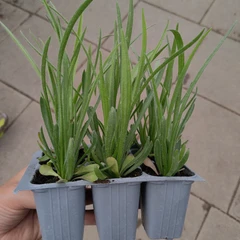
Six-pack
Attracts pollinators 🐝
Blooming period
Difficulty
Diseases
Edible
Flower color
Flower color: Shade
Foliage color
Fragrant (aromatic) 👃
Frost resistance
Hardiness zone
Height
Long-lived perennial
Moisture
Pests
Poisonous
Position
Self-seeding
Short-lived perennial
Soil
Spacing
Spacing: Plants per m²
Species
Suitable for cutting
Suitable for drying
Support
Winter interest ❄️
Recommended products

Geum chiloense
Avens Tempest Scarlet

Nepeta racemosa
Catmint Superba

Salvia pratensis
Meadow Sage Swan Lake

Sesleria caerulea
Blue Moor Grass

Geum rivale
Geum Mango Lassi

Nepeta faassenii
Catmint Alba

Achillea millefolium
Yarrow Lilac Beauty

Aquilegia vulgaris
Columbine Kristall

Clematis heracleifolia
Clematis Mrs R. Brydon

Dicentra spectabilis Alba
Bleeding Heart Alba

Salvia pratensis
Meadow Sage Rose Rhapsody

Lychnis coronaria
Campion Alba

Verbascum nigrum var. album
Black Mullein

Sanguisorba tenuifolia
Sanguisorba Alba


Aquilegia vulgaris
Columbine Black Barlow

Thymus vulgaris
Thyme Compactus

Paeonia
Peony Shirley Temple

Calendula officinalis
Marigold Pacific Beauty Apricot

Cosmos bipinnatus
Cosmos Cupcakes Blush

Cephalaria gigantea
Giant scabious

Liatris spicata
Liatris Floristan White

Thalictrum aquilegiifolium
Columbine meadow-rue

Aquilegia vulgaris
Columbine Heidi

Paeonia
Peony Monsieur Jules Elie

Mentha spicata
Moroccan mint

Verbena hastata
Blue Vervain Pink Spires

Myosotis scorpioides
Water Forget-me-not

Nepeta racemosa
Catmint Walker’s Low

Helleborus orientalis
Hellebore Double Ellen Yellow Spotted
Cultivation
For the successful cultivation of this airy perennial, choosing the right location is absolutely crucial. Blue star, which you will receive as an established seedling, requires full sun and warmth. In the shade, the plant would suffer, bloom poorly, and its stems would stretch and flop. The soil must be very well-draining, ideally sandy, rocky, or gravelly. The plant is undemanding regarding nutrients and prefers poorer soils. If you have heavy clay soil in your garden, it is essential to add a thick drainage layer to the planting hole and lighten the soil with sand or fine gravel before planting.
We plant the seedlings with a spacing of approximately 35 cm (about 8 plants per m²) so they have plenty of space and air. After planting, water the plant so it roots well, but once established, water sparingly. Blue star is drought-tolerant and waterlogging harms it more than long-term drought. Fertilizing is unnecessary – an excess of nutrients would lead to lush leaf growth at the expense of flowers. A great advantage is that this plant does not suffer from any specific diseases or pests, so you can do without chemical protection.
We must take into account its natural short lifespan; it usually lasts in full vigor for 3 to 4 years in one location. However, you can extend its lifespan with proper care, especially by ensuring dryness in winter. Although it is frost-resistant down to -18 °C, it cannot stand winter wetness, which causes root rot. Therefore, we recommend not covering the plant with impermeable materials for the winter, but rather ensuring water drainage. To encourage the formation of new buds during the summer, regularly remove faded flowers.
If you don't have a garden, Blue star can also be successfully grown in containers or window boxes. The container must have a drainage hole at the bottom and a drainage layer (expanded clay, pebbles). Mix the substrate in a 1:1 ratio with horticultural sand or gravel so the water drains quickly. In containers, the plant is somewhat more sensitive to the freezing of the root ball, so move it to a protected place by the house wall for the winter or wrap the container with insulation.
The information given is based on our experience, please use it as a guide only. Times may vary depending on the season, climate, location, sowing and transplanting dates and possibly also the conditions in the greenhouse/greenhouse. We always recommend testing how the plant performs in your conditions. Please do not take this as a guarantee.
More products in category Six-packs


Callistephus chinensis
China aster Lady Coral Chamois

Helichrysum bracteatum
Strawflower silvery pink

Cosmos bipinnatus
Cosmos Cupcakes White

Scabiosa atropurpurea
Scabiosa QIS Dark Blue

Cosmos bipinnatus
Cosmos Cupcakes Blush


Helichrysum bracteatum
Strawflower Salmon

Cosmos bipinnatus
Cosmos Velouette

Callistephus chinensis
China aster Valkyrie Holländer Salmon

Helichrysum bracteatum
Strawflower White


Callistephus chinensis
China aster Matsumoto Yellow

Scabiosa atropurpurea
Scabiosa QIS Deep Red

Cosmos bipinnatus
Cosmos Double Click Snow Puff


Helichrysum bracteatum
Strawflower Orange


