


Helleborus orientalis
Hellebore Color Mix
The hellebore seedlings we offer are grown from seed. With plants propagated this way, each one is a bit unique – nature sometimes adds its …
Zobrazit všeLarge seedling


Attracts pollinators 🐝
Difficulty
Diseases
Edible
Flower color
Flower color: Shade
Foliage color
Fragrant (aromatic) 👃
Frost resistance
Hardiness zone
Height
Moisture
Pests
Position
Soil
Spacing
Spacing: Plants per m²
Species
Suitable for cutting
Suitable for drying
Recommended products

Helleborus orientalis
Hellebore Double Ellen Picotee

Helleborus orientalis
Hellebore Pretty Ellen Red

Aquilegia vulgaris
Columbine Kristall

Helleborus orientalis
Hellebore Double Ellen Yellow Spotted

Geum chiloense
Avens Totally Tangerine

Digitalis purpurea
Foxglove Dalmatian Rose

Lupinus
Lupine Band of Nobles Kastellan

Cephalaria gigantea
Giant scabious


Polemonium caeruleum f. album
Jacob's Ladder White Pearl

Luzula nivea
Snowy Woodrush

Phlomis russeliana
Phlomis Russeliana

Aquilegia vulgaris
Columbine Heidi

Achillea millefolium
Yarrow Lilac Beauty

Helleborus orientalis
Hellebore Double Ellen White

Helleborus orientalis
Hellebore Pretty Ellen Pink

Salvia pratensis
Meadow Sage Rose Rhapsody

Geum chiloense
Avens Tempest Scarlet

Geranium sanguineum
Bloody Cranesbill Apfelblüte

Helleborus orientalis
Hellebore Pretty Ellen Purple

Caryopteris clandonensis
Bluebeard Sterling Silver

Sedum telephium
Sedum Herbstfreude

Pennisetum alopecuroides var. viridescens
Fountain grass viridescens

Gypsophila paniculata
Baby's breath Flamingo

Lychnis flos-cuculi
Ragged Robin

Sedum spectabile
Sedum Matrona

Helleborus orientalis
Hellebore Pretty Ellen White Spotted

Aquilegia vulgaris
Columbine White Barlow

Hydrangea paniculata
Panicle Hydrangea Kyushu

Helleborus orientalis
Hellebore Pretty Ellen White
Cultivation
Hellebore is an undemanding, long-lived perennial that even a complete beginner can grow without problems. In the garden, choose a place in partial shade or shade, ideally under the crowns of trees or shrubs, where it will have natural protection. It thrives best in permeable, loamy soil that is sufficiently rich in humus. Plant the supplied seedlings approximately 50 centimeters apart, which corresponds to four to six plants per square meter. This generous spacing will ensure sufficient air circulation, naturally preventing the development of fungal diseases such as gray mold or black spot.
During the season, the plant requires moderate watering. Keep the soil slightly moist, but be careful of waterlogging, which Hellebore tolerates poorly. The most important intervention for the plant comes at the end of winter, just before the first buds appear. At this time, cut and remove all unsightly or damaged last year's leaves. The new flowers will stand out much better as a result. Moreover, always discard the cut leaves immediately and do not put them on the compost; you will prevent the spread of any diseases from the previous season. Through the summer, the Hellebore will then produce a new, healthy clump of dark green leathery leaves.
This perennial is highly frost-hardy and easily handles temperatures falling down to -28 °C, so it does not require any special winter protection. Although it is a very resilient plant, it can occasionally be troubled by pests. What to look out for most:
Aphids: Regularly check young shoots and the first buds.
Slugs and snails: Especially in the spring, they can nibble on new fragile leaves.
Black vine weevil: Bites out typical ornaments on the edges of leaves; its larvae near the roots are also dangerous. The plant attracts early pollinators to its first spring flowers, so bees will enliven your garden in February and March. All parts of the plant are poisonous, so we recommend using gardening gloves when handling and pruning. If you enjoy cutting flowers for a vase, remember an important rule. Cut the Hellebore only when conspicuous seed pods form in the center of the flower and the flower is mature; earlier, they tend to wilt and the stems will not keep the flower in an upright position.
Customers often ask us if it is possible to grow Hellebore in a pot or window box. The good news is yes, but it has its specifics. Hellebore forms a deep and rich root system, so it needs a sufficiently large and deep container. Do not forget very good drainage at the bottom of the pot and a drainage hole so that water can always flow away freely after watering. Use a high-quality humus-rich substrate mixed with loam. In a container, the plant will require more regular moisture checks so that the substrate does not dry out completely, but at the same time, it must not sit in water. Hellebore grown this way will beautifully decorate shaded terraces or entryways to the house just at the time when most other plants are still deep asleep.
The information given is based on our experience, please use it as a guide only. Times may vary depending on the season, climate, location, sowing and transplanting dates and possibly also the conditions in the greenhouse/greenhouse. We always recommend testing how the plant performs in your conditions. Please do not take this as a guarantee.
Frequently
asked
questions
Diseases & pests
What diseases affect Helleborus and how can I prevent them?
Does this plant suffer from any pests?
Propagation
Does Hellebore self-seed in the garden?
Harvest
Can I use Helleborus flowers in a vase?
Characteristics
Is Helleborus frost-resistant?
Why does my Helleborus have a different flower color than in the photo?
Is Helleborus poisonous?
When does Helleborus bloom?
Is this plant suitable for bees?
Planting site
What kind of soil does Helleborus need?
Where is the best place to plant Helleborus?
Growing
Do I need to prune Helleborus? When should I remove old leaves?
How often and how much should I water Helleborus?
What should I fertilize Hellebore with and when?
How far apart should I plant Hellebore seedlings?
Can I grow Helleborus in a pot?
Photos
in time
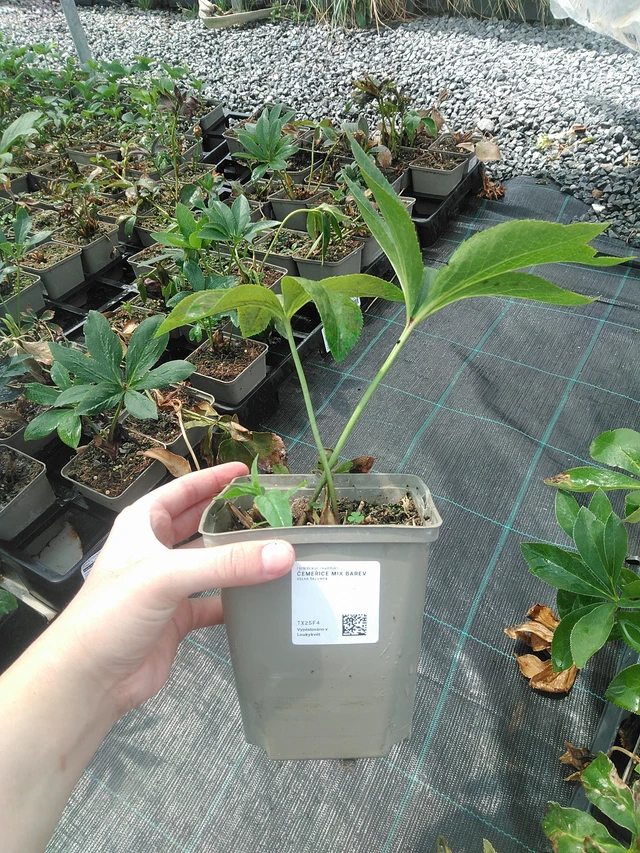
See how the seedling looks over the course of a year.


More products in category Hellebore
Helleborus orientalis
Hellebore Double Ellen White

Helleborus orientalis
Hellebore Double Ellen Red
Helleborus orientalis
Hellebore Double Ellen Picotee

Helleborus orientalis
Hellebore Double Ellen Purple

Helleborus orientalis
Hellebore Double Ellen Pink Spotted
Helleborus orientalis
Hellebore Double Ellen Yellow Spotted
Helleborus orientalis
Hellebore Pretty Ellen Pink

Helleborus orientalis
Hellebore Double Ellen Pink

Helleborus orientalis
Hellebore Pretty Ellen Spotted

Helleborus orientalis
Hellebore Double Ellen Green
Helleborus orientalis
Hellebore Pretty Ellen Purple
Helleborus orientalis
Hellebore Pretty Ellen White Spotted
Helleborus orientalis
Hellebore Pretty Ellen White
Helleborus orientalis
Hellebore Pretty Ellen Red

Helleborus orientalis
Hellebore Double Ellen White Spotted

Helleborus
Hellebore Magnificent Bells

Helleborus orientalis
Hellebore Double Ellen Flash

Helleborus
Hellebore Queens Pink

Helleborus argutifolius
Corsican Hellebore

Helleborus
Hellebore Queens White
More products in category Perennials

Alchemilla mollis
Lady's mantle Irish Silk

Achillea millefolium
Yarrow Summer Pastels

Verbena bonariensis
Verbena

Salvia nemorosa
Woodland Sage Caradonna

Perovskia atriplicifolia
Russian Sage

Gaura lindheimeri
Gaura Siskiyou Pink

Echinacea purpurea
Coneflower Rubinstern

Echinacea pallida
Echinacea pallida

Eryngium planum
Sea Holly

Salvia nemorosa
Woodland Sage Ostfriesland

Echinacea purpurea
Coneflower Magnus

Calamintha nepeta
Calamint Blue Cloud

Rudbeckia fulgida
Rudbeckia Goldsturm

Calamintha nepeta ssp. nepeta
Calamint

Gaura lindheimeri
Gaura Summer Breeze

Salvia nemorosa
Woodland Sage Amethyst

Leucanthemum vulgare
Daisy Maikönigin

Achillea millefolium
Yarrow Terracotta

Perovskia atriplicifolia
Russian sage Little Spire

Salvia nemorosa


