
Erigeron
Fleabane Dominator
Seedling


Attracts pollinators 🐝
Difficulty
Diseases
Edible
Flower color
Flower color: Shade
Foliage color
Fragrant (aromatic) 👃
Frost resistance
Hardiness zone
Height
Moisture
Pests
Position
Soil
Spacing
Spacing: Plants per m²
Species
Suitable for cutting
Suitable for drying
Recommended products

Erigeron
Fleabane Sommerneuschnee

Veronica longifolia
Speedwell First Love

Kalimeris mongolica
Japanese Aster Antonia

Agastache hybrida
Agastache Danish Delight

Achillea millefolium
Yarrow Appleblossom

Scabiosa columbaria
Scabiosa Pink Mist

Salvia nemorosa
Woodland sage Schwellenburg

Anemone hybrida
Japanese Anemone Whirlwind

Veronica pinnata
Speedwell Blue Feathers

Caryopteris clandonensis
Bluebeard Dark Knight

Coreopsis verticillata
Coreopsis Moonbeam

Hydrangea paniculata
Panicle Hydrangea Silver Dollar

Coreopsis
Coreopsis Full Moon

Sedum telephium
Sedum Star Dust

Lythrum salicaria
Loosestrife Pink Tails

Solidaster hybride
Solidaster Lemore

Scutellaria
Skullcap Bumblebee Blues

Anemone hybrida
Japanese Anemone Serenade

Anemone hybrida
Japanese Anemone Königin Charlotte

Tulipa
Tulip Palmyra

Artemisia lactiflora
Artemisia

Sidalcea
Checkerbloom Brilliant

Verbena hastata
Verbena hastata White Spires

Gypsophila paniculata
Baby's Breath Snowflake

Pennisetum alopecuroides
Fountain grass Hameln

Solidago canadensis
Goldenrod Romantic Glory

Aster pringlei
Aster Monte Cassino

Alchemilla mollis
Lady's mantle Irish Silk

Aster novae-angliae
Aster Septemberrubin

Anaphalis triplinervis
Pearly Everlasting
Cultivation
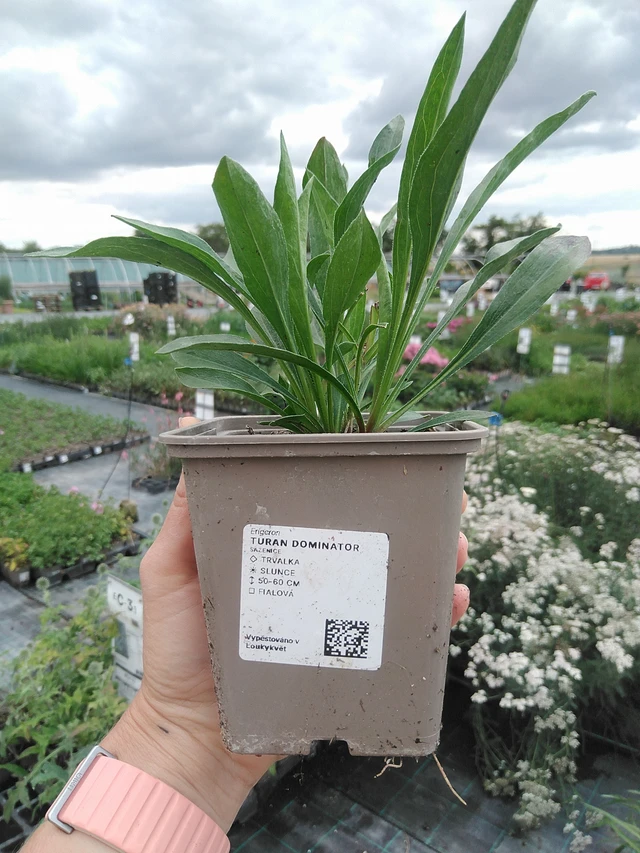
Growing fleabane is a breeze even for beginners, as it is an exceptionally hardy and adaptable perennial. Since we supply already established seedlings, your first step will be to choose the ideal spot in your garden. Fleabane thrives best in a hot, sunny location with well-draining, sandy, or loamy soil. Definitely avoid areas with heavy, constantly wet ground. When planting, be sure to maintain proper spacing. The ideal distance between individual plants is 30 to 40 centimeters, which ensures not only a beautiful and dense growth but also good air circulation. The extra space between leaves is great prevention against powdery mildew, which can appear in humid and stuffy environments. Fleabane grows to a height of about half a meter and, thanks to its sturdy stems, does not need any support at all.
From June to August, you can look forward to a flood of dark purple to blue-violet flowers that will reliably brighten up any garden and attract many useful pollinators. If you want to maximize flowering, regularly remove faded blooms. Fleabane is also an excellent cut flower. If you want to bring it home, cut the stems when they are fully open – they will bring you joy in a vase for a very long time. During the summer, maintain moderate watering. The soil should be reasonably moist, but water must not stand in it. Perhaps only pests will require your attention. In the spring, it is necessary to protect the tender young leaves from raids by slugs and snails, and during the summer season, check occasionally to see if aphids have settled on the plant.
Are you tempted to have these beautiful purple flowers on your balcony? Fleabane is perfect for growing in containers and larger window boxes. For planting in pots, choose a light, well-draining substrate and do not forget to place a thick layer of drainage at the bottom so that excess water can flow away freely. Plants in containers will need more frequent watering and light fertilization during flowering. At the end of the season, fleabane requires no special care, and its overwintering is completely worry-free. This perennial is fully frost-hardy and can easily cope with temperatures dropping down to minus 35 degrees Celsius. You can leave dead stems and leaves on the flowerbed in autumn to protect the roots, and at the beginning of spring, you simply cut the whole plant back just above the ground. The plant also likes to self-seed, so it will keep you company in the garden for many years to come.
The information given is based on our experience, please use it as a guide only. Times may vary depending on the season, climate, location, sowing and transplanting dates and possibly also the conditions in the greenhouse/greenhouse. We always recommend testing how the plant performs in your conditions. Please do not take this as a guarantee.
Frequently
asked
questions
Planting site
What kind of location and soil does the seedling need?
Which other plants does Erigeron pair well with?
Harvest
Is Erigeron suitable for cut flower bouquets?
Is it possible to dry the flowers for winter?
Characteristics
Do I need to protect the plant for the winter?
Does Erigeron attract pollinators to the garden?
Is the plant toxic to children or pets?
Is this perennial fragrant?
Diseases & pests
What about pests, what should I look out for?
Is the plant prone to any diseases?
Troubleshooting
Why is there a white powdery substance forming on the leaves?
Growing
How far apart should I plant the seedlings?
How much water does the plant need?
Does the plant require support to prevent it from breaking?
Photos
in time
See how the seedling looks over the course of a year.


More products in category Fleabane

Erigeron karvinskianus
Fleabane Blütenmeer
Erigeron
Fleabane Sommerneuschnee
More products in category Perennials
Alchemilla mollis
Lady's mantle Irish Silk

Achillea millefolium
Yarrow Summer Pastels

Verbena bonariensis
Verbena

Salvia nemorosa
Woodland Sage Caradonna

Perovskia atriplicifolia
Russian Sage

Gaura lindheimeri
Gaura Siskiyou Pink

Echinacea purpurea
Coneflower Rubinstern

Echinacea pallida
Echinacea pallida

Eryngium planum
Sea Holly

Echinacea purpurea
Coneflower Magnus

Salvia nemorosa
Woodland Sage Ostfriesland

Calamintha nepeta
Calamint Blue Cloud

Rudbeckia fulgida
Rudbeckia Goldsturm

Calamintha nepeta ssp. nepeta
Calamint

Gaura lindheimeri
Gaura Summer Breeze

Salvia nemorosa
Woodland Sage Amethyst

Leucanthemum vulgare
Daisy Maikönigin

Achillea millefolium
Yarrow Terracotta

Perovskia atriplicifolia
Russian sage Little Spire

Salvia nemorosa


