
Aster amellus
Aster Blue King
Seedling

Attracts pollinators 🐝
Difficulty
Diseases
Edible
Flower color
Flower color: Shade
Foliage color
Fragrant (aromatic) 👃
Frost resistance
Hardiness zone
Height
Moisture
Pests
Position
Soil
Spacing
Spacing: Plants per m²
Species
Suitable for cutting
Suitable for drying
Recommended products

Aster novae-angliae
Aster Septemberrubin

Veronica pinnata
Speedwell Blue Feathers

Coreopsis verticillata
Coreopsis Moonbeam

Artemisia ludoviciana
Artemisia Silver Queen

Gaura lindheimeri
Gaura

Kalimeris mongolica
Japanese Aster Antonia

Veronica longifolia
Speedwell First Love

Rudbeckia subtomentosa
Rudbeckia Henry Eilers

Agastache hybrida
Agastache Danish Delight

Potentilla nepalensis
Nepal Cinquefoil Miss Willmott

Rudbeckia fulgida
Rudbeckia Goldsturm

Anemone hybrida
Japanese Anemone Andrea Atkinson

Salvia nemorosa
Woodland sage Schwellenburg

Persicaria amplexicaulis
Persicaria Speciosa

Salvia gregii
Salvia Blue Note

Perovskia
Russian Sage Blue Spire

Erigeron
Fleabane Dominator

Centaurea cyanus
Cornflower Tall Double Blue Boy

Delphinium elatum
Delphinium Highlander Moonlight

Phlomis russeliana
Phlomis Russeliana

Geum rivale
Geum Mango Lassi

Coreopsis
Coreopsis Full Moon

Salvia pratensis
Meadow Sage Sky Dance

Ceratostigma plumbaginoides
Plumbago

Salvia nemorosa
Woodland Sage Ostfriesland

Thalictrum aquilegiifolium
Columbine meadow-rue

Gypsophila paniculata
Baby's breath Bristol Fairy

Anemone hybrida
Japanese Anemone Serenade

Aster novi-belgii
Aster novi-belgii Marie Ballard

Potentilla nepalensis
Nepal Cinquefoil Ron McBeath
Cultivation
Have you found a sunny spot for this beautiful autumn perennial? Excellent, that's exactly where it will thrive best. Aster Blue King loves the sun and needs well-draining, standard loamy soil for abundant blooming. If you have overly heavy clay soil in your garden, we recommend improving it with sand and compost before planting. Since it will arrive as a strong, rooted seedling in a pot, you can plant it in the flowerbed from spring to early autumn. The correct planting spacing is very important and should be 30 to 40 centimeters. This sufficient space acts as the best natural prevention against powdery mildew, as it ensures good air circulation.
Watering should be regular but moderate. The aster likes slightly moist soil, but it definitely shouldn't stand in mud. You can also successfully grow this compact perennial, which reaches a height of 40 to 60 centimeters, in a spacious pot or window box on the terrace. When growing in containers, don't forget these principles:
- High-quality drainage: Layer gravel or expanded clay at the bottom.
- Drainage holes: Water must not stand in the container.
- Regular checks: The substrate dries out faster in a container, so check watering more often than in a flowerbed. During the growing season, you can occasionally add a standard fertilizer for flowering perennials; this will encourage the formation of blue-purple flowers.
Caring for this perennial is undemanding. It grows very sturdily and does perfectly well without support. During the season, it is good to occasionally check if aphids are feasting on the young shoots, and watch out for slugs in the spring. To prolong its aesthetic appearance, you can continuously remove faded parts. Given that this aster is excellently frost-resistant down to -28 °C, it will survive the winter in the flowerbed without any special care. Cut back the dried stems only in early spring. If you are growing it in a pot, wrap the container with jute for the winter to protect the roots.
The information given is based on our experience, please use it as a guide only. Times may vary depending on the season, climate, location, sowing and transplanting dates and possibly also the conditions in the greenhouse/greenhouse. We always recommend testing how the plant performs in your conditions. Please do not take this as a guarantee.
How far apart should I plant the seedlings?
Can this China aster be grown in a pot or window box on a balcony?
What kind of soil and watering does this perennial need?
Does the plant need any support so it doesn't break under the weight of the flowers?
Do I need to protect the China aster for the winter? Is it hardy enough?
Frequently asked questions
Harvest
Can the flowers be cut for a vase, and can they also be dried?
Characteristics
Does the plant have any strong fragrance?
Do the flowers attract beneficial insects like bees and butterflies?
Is this China aster toxic to children or pets?
Planting site
Where in the garden should I plant these seedlings?
Diseases & pests
How do I recognize powdery mildew and how can I protect the plants against it?
Which pests do I need to look out for when growing these?
Propagation
How can I propagate this perennial if it doesn't self-seed?
Does the China aster self-seed in the garden?
Basic information
Can a complete beginner grow this plant?
Troubleshooting
Why is my China aster drying out in the flower bed and its bottom leaves turning yellow?
Photos in time
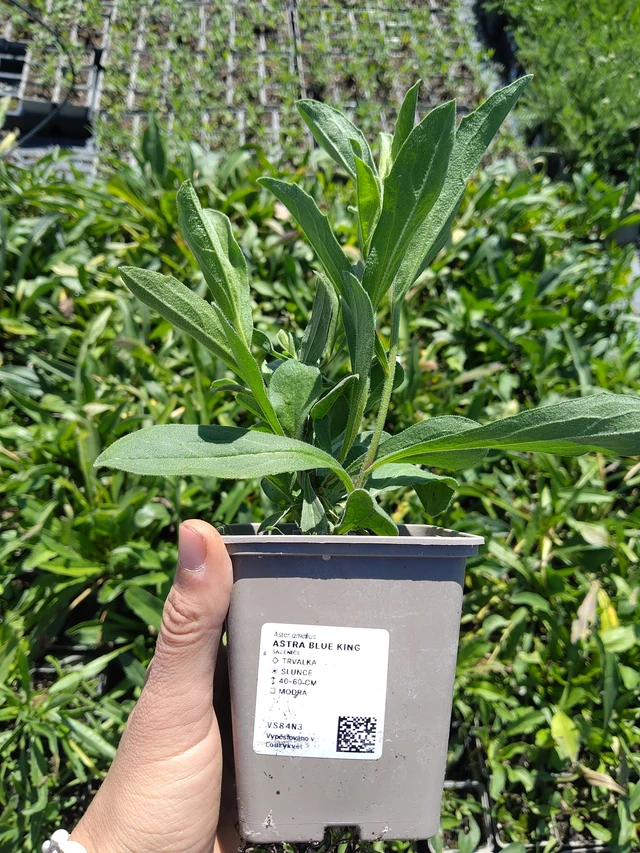
See how the seedling looks over the course of a year.

More products in category Aster

Aster novi-belgii
Aster novi-belgii Fellowship

Aster ericoides
Aster Lovely

Aster ericoides
Aster Pink Cloud

Kalimeris incisa
Japanese Aster Madiva

Aster pringlei
Aster Pink Star

Aster dumosus
Aster Professor A. Kippenberg

Aster pringlei
Aster Monte Cassino
Aster novi-belgii
Aster novi-belgii Marie Ballard

Aster novi-belgii
Aster White Ladies

Aster × hybridus
Aster Primavera

Aster ageratoides
Aster ageratoides Starshine

Aster ericoides
Aster Schneetanne

Aster divaricatus
White Wood Aster Eastern Star

Aster lateriflorus
Aster Lady in Black

Aster ericoides
Aster Blue Star

Aster ericoides
Aster Erlkönig

Aster novae-angliae
Aster Barr’s Pink

Aster x herveyi
Aster Twilight

Aster × hybridus
Aster Blanca

Aster divaricatus
White wood aster Beth Chatto
More products in category Perennials

Alchemilla mollis
Lady's mantle Irish Silk

Achillea millefolium
Yarrow Summer Pastels

Verbena bonariensis
Verbena

Salvia nemorosa
Woodland Sage Caradonna

Perovskia atriplicifolia
Russian Sage

Gaura lindheimeri
Gaura Siskiyou Pink

Echinacea purpurea
Coneflower Rubinstern

Echinacea pallida
Echinacea pallida

Eryngium planum
Sea Holly

Echinacea purpurea
Coneflower Magnus
Salvia nemorosa
Woodland Sage Ostfriesland

Calamintha nepeta
Calamint Blue Cloud
Rudbeckia fulgida
Rudbeckia Goldsturm

Calamintha nepeta ssp. nepeta
Calamint

Gaura lindheimeri
Gaura Summer Breeze

Salvia nemorosa
Woodland Sage Amethyst

Leucanthemum vulgare
Daisy Maikönigin

Achillea millefolium
Yarrow Terracotta

Perovskia atriplicifolia
Russian sage Little Spire

Salvia nemorosa


