Geranium clarkei
Cranesbill Kashmir White
Seedling

Attracts pollinators 🐝
Difficulty
Diseases
Edible
Flower color
Flower color: Shade
Foliage color
Fragrant (aromatic) 👃
Frost resistance
Hardiness zone
Height
Moisture
Pests
Position
Soil
Spacing
Spacing: Plants per m²
Species
Suitable for cutting
Suitable for drying
Recommended products

Cosmos bipinnatus
Cosmos Afternoon White

Nigella damascena
Nigella Miss Jekyll Sky Blue

Geranium pratense
Geranium Hocus Pocus

Thalictrum aquilegiifolium
Columbine meadow-rue

Alchemilla mollis
Lady's mantle Irish Silk

Dicentra spectabilis
Bleeding Heart

Filipendula hybridum
Meadowsweet Kahome

Lupinus
Lupine Band of Nobles Kastellan

Paeonia
Peony Red Charm

Pennisetum alopecuroides
Fountain grass Hameln

Rudbeckia fulgida
Rudbeckia Goldsturm

Paeonia
Peony Red Sarah Bernhardt

Perovskia atriplicifolia
Russian sage Little Spire

Dahlia
Dahlia Labyrinth

Dahlia
Dahlia Café Au Lait

Epimedium hybridum
Epimedium Valor

Cimicifuga japonica
Bugbane Silver Dance

Sanguisorba officinalis
Burnet Pink Tanna

Geranium hybrida
Geranium Rozanne

Delphinium elatum
Delphinium Magic Fountains Dark Blue (Dark Bee)

Delphinium elatum
Delphinium Magic Fountains Deep Rose (White Bee)

Salvia nemorosa
Woodland Sage Caradonna

Salvia nemorosa
Woodland Sage Adrian

Erigeron karvinskianus
Fleabane Blütenmeer

Tiarella cordifolia
Heartleaf foamflower

Gaura lindheimeri
Gaura Siskiyou Pink

Perovskia atriplicifolia
Russian Sage

Echinacea purpurea
Coneflower Big Kahuna

Ajuga reptans
Bugleweed Rosea

Astilbe japonica
Astilbe Europa
Cultivation
This undemanding, long-lived perennial will thrive best in a sunny spot or in mild semi-shade, where its pure white flowers will stand out beautifully. Choosing the right soil is very important; it should be humous and, above all, well-draining, so excess water doesn't sit at the roots. Although the plant originates from the harsher mountainous regions of the Himalayas and can tolerate a lot, it could suffer and rot during the winter months in heavy, clayey, and waterlogged soil. Therefore, we recommend planting in previously carefully loosened soil enriched with high-quality aged compost, which will provide the plant with all the necessary nutrients for a successful start and quick rooting.
When actually planting, keep a spacing of 30 to 40 centimeters, which corresponds to roughly seven to nine plants per square meter. With this arrangement, the plants have plenty of space for healthy development and good air circulation is ensured. Cranesbill grows very compactly to a height of around forty to fifty centimeters and thus does not need any additional support, which will save you a lot of work and worry. Watering should be moderate. This means that we keep the soil appropriately moist, but it should dry out slightly on the surface between waterings to prevent root rot. Especially in the hot summer months and immediately after planting, ensure a regular supply of water so the plant maintains its fresh, rich green leaves and an abundant set of pure white flowers.
During the summer months, when the cranesbill blooms intensively from June to August, it attracts bees and bumblebees to the garden and acts as a valuable food source for pollinators. If you want to encourage the formation of more buds and keep the perennial in peak aesthetic condition, we recommend continuously removing faded flowers and possibly even dried or mechanically damaged leaves. After the main wave of blooming, you can even cut the plant back slightly, which will encourage the growth of new, fresh leaves and overall increase its vitality until the end of the season. A huge advantage of this Himalayan species is its total resilience – it does not suffer from any common fungal diseases, and pests avoid it. You thus won't have to deal with any preventive or curative chemical sprays.
You often ask us if it's possible to grow this elegant cranesbill in containers as well. The answer is yes, thanks to its compact growth, it is absolutely ideal for it! When growing in a pot or window box, do not forget to place a sufficiently thick drainage layer of expanded clay or gravel at the bottom and use a high-quality, well-draining substrate. In a container, the plant will logically require slightly more frequent watering and regular fertilizing with a standard liquid fertilizer for flowering perennials. As for overwintering, you need not worry at all, because this variety is extremely frost-resistant and will easily handle temperatures dropping down to minus twenty-eight degrees. For winter, it draws nutrients into the roots, loses its above-ground part, and will reliably sprout again in the spring, so it requires no special winter protection in the flowerbed.
The information given is based on our experience, please use it as a guide only. Times may vary depending on the season, climate, location, sowing and transplanting dates and possibly also the conditions in the greenhouse/greenhouse. We always recommend testing how the plant performs in your conditions. Please do not take this as a guarantee.
Does the mature plant need any support so it doesn't sprawl on the ground?
Can the seedling be grown in a pot on the patio?
Will this plant survive our winters? Do I need to protect it in any way?
How far apart should I plant the seedlings?
How often does the geranium need watering?
Frequently asked questions
Propagation
How can I propagate Geranium later if I want more plants?
Characteristics
Is this perennial suitable for cutting for a vase or for drying?
When will I see flowers, and do they attract beneficial insects?
Does the plant tend to self-seed in the garden?
Planting site
What is the most suitable location for this species?
Which other perennials can I successfully combine this geranium with?
Diseases & pests
Is Geranium susceptible to any diseases or prone to pest attacks?
Basic information
What are the general maintenance requirements? Is Geranium suitable for beginners?
Is the plant toxic? I have small children and pets.
Growing
What kind of soil should I plant the seedling in after delivery?
Photos in time
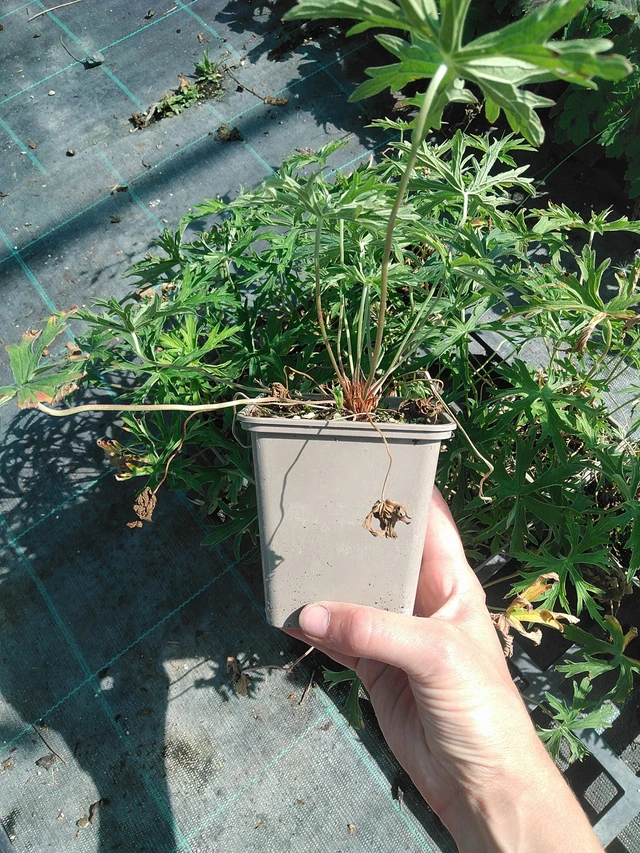
See how the seedling looks over the course of a year.

More products in category Cranesbill
Geranium hybrida
Geranium Rozanne

Geranium cantabrigiense
Cranesbill Biokovo

Geranium sanguineum
Bloody Cranesbill Elsbeth

Geranium cantabrigiense
Cranesbill Cambridge

Geranium sanguineum
Bloody cranesbill

Geranium oxonianum
Geranium Rose Claire

Geranium renardii
Geranium Philippe Vapelle

Geranium pratense
Geranium Summer Skies

Geranium endressii
Geranium Wargrave Pink

Geranium cantabrigiense
Cambridge Geranium Saint Ola

Geranium oxonianum
Geranium Claridge Druce

Geranium pratense
Cranesbill Midnight Reiter

Geranium himalayense
Geranium Johnson's Blue

Geranium sanguineum
Bloody Cranesbill Apfelblüte

Geranium himalayense
Geranium Gravetye

Geranium pratense
Geranium Azure Skies

Geranium pratense
Geranium Cloud Nine

Geranium versicolor
Pencilled cranesbill

Geranium sylvaticum
Wood Cranesbill Album

Geranium phaeum
Cranesbill Samobor
More products in category Perennials
Alchemilla mollis
Lady's mantle Irish Silk

Achillea millefolium
Yarrow Summer Pastels

Verbena bonariensis
Verbena
Salvia nemorosa
Woodland Sage Caradonna
Perovskia atriplicifolia
Russian Sage
Gaura lindheimeri
Gaura Siskiyou Pink

Echinacea purpurea
Coneflower Rubinstern

Echinacea pallida
Echinacea pallida

Eryngium planum
Sea Holly

Echinacea purpurea
Coneflower Magnus

Salvia nemorosa
Woodland Sage Ostfriesland

Calamintha nepeta
Calamint Blue Cloud
Rudbeckia fulgida
Rudbeckia Goldsturm

Calamintha nepeta ssp. nepeta
Calamint

Gaura lindheimeri
Gaura Summer Breeze

Salvia nemorosa
Woodland Sage Amethyst

Leucanthemum vulgare
Daisy Maikönigin

Achillea millefolium
Yarrow Terracotta
Perovskia atriplicifolia
Russian sage Little Spire

Salvia nemorosa


