
Santolina viridis
Olive herb
Seedling


Attracts pollinators 🐝
Difficulty
Diseases
Edible
Flower color
Flower color: Shade
Foliage color
Fragrant (aromatic) 👃
Frost resistance
Hardiness zone
Height
Moisture
Pests
Position
Soil
Spacing
Spacing: Plants per m²
Recommended products

Verbena bonariensis
Verbena

Thymus citriodorus
Thyme Doone Valley

Achillea millefolium
Yarrow Terracotta

Alchemilla mollis
Lady's mantle Irish Silk

Salvia pratensis
Meadow Sage Rose Rhapsody

Mentha spicata
Moroccan mint

Thymus vulgaris
Thyme Compactus

Thymus citriodorus
Thyme Silver King

Anemone hybrida
Japanese Anemone Serenade

Achillea filipendulina
Yarrow Parkers Varietät

Aquilegia vulgaris
Columbine Kristall

Dicentra spectabilis
Bleeding Heart

Geum chiloense
Avens Tempest Scarlet

Mentha piperita
Mint Eau de Cologne

Geum chiloense
Avens Totally Tangerine

Dicentra spectabilis Alba
Bleeding Heart Alba

Calamagrostis acutiflora
Feather Reed Grass Karl Förster

Salvia pratensis
Meadow Sage Swan Lake

Achillea millefolium
Yarrow Cerise Queen

Geum rivale
Geum Mango Lassi

Ruta graveolens
Common Rue

Delphinium hybrida
Larkspur Benary’s Pacific Galahad

Achillea millefolium
Yarrow Summer Pastels

Delphinium hybrida
Larkspur Benary’s Pacific Black Knight

Phlomis russeliana
Phlomis Russeliana

Mentha spicata
Lemon mint

Aquilegia vulgaris
Columbine Black Barlow

Catananche caerulea
Shoofly plant Blue

Salvia pratensis
Meadow Sage Sky Dance

Cephalaria gigantea
Giant scabious
Cultivation
For the successful cultivation of olive herb, choosing the right location is key. This heat-loving perennial originates from the Mediterranean, so give it the warmest and sunniest spot in the garden, ideally facing south. The soil must be exceptionally well-draining, sandy, and rather nutrient-poor. Avoid heavy and permanently waterlogged soils at all costs. Ideally, plant the seedlings in the flowerbed in the spring as soon as the threat of ground frosts has passed. It is important to maintain a planting distance of about 40 centimeters. The plants will soon spread out, and sufficient space will ensure proper air circulation around the leaves, which naturally promotes their healthy growth.
Watering should be very moderate. While newly planted plants initially need moderate watering to establish well, once they take root, they handle drought brilliantly. Skip fertilizing entirely; in nutrient-rich soil, the olive herb would lose its compact shape, and its shoots would become unnecessarily leggy. Moreover, olive herb is completely trouble-free when it comes to cultivation – it does not suffer from any diseases, and you will be pleased to know that it grows entirely pest-free. You can also successfully grow this aromatic beauty on a terrace. For container growing, follow these principles:
- Choose a pot with drainage holes and place a thicker drainage layer at the bottom.
- Mix regular potting soil with a larger proportion of sand or fine gravel.
- Water only when the soil in the pot has completely dried out.
To maintain their attractive dense appearance and vitality, the shrubs require regular pruning. Prune the plant every spring to encourage the sprouting of new shoots. Perform a second, gentler maintenance prune right after the yellow flowers bloom during the summer. Conversely, avoid pruning in the autumn; older shoots provide the plant with natural protection. Olive herb is frost-resistant down to -17 °C (climate zone 7a), but in winter, it is very sensitive to waterlogged roots. As winter protection against severe bare frosts and harsh winter sun, covering the shrubs with pine branches has proven effective, as it also helps wick away excess moisture.
The information given is based on our experience, please use it as a guide only. Times may vary depending on the season, climate, location, sowing and transplanting dates and possibly also the conditions in the greenhouse/greenhouse. We always recommend testing how the plant performs in your conditions. Please do not take this as a guarantee.
Will Santolina survive our winters?
Should I fertilize the santolina?
Can santolina be grown on a balcony in a window box or pot?
How often should I water the santolina?
Does santolina need to be pruned? When and how?
Frequently asked questions
Basic information
At what spacing and when should I plant the seedlings?
What other plants can I combine with santolina in a flower bed?
Diseases & pests
Is santolina susceptible to any pests or diseases?
Propagation
How can I propagate santolina at home?
Characteristics
Is Santolina toxic to dogs and cats?
Is santolina edible? How can I use it in the kitchen?
Does Santolina attract bees and other pollinators?
Planting site
Where is the best place in the garden to plant Santolina?
What kind of substrate or soil does Santolina need?
Harvest
What is the best time and way to harvest Santolina for drying?
Troubleshooting
Why is my santolina turning dark or rotting from the bottom?
Photos in time
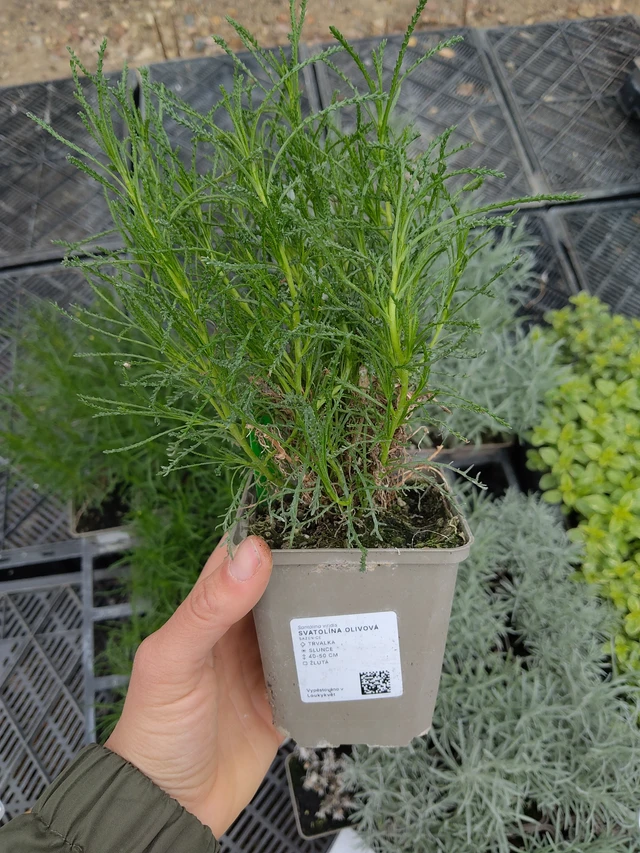
See how the seedling looks over the course of a year.


More products in category Herbs
Mentha spicata
Moroccan mint
Thymus vulgaris
Thyme Compactus

Thymus citriodorus
Thyme Lemon

Satureja montana
Winter Savory

Thymus serpyllum
Thyme Albus

Artemisia abrotanum var. maritima
Artemisia Coca Cola

Mentha piperita citrata
Chocolate mint

Thymus serphyllus
Thyme Coccineus

Lippia citriodora
Lemon verbena

Helichrysum angustifolia
Curry plant Tall Curry

Valeriana officinalis
Valerian

Origanum vulgare
Oregano Compactum

Levisticum officinale
Lovage
Thymus citriodorus
Thyme Doone Valley
Mentha spicata
Lemon mint

Coriandrum sativum
Coriander

Mentha spicata
Spanish Mint

Petroselinum hortense
Garden Parsley

Origanum rotundifolia
Ornamental oregano Kent Beauty

Anethum graveolens


