


Verbascum
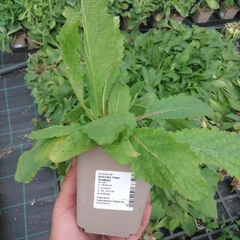
Mullein Pink Domino
Seedling


Attracts pollinators 🐝
Difficulty
Diseases
Edible
Flower color
Flower color: Shade
Foliage color
Fragrant (aromatic) 👃
Frost resistance
Hardiness zone
Height
Moisture
Pests
Position
Soil
Spacing
Spacing: Plants per m²
Species
Suitable for cutting
Suitable for drying
Recommended products

Aquilegia vulgaris
Columbine Kristall

Achillea millefolium
Yarrow Lachsschönheit

Verbascum nigrum var. album
Black Mullein

Aquilegia vulgaris
Columbine Blue Barlow

Verbascum chaixii
Mullein Sixteen Candles

Anemone hybrida
Japanese Anemone Serenade

Aquilegia vulgaris
Columbine Heidi

Aquilegia vulgaris
Columbine Black Barlow

Verbascum chaixii Album
Mullein Wedding Candles

Delphinium hybrida
Larkspur Benary’s Pacific Black Knight

Polemonium caeruleum f. album
Jacob's Ladder White Pearl

Sanguisorba tenuifolia
Sanguisorba Alba

Physostegia virginiana
Obedient Plant Rosea

Salvia pratensis
Meadow Sage Rose Rhapsody

Sedum telephium
Sedum Star Dust

Papaver orientale
Oriental Poppy Royal Wedding

Sanguisorba officinalis
Great Burnet

Hydrangea paniculata
Panicle Hydrangea Kyushu

Geranium pratense
Meadow Cranesbill Painter’s Palette

Briza media
Quaking grass Tinkerbell

Sanguisorba officinalis
Burnet Lum

Aquilegia vulgaris
Columbine Nora Barlow

Filipendula rubra
Meadowsweet Venusta


Anemone hybrida
Japanese Anemone Andrea Atkinson

Matthiola incana
Stock Katz White

Anemone hupehensis
Anemone Praecox

Achillea filipendulina
Yarrow Parkers Varietät

Matthiola incana
Stock Katz Cherry Blossom

Daucus carota
Ornamental Carrot Dara
Cultivation
Plant the seedling of the mullein 'Pink Domino' ideally in full sun, where its beauty will fully manifest. Mulleins are drought-tolerant and rather short-lived perennials, sometimes just biennials. A lot depends on choosing the right location. They will thrive best in well-drained, light gravelly and sandy soils. Rather avoid heavy and waterlogged clay soils; the plants' roots would rot in them over winter, which is a frequent reason for their death. Plant the seedlings in the flower bed in spring or early autumn at a spacing of 40 centimeters, which corresponds to roughly five to seven plants per square meter. This spacing will reliably ensure adequate air circulation around the attractive grey-green leaves.
Once the mullein takes root, caring for it is absolutely minimal and even a complete beginner can handle it. It requires watering only during truly extreme drought, otherwise it handles moisture on its own. It likewise does not need any fertilizing; in soil that is too rich, it could lose its compact shape and begin to break. Although it grows to a height of over one meter, it needs no support. A huge advantage of this cultivar is that it does not suffer from any diseases and pests avoid it by a wide margin. You can thus enjoy a healthy and strong plant without the need to use any sprays.
The inflorescences appear in May and June and attract numerous pollinators to the garden. After blooming, we can cut the plants back so they sprout and bloom again. This cutting back will significantly support overall vitality and extend the lifespan of this otherwise rather short-lived perennial. You don't have to worry about frost hardiness; the plant will reliably handle winter temperatures down to a deep -23 °C. Over winter, however, it is absolutely essential to prevent moisture accumulation at the roots, as winter wetness is its greatest enemy.
Mullein can also be successfully grown in containers and spacious window boxes, which is great news for owners of sunny terraces. For pot cultivation, choose a sufficiently deep container because mullein forms a long taproot. At the bottom, do not forget to pour a thick layer of drainage made of pebbles or expanded clay and use a very well-drained substrate mixed with sand. In a container, the plant will need slightly more frequent watering than in a flower bed, but always let the substrate dry out perfectly before the next watering. Also, don't forget that you can cut gorgeous bouquets for a vase from this plant; just cut the stems when half of the flowers are fully open.
The information given is based on our experience, please use it as a guide only. Times may vary depending on the season, climate, location, sowing and transplanting dates and possibly also the conditions in the greenhouse/greenhouse. We always recommend testing how the plant performs in your conditions. Please do not take this as a guarantee.
How far apart should I plant the seedlings in the garden bed?
How often do I need to water the mullein?
Is growing this seedling suitable for absolute beginners?
What should I do after the mullein has finished flowering? How do I care for it afterwards?
Does this tall plant need any support against strong wind?
Frequently asked questions
Characteristics
Is the plant poisonous to children or pets?
When does the mullein bloom and attract pollinators to the garden?
Planting site
What is the best location for this seedling?
What plants does mullein combine best with in a flower bed?
Basic information
Do I need to protect or cover the mullein before winter?
What does it mean in practice that this is a short-lived perennial?
Harvest
Are 'Pink Domino' mullein flowers suitable for cutting for a vase?
Growing
Is it possible to grow this mullein in a large pot or container?
Diseases & pests
Which diseases or pests are most likely to threaten mullein?
Troubleshooting
Why are my seedlings rotting in the flowerbed or why are their leaves turning yellow?
Photos in time
See how the seedling looks over the course of a year.


More products in category Mullein

Verbascum hybridum
Mullein Southern Charm
Verbascum nigrum var. album
Black Mullein

Verbascum hybrida
Mullein Plum Smokey
Verbascum chaixii Album
Mullein Wedding Candles
Verbascum chaixii
Mullein Sixteen Candles

Verbascum hybrida
Mullein Rosie

Verbascum
Mullein White Domino

Verbascum
Mullein Gainsborough

Verbascum hybrida
Mullein Sugar Plum

Verbascum hybrida
Mullein Honey Dijon

Verbascum hybrida
Mullein Dark Eyes

Verbascum
Mullein Clementine

Verbascum
Mullein Cotswold Queen
More products in category Perennials

Alchemilla mollis
Lady's mantle Irish Silk

Achillea millefolium
Yarrow Summer Pastels

Verbena bonariensis
Verbena

Salvia nemorosa
Woodland Sage Caradonna

Perovskia atriplicifolia
Russian Sage

Gaura lindheimeri
Gaura Siskiyou Pink

Echinacea purpurea
Coneflower Rubinstern

Echinacea pallida
Echinacea pallida

Eryngium planum
Sea Holly

Echinacea purpurea
Coneflower Magnus

Salvia nemorosa
Woodland Sage Ostfriesland

Calamintha nepeta
Calamint Blue Cloud

Rudbeckia fulgida
Rudbeckia Goldsturm

Calamintha nepeta ssp. nepeta
Calamint

Salvia nemorosa
Woodland Sage Amethyst

Gaura lindheimeri
Gaura Summer Breeze

Leucanthemum vulgare
Daisy Maikönigin

Achillea millefolium
Yarrow Terracotta

Perovskia atriplicifolia
Russian sage Little Spire

Salvia nemorosa


