
Ocimum basilicum
Basil Magic Mountain
Seedling
Attracts pollinators 🐝
Difficulty
Diseases
Edible
Flower color
Flower color: Shade
Foliage color
Fragrant (aromatic) 👃
Frost resistance
Hardiness zone
Height
Moisture
Pests
Position
Soil
Spacing
Spacing: Plants per m²
Recommended products

Geum chiloense
Avens Tempest Scarlet

Aquilegia vulgaris
Columbine Kristall

Mentha spicata
Moroccan mint

Geum chiloense
Avens Totally Tangerine

Salvia pratensis
Meadow Sage Rose Rhapsody

Centaurea montana
Mountain Cornflower

Papaver orientale
Oriental Poppy Royal Wedding

Briza media
Quaking grass Tinkerbell

Limonium latifolium
Sea lavender

Chasmanthium latifolium
Northern Sea Oats

Thymus citriodorus
Thyme Silver King

Achillea millefolium
Yarrow Alabaster

Thymus citriodorus
Thyme Doone Valley

Anemone hybrida
Japanese Anemone Serenade

Nepeta faassenii
Catmint Six Hills Giant

Aquilegia vulgaris
Columbine Heidi

Mentha spicata
Lemon mint

Helleborus orientalis
Hellebore Pretty Ellen Purple

Mentha piperita
Mint Eau de Cologne

Leucanthemum
Daisy Becky

Malva moschata
Musk mallow

Kalimeris incisa
Japanese Aster Charlotte

Persicaria amplexicaulis
Persicaria Speciosa

Aquilegia vulgaris
Columbine Blue Barlow

Briza media
Quaking grass Limouzi

Gypsophila paniculata
Baby's breath Flamingo

Monarda hybride
Monarda Cambridge Scarlet

Delphinium hybrida
Larkspur Benary’s Pacific Galahad

Lupinus
Lupine Band of Nobles Kastellan

Helleborus orientalis
Hellebore Pretty Ellen Spotted
Cultivation
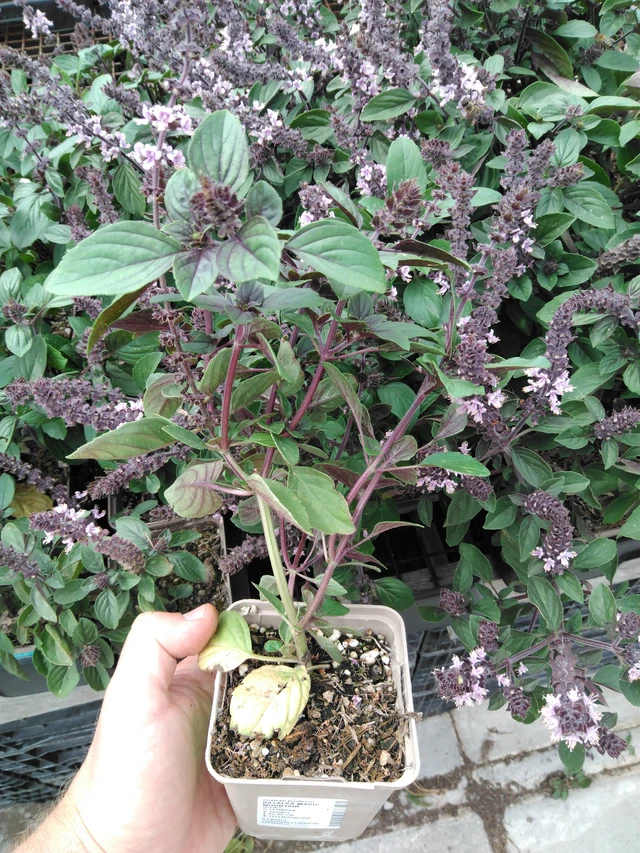
Basil 'Magic Mountain' will arrive as a beautifully grown seedling, fully prepared for moving to its permanent location. Because it is a plant of tropical origin that absolutely cannot tolerate frost, definitely wait with planting it outdoors until the second half of May, when there is no longer a risk of morning frosts. Choose the sunniest spot possible, protected from the wind. The soil should be nutritious, rich in humus, and, most importantly, well-drained. As you may already know, overly wet and heavy clay soils are not suitable; the roots cannot breathe in them, and the plant would suffer. Since this cultivar grows to an impressive height of forty to eighty centimeters, maintain a spacing of around fifty centimeters when planting in a flower bed. This corresponds to about four to six plants per square meter, which ensures sufficient air circulation.
This basil is absolutely ideal for growing in spacious containers or planters on balconies and terraces. If you choose a pot, don't forget to place a drainage layer at the bottom and use high-quality, permeable substrate. It requires regular watering; the soil should remain slightly damp but never permanently waterlogged. On hot summer days, the plant in the container will need watering more frequently than one in a bed. For lush foliage and a profusion of dark purple flowers, which appear from June to September and attract bees, we recommend occasional fertilization during the season. It is best to use organic fertilizer specifically designed for herbs to preserve its excellent properties for use in the kitchen.
Growing it is extremely easy, and even absolute beginners can handle it with ease. The plant is naturally highly resistant and does not suffer from any common diseases. During the season, just occasionally check to see if slugs or snails are enjoying the juicy leaves, and aphids may exceptionally appear on young shoots. Don't be afraid to regularly trim and pinch the plant – cutting long stems for summer bouquets or culinary purposes acts as a great back-pruning that will support its branching and overall vitality. In the autumn, you will unfortunately have to say goodbye to it. It is a typical annual whose life cycle ends uncompromisingly at temperatures around zero, so any overwintering is not possible.
The information given is based on our experience, please use it as a guide only. Times may vary depending on the season, climate, location, sowing and transplanting dates and possibly also the conditions in the greenhouse/greenhouse. We always recommend testing how the plant performs in your conditions. Please do not take this as a guarantee.
Frequently
asked
questions
Growing
How often and in what way should I water the basil?
When exactly can I plant the seedling out into the garden?
What kind of soil does Magic Mountain basil need to grow properly?
What is the recommended spacing if I am planting multiple seedlings next to each other?
Characteristics
Can I use Magic Mountain basil flowers in a vase as cut flowers?
When does this variety bloom and is it attractive to pollinators?
Is Magic Mountain basil frost-hardy and will it survive a harsh winter?
Harvest
Is this ornamental variety edible and how can I use it in the kitchen?
How should I harvest the leaves to encourage healthy plant growth?
Propagation
Can an adult plant be propagated via cuttings if I don't want to sow seeds?
Basic information
What is 'Magic Mountain' basil and how does it differ from regular basil?
Planting site
Where is the best place to plant a basil seedling?
Can I grow this basil in a pot on my balcony?
Troubleshooting
What should I do if the basil leaves start yellowing and falling off?
Diseases & pests
What pests can attack this basil and how can I protect it?
Photos
in time
See how the seedling looks over the course of a year.
More products in category Basil

Ocimum basilicum
Basil African Blue

Ocimum basilicum
Basil Magic Azure

Ocimum basilicum
Basil Cinamonette

Ocimum basilicum
Basil Mrs Burns

Ocimum basilicum
Basil Sweet

Ocimum basilicum
Basil Green Sensation

Ocimum basilicum
Basil Dark Opal

Ocimum basilicum
Basil Coldasil

Ocimum basilicum
Basil Pesto Perpetuo

Ocimum basilicum herbalea
Basil Ajaka
More products in category Herbs
Mentha spicata
Moroccan mint

Thymus vulgaris
Thyme Compactus

Thymus serpyllum
Thyme Albus

Origanum laevigatum
Oregano Herrenhausen

Thymus citriodorus
Thyme Lemon

Satureja montana
Winter Savory

Mentha piperita citrata
Chocolate mint

Thymus serphyllus
Thyme Coccineus

Artemisia abrotanum var. maritima
Artemisia Coca Cola

Lippia citriodora
Lemon verbena

Helichrysum angustifolia
Curry plant Tall Curry

Valeriana officinalis
Valerian

Origanum vulgare
Oregano Compactum

Levisticum officinale
Lovage
Thymus citriodorus
Thyme Doone Valley

Coriandrum sativum
Coriander

Mentha spicata
Spanish Mint

Salvia officinalis
Sage Maxima

Petroselinum hortense
Garden Parsley

Origanum rotundifolia


